(Transcript from SBS World News Radio)
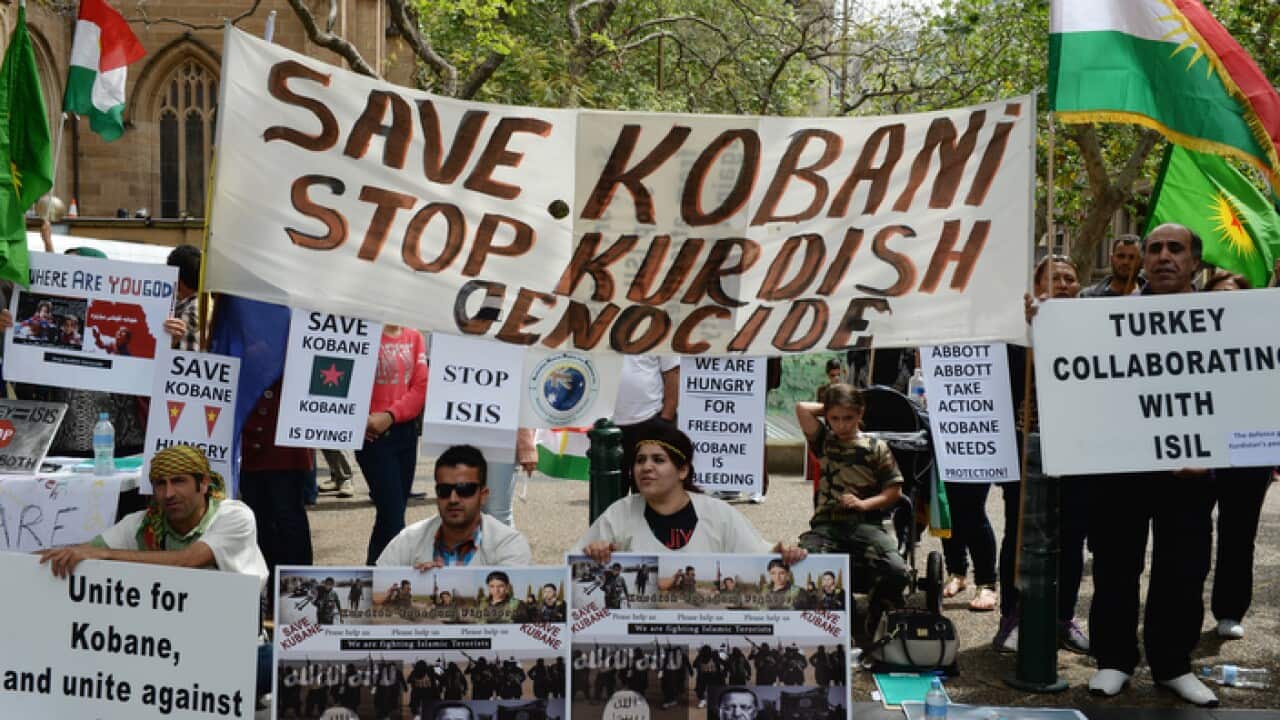
Militants of the self-proclaimed Islamic State have encountered increasingly tough resistance from Kurdish forces in the Syrian battleground town of Kobani.
The battle continues, though, with the United Nations saying thousands of people will probably be massacred if Kobani does fall into the hands of IS fighters.
Peggy Giakoumelos reports.
(Click on the audio tab above to hear the full interview)
News that makes sense
Your trusted source for staying up-to-date with the world around you. Get free daily news updates and analysis, straight to your inbox.
Kurdish fighters have been calling for Turkey to establish a corridor to Kobani to let aid and military supplies reach the town lying within sight of Turkish territory.
But Turkey's Foreign Minister Mevlut Cavusoglu has told France 24 a corridor allowing weapons and volunteer fighters from Turkey into Kobani is unrealistic.
"Turkey cannot actually give weapons to civilians who ask to go back and fight with terrorist groups. We cannot actually risk the lives of these people like this. Instead of this strategy, I think we need to have a predetermined strategy and a comprehensive strategy, first of all, to stop ISIL and other terrorist groups and eradicate them from the region. This is more realistic."
Earlier this month, Turkey's parliament approved a mandate allowing ground troops be sent to Iraq and Syria and letting foreign soldiers use Turkey as a base for the same reason.
Mr Cavusoglu said Turkey would seriously consider the execution of that strategy with allies and friendly countries.
But, at the moment, no action had been officially announced.
United Nations Secretary General Ban Ki-Moon has renewed his call for all parties able to intervene against the IS -- also known as ISIL or Daesh -- to do so.
"(I have) deep concern over the situation in and around the Syrian city of Kobani. Through the continuing attacks by ISIL, or Daesh, thousands of lives are at stake. I once again call on all the parties that can act to step up to prevent a massacre and protect the civilians of Kobani."
Turkey has been reluctant to help Kurd fighters defending Kobani, in one of three areas of northern Syria where Kurds established self rule after Syria's civil war began in 2011.
The main Syrian Kurdish group has close ties to the Kurdistan Workers' Party, or PKK.
The PKK has long waged a militant campaign for Kurdish rights in Turkey and is listed as a terrorist group by Turkey and its Western allies, including Australia.
The Kurdish YPG militia, also known as the People's Protection Units, is fighting in Kobani and is allied to the PKK.
Meanwhile, United States Secretary of State John Kerry says any action by the US-led coalition to fight IS militants will take time and will have to stretch beyond Kobani.
"Kobani is one community, and it's a tragedy what is happening there. And we don't diminish that. But we have said from Day 1 it is going to take a period of time to bring the coalition thoroughly to the table, to rebuild some of the morale and capacity of the Iraqi army, and to begin to focus where we ought to be focusing first, which is in Iraq, while we are degrading and eliminating some of the command and control centres and supply centres and fuel centres and training centres for ISIL within Syria."
Meanwhile, the violence in neighbouring Iraq continues as well.
Officials say at least 40 people have been killed and many others wounded in three suicide car bomb attacks in the Kurdish controlled town of Qara Tapah.
The town lies close to Jalawla, a key battleground northeast of the Iraqi capital Baghdad.
A security official in the autonomous Kurdish government says most of the dead were Peshmerga veterans who volunteered to return to active duty to fight the IS militants.
This Baghdad resident says the new government is continuing to fail to adequately protect civilians.
(Translated)"Children were orphaned, and families lost their breadwinners. What can we say? Until when will we continue to suffer in this way? We've been living like this for years now. Nothing has been changed regarding security. There is no improvement. On the contrary, things are getting worse. To whom shall we complain? We will plea to the Almighty God to relieve our distress. It's useless to call on the government. They (officials) do not feel our pain, because none of their sons or brothers have been hurt. We're the only ones who suffer."
In a separate attack, officials say a bomb has killed the police chief of Iraq's restive Anbar province in the west of the country.







