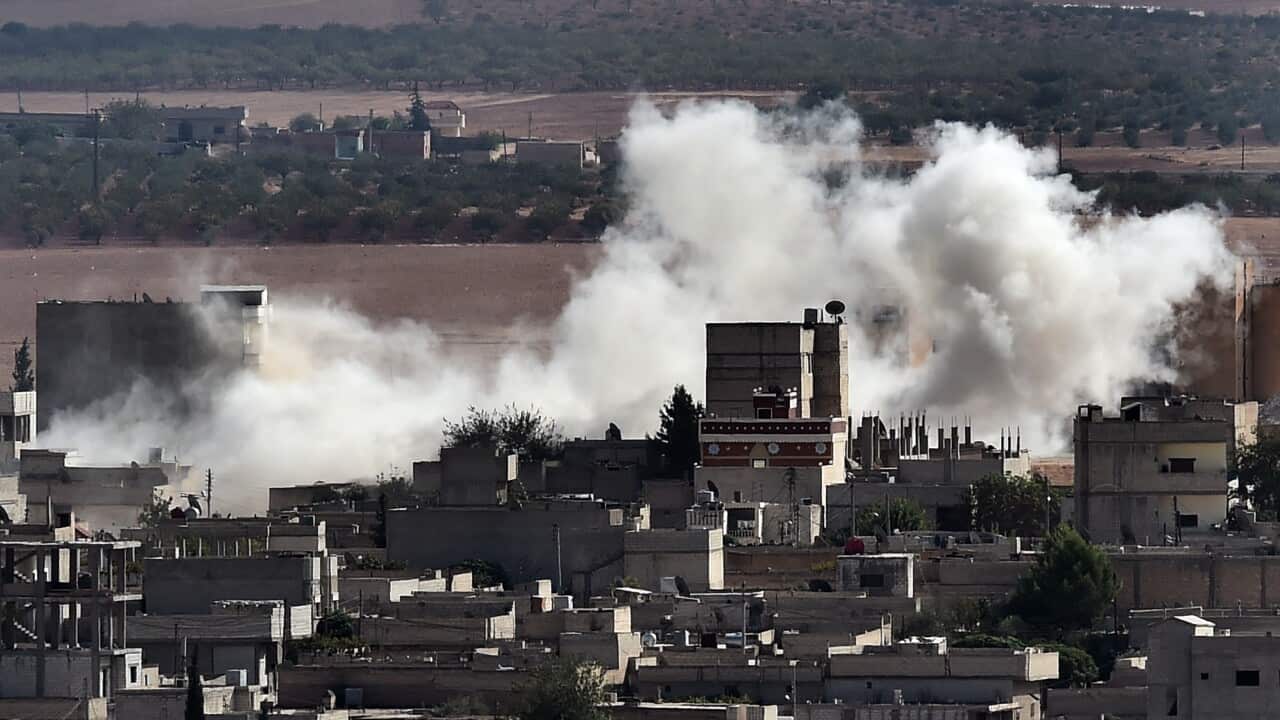
US-led warplanes have intensified air strikes against IS fighters who have been closing on the town for three weeks, but the Pentagon has warned that without a force on the ground to work with, there are limits to what can be done.
The co-ordinator of the US-led campaign, retired US general John Allen, was to hold a second day of talks in Ankara after the NATO ally insisted it could not be expected to take ground action alone against the jihadists on its doorstep.
Fierce clashes raged early on Friday close to the command headquarters of the main Kurdish fighting force, the People's Protection Units (YPG), the Syrian Observatory for Human Rights said.
IS fighters had already captured the nearby offices of the Kurds' asayesh internal security force on Thursday, bringing the front line to just 1.3 kilometres from the Turkish border.
US-led warplanes also carried out fresh strikes during the night on IS targets southwest of Kobani, said the Britain-based Observatory, which has a wide network of sources inside Syria.
News that makes sense
Your trusted source for staying up-to-date with the world around you. Get free daily news updates and analysis, straight to your inbox.
The number of daily air strikes around the town has jumped from a handful previously to 28 on Wednesday and at least 14 on Thursday, according to US Central Command, which runs the air war against the jihadists.
"We get them when we see them," said one military officer, who spoke on condition of anonymity.
"Opportunities (for air strikes) are presenting themselves in Kobani right now," the officer said.
But officials insisted there were no forward air controllers on the ground directing the strikes or a decision to ramp up the bombing runs.
There is "no change in strategy but ISIL (IS) has exposed their forces as they have pushed north to Kobani and provided solid targets", said another senior military official, who asked not to be named.
US commanders were mindful of the dire humanitarian situation for the Kurds in Kobani, where 300,000 civilians have fled the advancing jihadists, but Washington did not consider it a strategic location, the official said.
"We're not going to be drawn into a town-by-town strategy," the official said.
With the world media gathered just across the border in Turkey, the conquest of Kobani would be a highly visible symbolic victory for the extremists.
But for US commanders, the top priority remains defeating the IS group first in neighbouring Iraq, where there are more capable local forces to work with, the official said.
In Syria, the objective is to disrupt the IS group's supply lines and sanctuaries, as there is no viable, moderate rebel force fighting the jihadists on the ground, the official added.
Co-ordination in Kobani has been hampered by the close ties between the YPG fighters defending the town and the outlawed Kurdistan Workers Party (PKK) which has waged a three-decade insurgency for self-rule in neighbouring southeastern Turkey.
Those ties have also complicated Turkey's response, with the government deeply reluctant to allow weapons or Kurdish fighters to cross the border.
Pro-Kurdish protesters angered by Turkey's lack of action have clashed repeatedly with police, sparking violence that has claimed at least 31 lives and prompted the Turkish authorities to impose a curfew in six provinces.
There has been disappointment in Washington and elsewhere that Ankara has yet to commit its well-equipped and well-trained forces to the fight against the militants.
US co-ordinator Allen was to hold a second day of talks with Turkish officials on Friday on what role Ankara might play in the US-led coalition.
A joint US-Turkish military team will also meet next week to discuss the fight against the Islamist militants.
"There is no question that Turkey is well positioned to contribute," in areas including military co-operation, US State Department spokeswoman Jen Psaki said, while stressing "it's not a situation where we are making demands".
Turkey has been calling for a buffer zone to protect its border and provide some protection for fleeing Kurds.
The Turkish foreign minister was to hold talks in Paris on Friday, a day after France threw its weight behind the call.
But Russia said Thursday that any such plan would need the UN Security Council's approval.







