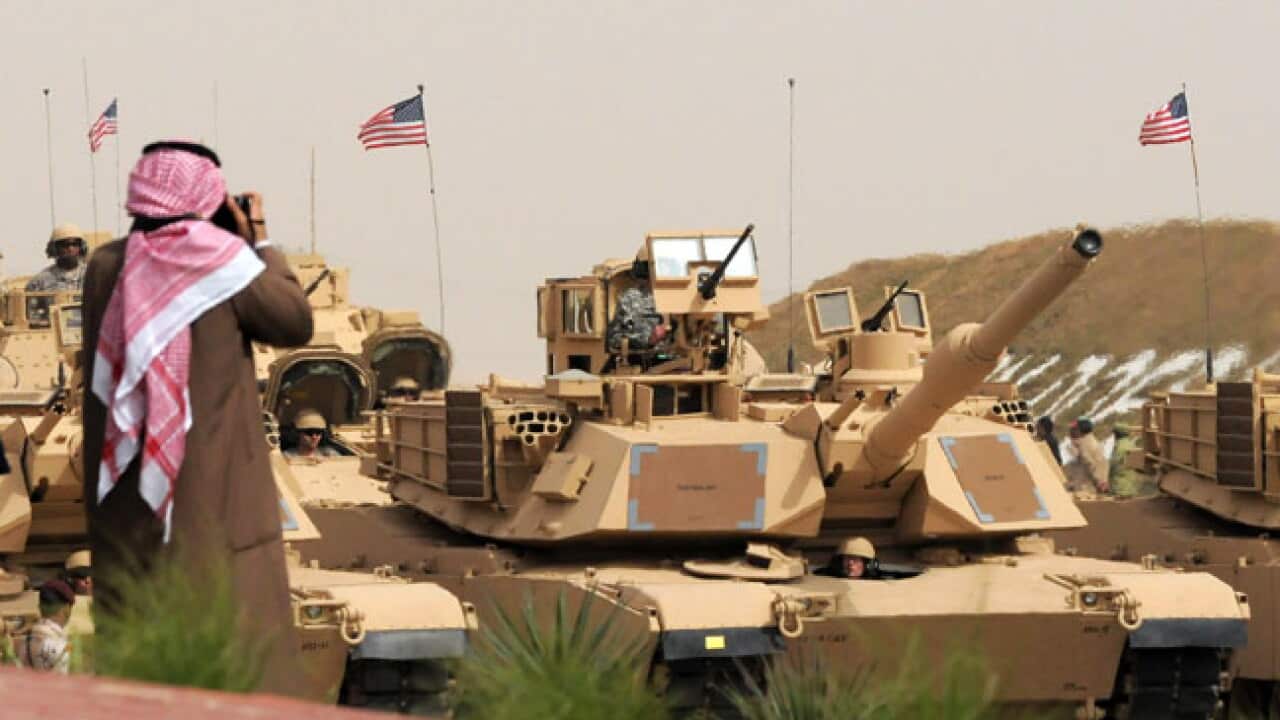
Warplanes, helicopters, tanks and armoured vehicles from the United States, France, Britain and 25 other countries, whose militaries took part in freeing Kuwait from Saddam Hussein's occupying forces, took part in the parade in Subbiya, 100 kilometres (60 miles) north of Kuwait City.
The United States' top military officer Admiral Mile Mullen said from the sidelines of the parade that it "speaks to the strong bond of partnership we have with this country and our close military relationship".
News that makes sense
Your trusted source for staying up-to-date with the world around you. Get free daily news updates and analysis, straight to your inbox.
Washington led an international coalition that drove the Iraqi troops out on Februry 26, 1991.
The oil-rich emirate is also celebrating 50 years of independence from British rule and Emir Sheikh Sabah al-Ahamd al-Sabah'S fifth anniversary in power.
To commemorate the three events, the emir has granted each of Kuwait's more than 1.1 million citizens 1,000 dinars ($3,570) and free distribution of basic food items for 14 months, at a total cost of over $5 billion.
The government also raised the basic salaries of servicemen by up to 115 percent at a total annual cost of close to $1 billion.
Thanks to high oil prices, Kuwait has ended the past 11 fiscal years with huge budget surpluses and has around $300 billion in its sovereign wealth fund mostly in overseas investments.
Call for political reform
Opposition political groups seized the occasion to press for wider political reform in this state, which was the first to embrace parliamentary democracy in the Arab states in the Gulf 49 years ago.
The newly-formed liberal Kuwait Progressive Group called in a statement Saturday for a change of government and appointing a new prime minister as a first step toward reforms.
The group also called for the closure of US military bases established after the liberation of the country, saying their presence is no longer justified since the toppling of Saddam's regime.
The former Iraqi leader ordered his troops to invade Kuwait on August 2, 1990 and annexed the emirate in the same month.
Iraqi President Jalaj Talabani was among the world leaders who watched the parade.
The largest contingent came from the US military which was represented by all the units that took part in the 1990-91 Gulf War as Colin Powell, then chairman of the US joint chiefs of staff, watched from the stands.
Also taking part were troops and personnel from Egypt, as well as Kuwait's partners in the Gulf Cooperation Council (GCC) states of Saudi Arabia, Bahrain, Oman, Qatar and United Arab Emiartes.
Kuwait has been in festive mode since the start of the month, with flags of the nations that liberated the emirate flying on major roads and buildings and decorative lights illuminating the small country.







