This audio is voiced by AI and may occasionally mispronounce words.
Share your feedback and help us improve this feature. Read more about how we use AI at SBS here.
Once upon a time, a diamond engagement ring was a powerful symbol of social status: the bigger the rock, the greater its cachet.
Today, ring owners posting in social media forums will often voice a different sentiment: "Does this look too big?"
The diamond industry has undergone an unprecedented shake-up in recent years due to the exploding popularity of lab-grown gems.
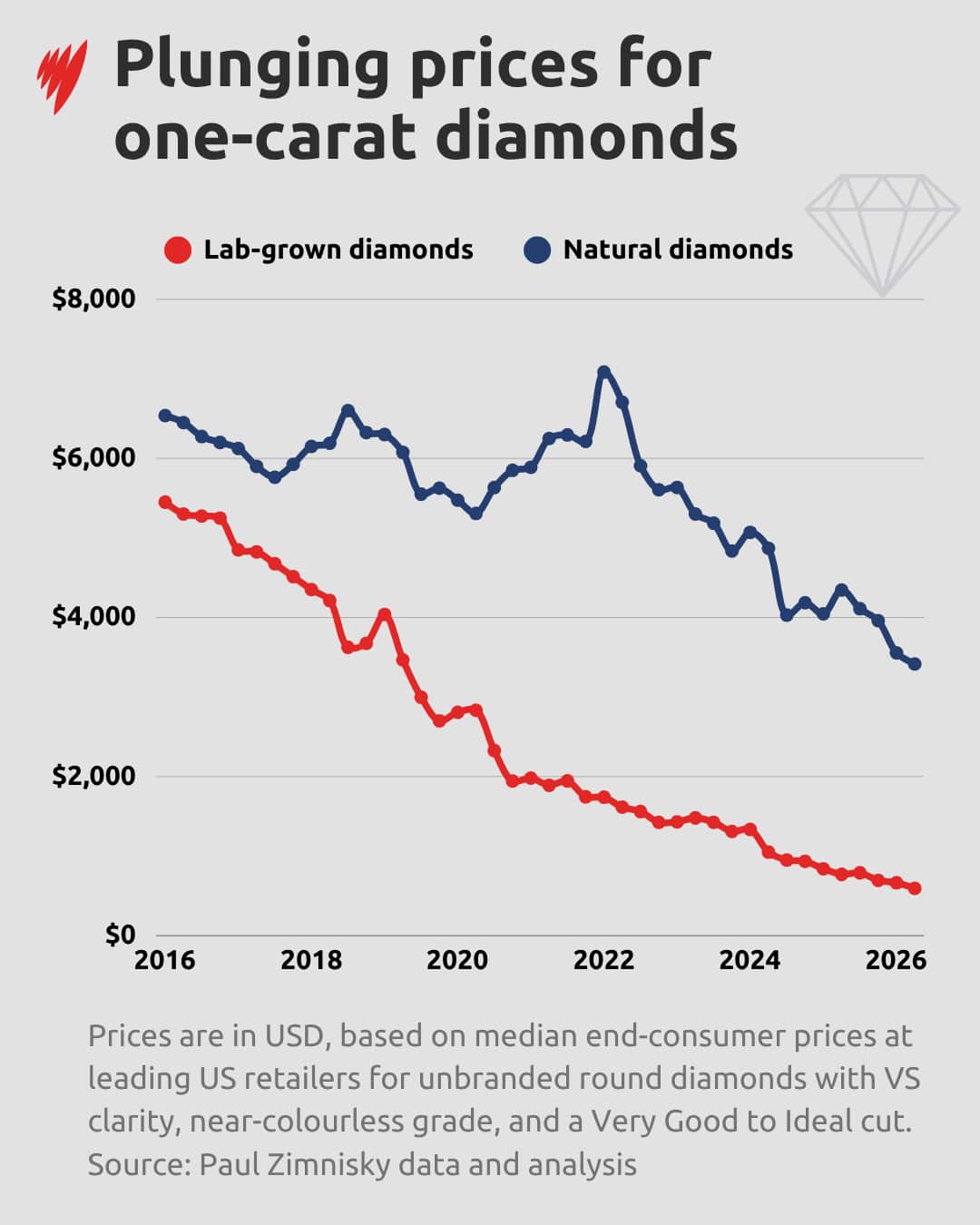
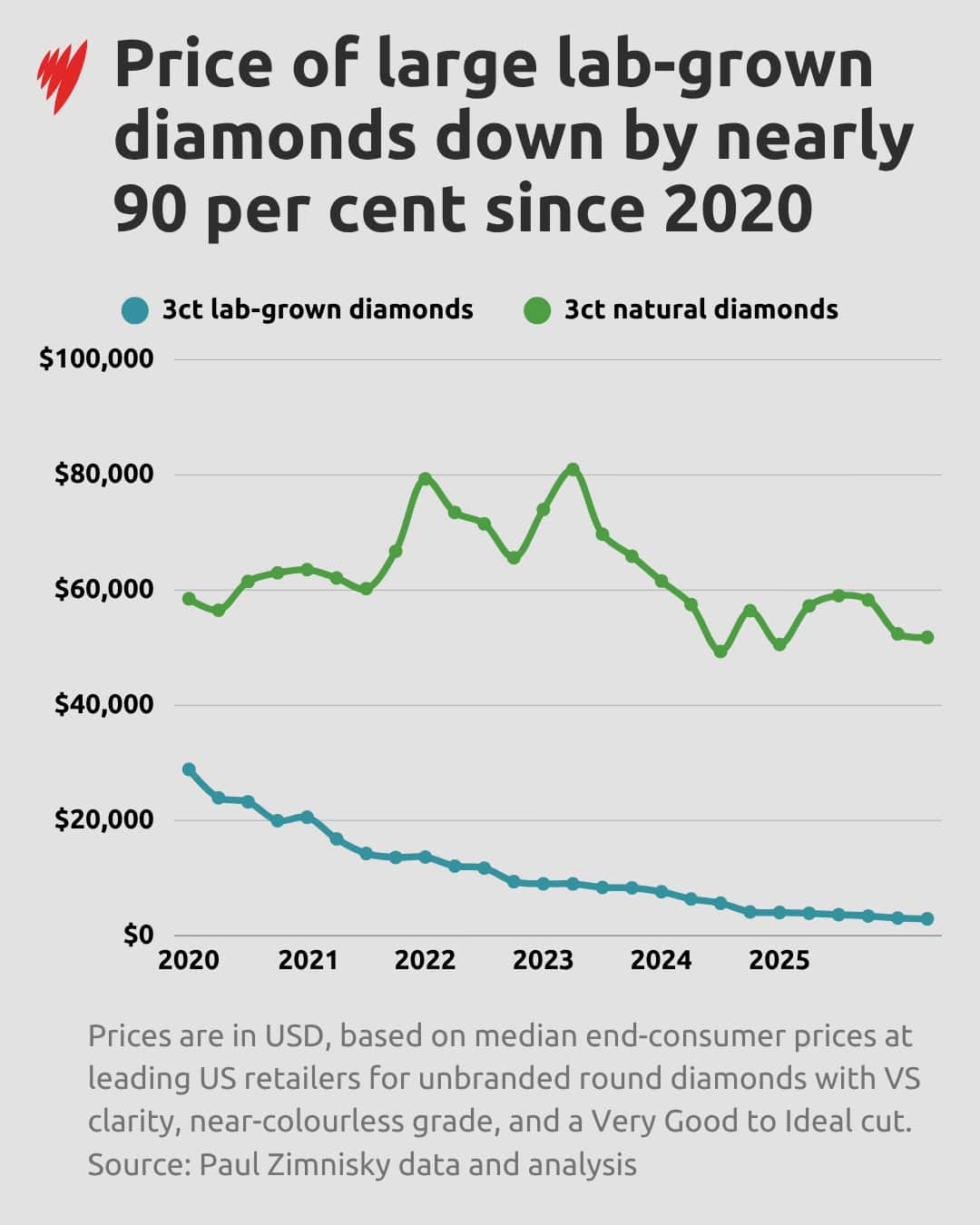
The price of a one-carat natural diamond has more than halved since the start of 2022, according to US industry data.
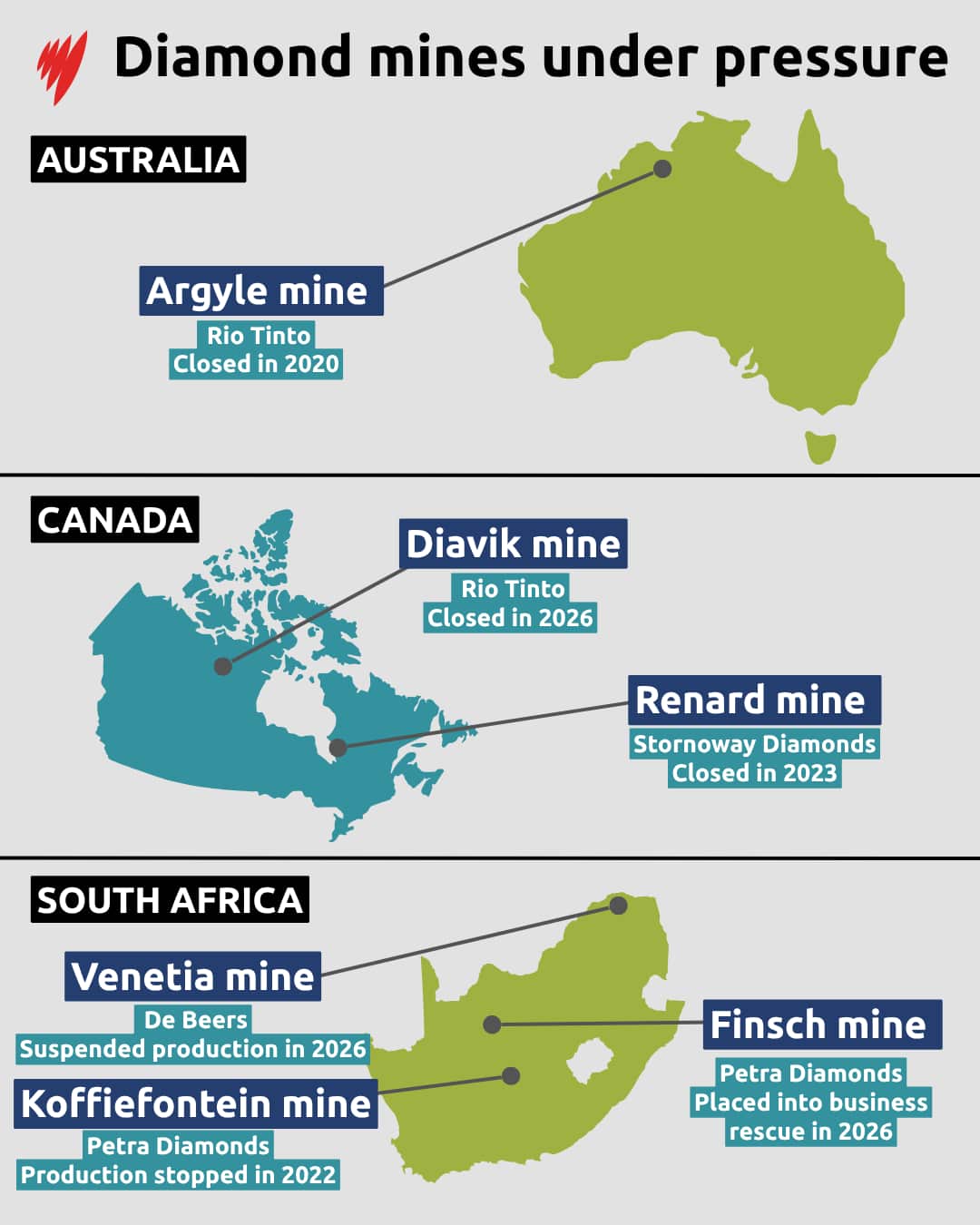
Last month, De Beers — the company that helped define the diamond industry and monopolised it for decades — suspended production at South Africa's biggest diamond mine, citing a need to cut costs amid challenging market conditions.
News that makes sense
Your trusted source for staying up-to-date with the world around you. Get free daily news updates and analysis, straight to your inbox.
It's the latest sign that the once-booming industry is at a crossroads as collapsing diamond prices force mining behemoths to close mines, delay new projects and suspend production.
At the heart of the upheaval is a physically identical product that has upended one of the most successful luxury marketing stories ever told.
Lab-grown diamonds are real diamonds — chemically and visually identical to those found deep underground.
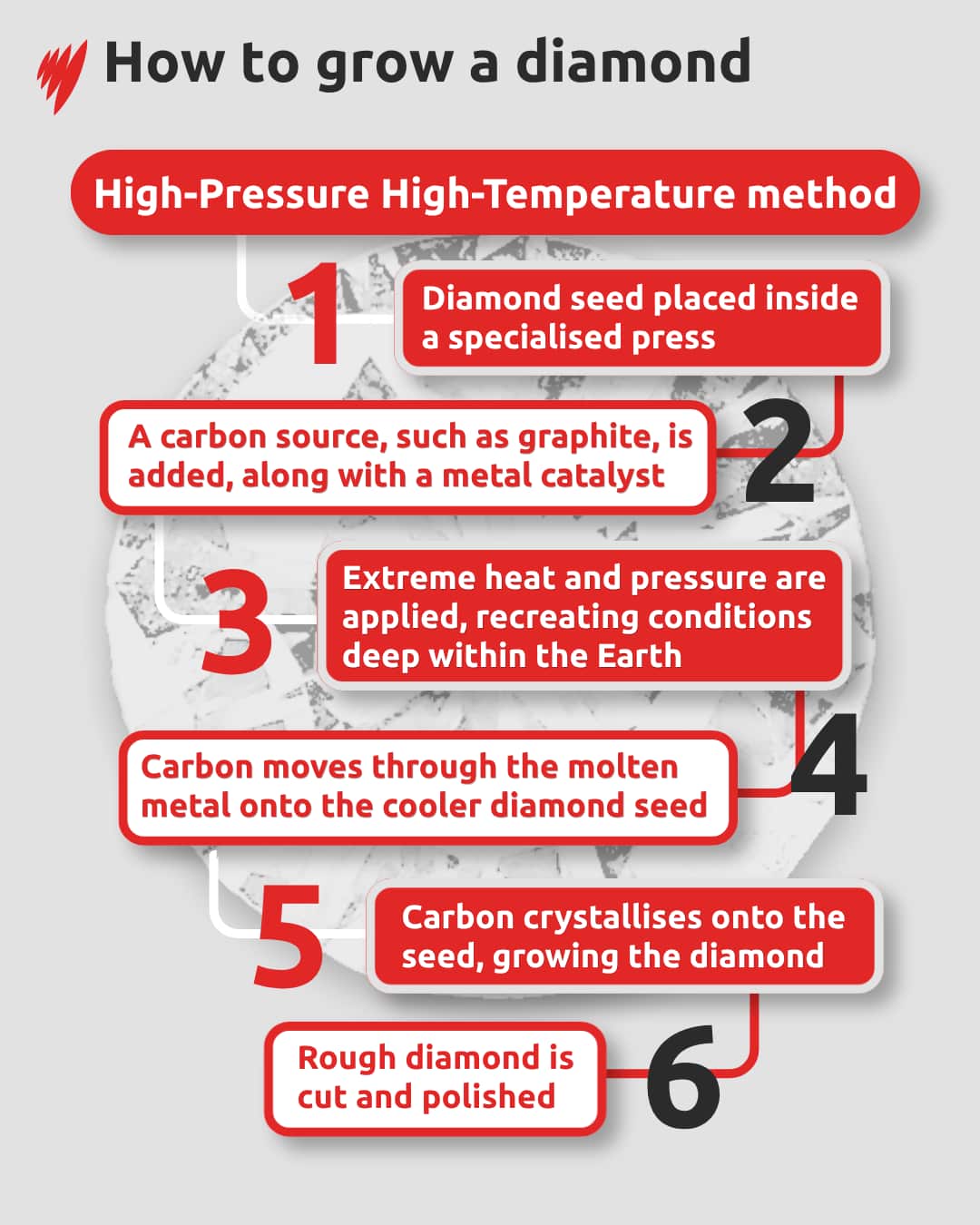
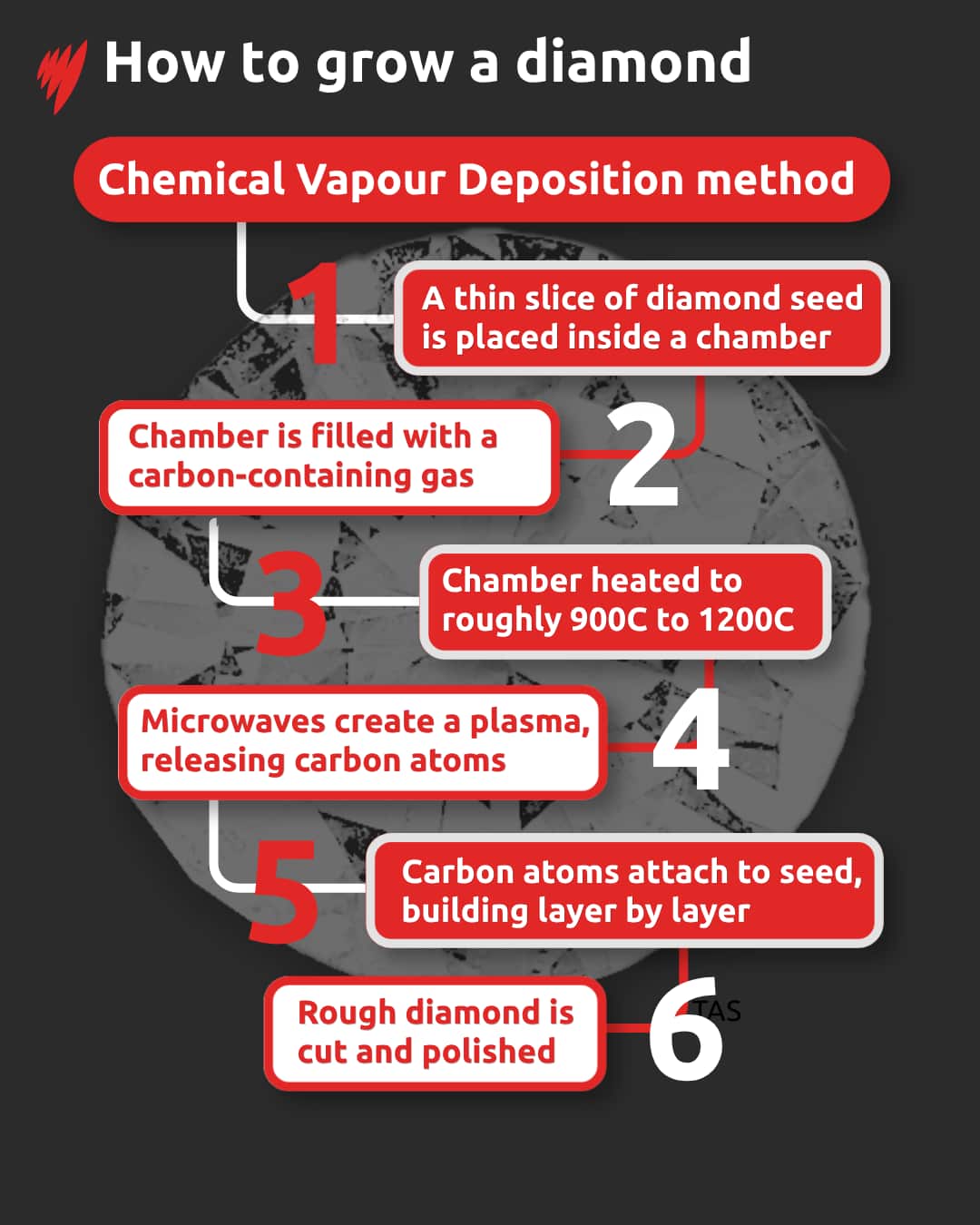
But rather than forming inside the Earth over a billion years or more, lab gems are created by scientists using one of two primary methods — High Pressure High Temperature (HPHT) or Chemical Vapour Deposition (CVD) — to recreate the conditions under which carbon crystallises into diamond.
It takes a matter of weeks.
How did the story of a gem forged over billions of years, and sold for generations as a symbol of rarity and exclusivity, change so dramatically in just a decade?
A history of diamond-making
After years of experimentation, the first proven human-made diamonds were created in the 1950s.
At the time, there was little concern that they could become serious competition for natural diamonds.
The early synthetic stones were small, brown and of poor quality for use in jewellery, instead used for industrial purposes such as manufacturing.
It wasn't until the 1970s that General Electric, the American company that pioneered synthetic diamond technology, produced the first gem-quality lab diamonds.
But the technology was still too expensive to make lab diamonds commercially viable for jewellery, and the stones weren't graded highly under gem colour and clarity standards.
As the technology continued to improve, a turning point arrived in 2007: the Gemological Institute of America (GIA), the world's leading independent authority on gem-grade diamonds, officially recognised lab diamonds.
The GIA began issuing reports for lab gems that year, but they represented only a tiny fraction of diamonds submitted for grading — around 0.05 per cent.
A decade later, lab-grown diamonds still only accounted for a small share of the global market.
But in the last few years, they've erupted into the mainstream.
Paul Zimnisky, a leading independent diamond industry analyst based in New York City, says the influx of lab gems has dramatically altered the global market.
"The technology to make those diamonds has rapidly improved, and the price to make them has come down substantially," Zimnisky tells SBS News.
As the price has come down, that's when I've really seen consumer demand pick up for the man-made diamonds, and that I would say happened within the last five years in a big way.
In 2016, a one-carat natural diamond would retail in the US for around $9,380, while a lab-grown stone of the same cut and clarity would cost $7,820, according to Zimnisky's data.
Today, the natural diamond retails for $4,900 while the equivalent lab stone can be bought for around $850 or less.
Zimnisky estimates lab-grown stones now account for around a third of the global diamond jewellery market.
In the US, the world's largest consumer market for diamonds, six in 10 engaged couples opted for a lab diamond last year, according to annual survey data from wedding planning website The Knot.
That was a 239 per cent increase from the site's 2020 survey.
At the same time, as lab diamonds are shifting consumer trends, they are also changing global manufacturing and production flows.
With production costs declining, manufacturers in China and India have expanded at an unprecedented scale.
In China, which dominates the global production market, the central province of Henan has become known as the nation's "diamond capital". In the city of Zhecheng's many factories, hundreds of machines work around the clock to produce millions of carats each year.
Today, even experts say they can't distinguish between a natural or lab-grown diamond without specialised equipment.
"The only way to tell the difference is either through the laser inscription, which is usually engraved on the girdle of the diamond, or through a certificate which is associated with the diamond," Michael Cohen, managing director of the Diamond Certification Laboratory of Australia, tells SBS News.
"Other than that, you need to put it to a laboratory to actually know the difference. It's not possible to actually see it visually through a microscope, through basic testing, even your countertop retail test."
But De Beers has been working to change that.
The London-headquartered multinational has developed a suite of advanced screening machines, costing from around $7,900 to more than $35,000, which allow diamond sellers to distinguish between natural and lab-grown diamonds by analysing microscopic signatures left behind by their different growth processes.
The technology forms part of the company's broader effort to persuade consumers that a diamond's origin, rather than its composition, is an important part of its story.
The rise of the big diamond
As larger diamonds have become more affordable and visible on social media, demand for smaller stones of one carat or less has slowed.
Designs that were once reserved for celebrities and the ultra-wealthy are now well within reach for many middle-income earners.
And it's not just the price that's more attractive: ethical concerns over the origin of gems have been offset by the lab-grown model, which does not rely on mining or supply chains that pass through conflict zones.
On Reddit forums, it's now common to see everyday people asking whether a diamond looks "too big" or ostentatious on their finger.
At the same time, some owners of natural diamonds have posted on social media worried that people will assume their ring is lab-grown as large diamonds become increasingly prevalent.
It reflects a generational change in consumer sentiment — one that is fast becoming an identity crisis for the natural diamond industry.
De Beers launched its own lab-grown jewellery brand in 2018 but shuttered it last year to focus on its original product.
It has outlined a plan to invest in emotionally driven campaigns that emphasise the rarity and origin of natural diamonds.
Cohen says the company realised it was giving lab-grown diamonds credibility by selling them under the De Beers banner, but its exit did little to slow demand.
Jana Bowden is a professor of marketing and consumer behaviour at Macquarie University, and says much of the identity crisis faced by major brands stems from the historical emphasis on a diamond's exclusivity.
"Diamonds have always been seen as an absolute status symbol," she says.
"So much of this has been driven by the perceived rarity and exclusivity of the diamonds, and of course the controlled supply of diamonds through the market, and particularly De Beers as being the pinnacle brand with the most control of the market and supply."
From rare to abundant: The 'forever' diamond
At its peak in the 1980s, De Beers controlled nearly 90 per cent of the global diamond market.
Its tight control of the world's diamond supply allowed it to stockpile excess diamonds and manage how many entered the market at any time, helping to keep prices elevated.
Through its marketing, the company famously built the idea that a diamond is rare, "forever", and the ultimate expression of love, turning diamond engagement rings into a social norm.
It also molded societal expectations around how much an engagement ring should cost.
"Isn't two months' salary a small price to pay for something that lasts forever?" a 1980s De Beers ad asked.
Bowden says historic luxury brands like De Beers built lasting perceptions in consumers' minds.
Really, we've been taught and we have learnt how to incorporate diamonds into our lives. This is not something that existed prior to the clever marketing campaigns.
Although diamonds are now far from rare, Bowden says many of those perceptions persist — but the market is splitting in two.
"Interestingly, the legacy branding that's come from the original, traditional mining of diamonds is also now naturally transferred to lab diamonds as well. So consumers still have that association with exclusivity or a milestone."
Bowden says the lab-grown diamond market is increasingly appealing to younger consumers, who are often more financially constrained and ethically motivated than older generations.
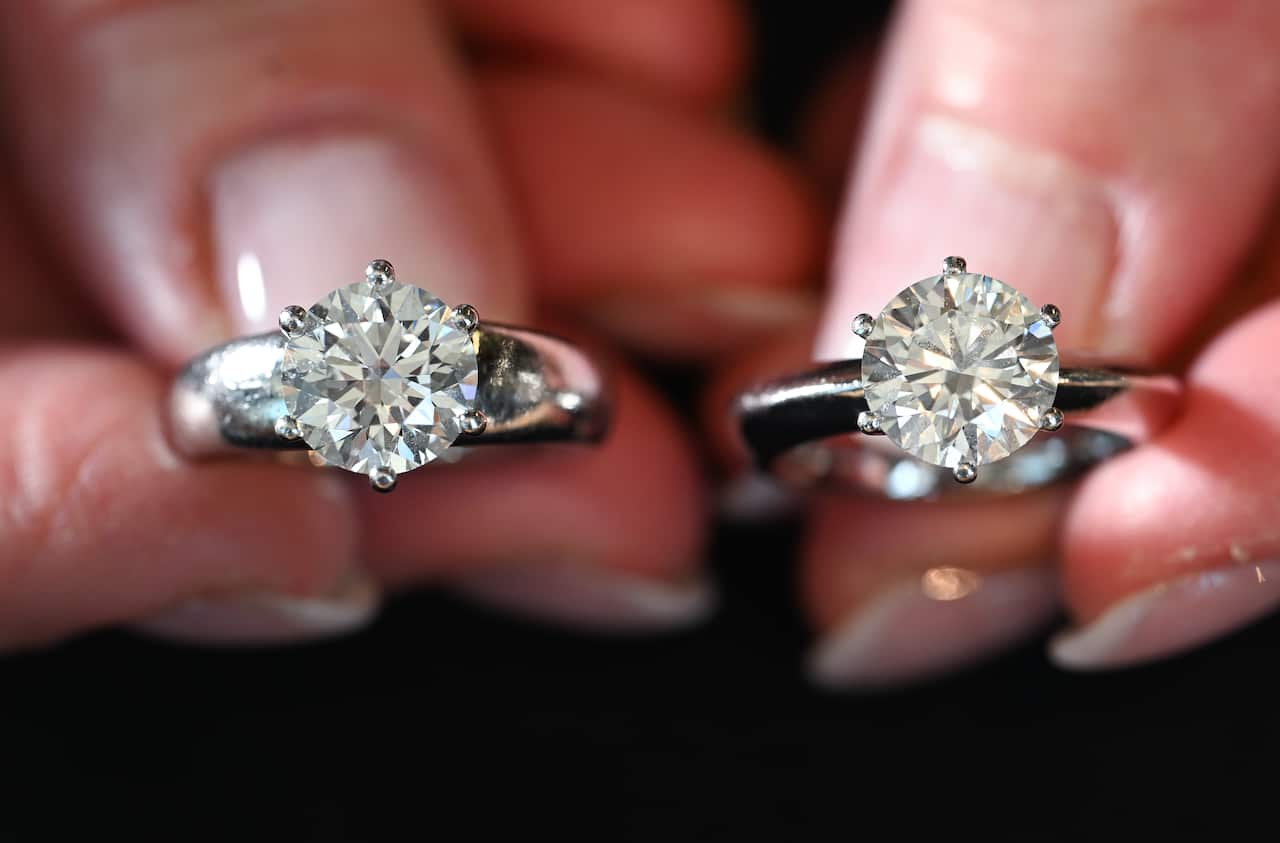
Ms Elangovan, 33, who asked to omit her first name to protect her privacy, tells SBS News she has accumulated more than 10 lab-grown and natural diamonds in her jewellery collection over the past decade or so.
While she's fascinated by the history and rarity of a natural diamond, she can no longer justify the price when she can buy a "virtually flawless" lab equivalent at a fraction of the price.
"When I look at it, I'm like, 'Oh, this existed millions of years before me, and it probably would [for] millions of years after me," she says of natural diamonds.
"So on that point, labs can't compete."
But ultimately, she says she's thrilled to be living in an age where beautiful jewels are accessible to more people.
"I'm intrigued [that] someone can just recreate millions of years of process in a lab," she says.
"It's a fascinating industry. I'm just happy I'm alive now, so I can have really pretty jewellery at a very affordable price and ethically sourced."
Can the mined diamond industry recover?
The natural diamond industry is now facing headwinds from multiple directions.
Changing consumer spending priorities, skyrocketing operational costs, geopolitical uncertainty, and declining diamond yields have all contributed to mines closing or suspending production in recent years.
Some mines were approaching the end of their lifespan regardless, but plummeting diamond prices and the enormous cost to open new mines have made it harder to justify investment in new projects.
"I think the natural diamond industry has to collect itself and come up with a strategy to further differentiate its product from lab-grown diamonds," Zimnisky says, adding that the industry must give consumers a compelling reason to pay 10 times as much for a natural stone.
He notes that De Beers is currently up for sale by its parent company, Anglo American, with a potential deal expected this year.
The new owner's arrival will be "an interesting catalyst" for the industry, he says.
I think they're probably going to pretty aggressively try to kind of reignite interest and demand and emotional appeal for natural diamonds.
For now, unless prices double or triple over the next decade, Zimnisky doesn't expect to see significant investment in new mines or the reopening of suspended operations.
Cohen, who has worked in the industry for more than 40 years, says there'll now be a "never-ending supply" of lab diamonds. But he expects prices may eventually increase as the significant energy required to produce them becomes more expensive — which could potentially create new ethical concerns for consumers.
He believes diamond mining will eventually come to an end, but the market for natural diamonds will endure.
"The biggest supply of diamonds will no longer come from the mine, but it'll come from the second-hand markets," he says.
"The diamonds don't get destroyed. As they say, a diamond is forever."
For the latest from SBS News, download our app and subscribe to our newsletter.







