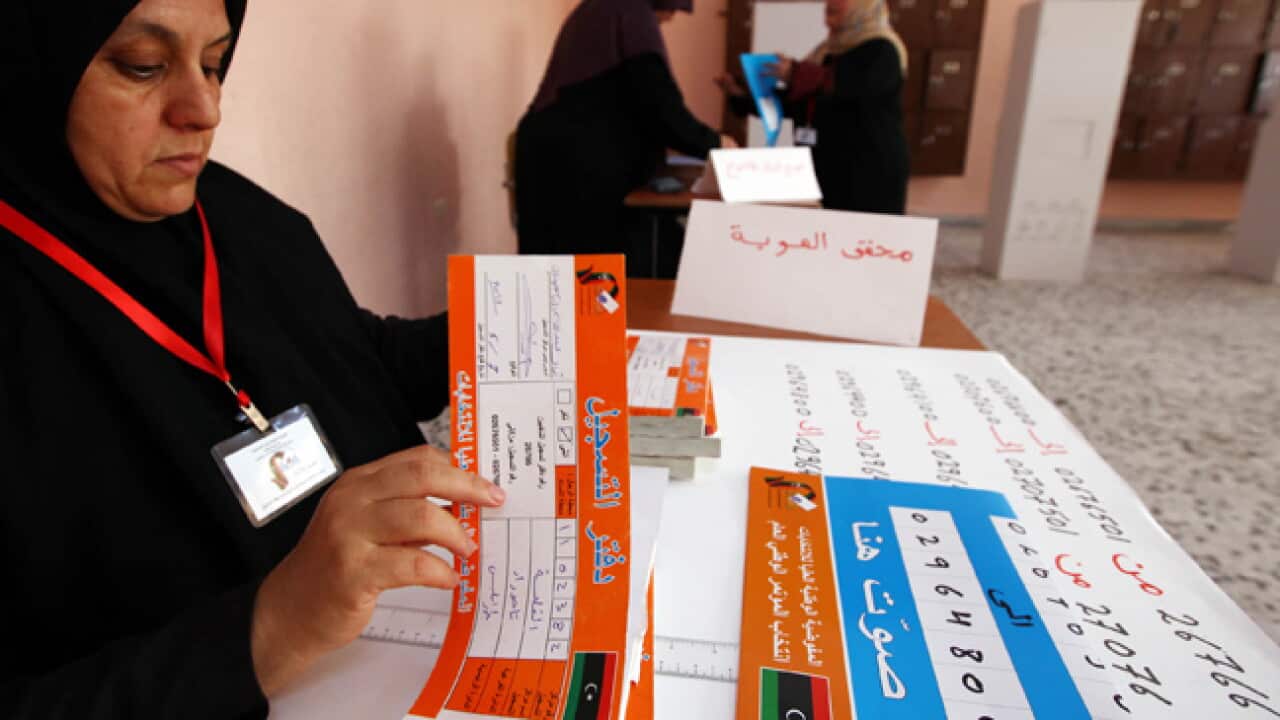
Polls have opened for Libya's first national elections in over four decades amid acts of sabotage in the east by protesters who feel their region is under-represented in the incoming congress.
In Tripoli, polling stations opened on schedule with lines of voters eager to elect the General National Congress, which will be at the helm of the country for a transition period, an AFP journalist said.
"Words cannot capture my joy, this is a historic day," said Fawziya Omran, 40, one of the first women in line at the Ali Abdullah Warith school at the heart of the capital.
News that makes sense
Your trusted source for staying up-to-date with the world around you. Get free daily news updates and analysis, straight to your inbox.
Voters turned up draped in black, red and green flags -- the colours adopted by revolutionaries who toppled long-time dictator Moamer Kadhafi last year -- while mosques blasted chants of "God is Great."
Saturday's vote for a 200-member transitional parliament caps a tumultuous nine-month transition toward democracy for the country after a bitter civil war that ended with the capture and killing of Muammar Gaddafi in October.
Many Libyans had hoped the oil-rich nation of six million would quickly thrive and become a magnet for investment, but the country has suffered a virtual collapse in authority that has left formidable challenges.
Armed militias still operate independently, and deepening regional and tribal divisions erupt into violence with alarming frequency.
On the eve of Saturday's vote, gunmen shot down a helicopter carrying polling materials near the eastern city of Benghazi, the birthplace of the revolution, killing one election worker, said Saleh Darhoub, a spokesman for the ruling National Transitional Council. The crew survived after a crash landing.
Prime Minister Abdurrahim el-Keib vowed the government would ensure a safe vote.
"Any action aimed at hindering the election process is against the supreme interest of the nation and serves only the remnants of the old regime," he said next to a screen showing the face of the slain worker.
"It is threatening to the future of the revolution and its accomplishments ... and an attempt to stop democracy for which Libyans sacrificed their souls."
It was not immediately clear who was behind Friday's shooting.
Many in Libya's oil-rich east feel slighted by election laws that allocate it less than a third of the parliamentary seats, with the rest going to the western region that includes Tripoli and the sparsely-settled desert south.
The east was systematically neglected and marginalised for decades by Gaddafi, and easterners are sensitive to anything they perceive of as an attempt to prolong that neglect after the sacrifices they made during the civil war.
After the NTC passed election laws, several tribal leaders along with former rebel commanders in the east declared self-rule, set up their own council and formed their own army, while saying that they would boycott elections and even work to prevent Saturday's vote from taking place. They are pushing for semi-autonomy for the east.
Former rebel fighters from the east, in utes armed with anti-aircraft guns, took control of oil refineries in the towns of Ras Lanouf, Brega and Sidr, shutting down the facilities to pressure the NTC to cancel the vote.
Earlier this week, ex-rebel fighters and other angry protesters in Benghazi and in the nearby town of Ajdabiya attacked election offices, setting fire to ballot papers and other voting materials.
Fadlallah Haroun, a former rebel commander in the east's regional capital Benghazi, put it simply: "We don't want Tripoli to rule all of Libya."
Nearly 2.9 million Libyans, or 80 per cent of Libyans eligible to vote, have registered for the election and more than 3000 candidates have plastered the country with posters and billboards. Polls are to be open from 8am to 8pm local time, with results expected within a week of voting.
There are four major parties in the race, ranging from the fundamentalist Muslim Brotherhood on one end of the spectrum to a secular-minded party led by a Western-educated former rebel prime minister on the other.
Flush with money, the Brotherhood's Justice and Construction party has led one of the best organised and most visible election campaigns, and they are hoping to become a political force in post-Gaddafi Libya like the Islamists have in post-revolution Egypt and Tunisia following the ouster of authoritarian regimes there.
Three other parties are expected to perform well: Former prime minister Mahmoud Jibril's secular Alliance of National Forces, former jihadist and rebel commander Abdel-Hakim Belhaj's Al-Watan - also cofounded by Brotherhood leaders - and the National Front party, one of Libya's oldest political groups, which is credited with organising several failed assassination attempts against Gaddafi.







