Australia has the highest rate of food allergies in the world, with thousands of new cases every year.
Experts say children from Asian backgrounds are over-represented among those with life-threatening reactions.
And language barriers are becoming an increasing concern hindering communication about the deadly potential of anaphylaxis.
Melbourne woman Nhanh Cutajar says her two-year-old son August Cutajar loves his food.
But she says, when he first started eating solid foods, it quickly became clear that what he could eat safely was very limited.
News that makes sense
Your trusted source for staying up-to-date with the world around you. Get free daily news updates and analysis, straight to your inbox.
"He vomited when we fed him milk and yoghurt. He had a rash when I fed him egg a few weeks later. With tahini (sesame seed paste) he was lethargic, threw up and had diarrhoea."
August has multiple allergies including dairy, egg, soy, peanuts, sesame and salmon.
The reaction to some of those foods is so severe, they can lead to his body shutting down with anaphylactic shock.
Last month he was hospitalised after a woman, who spoke little English, gave him a biscuit containing dairy products at a playgroup.
"If it was someone who was able to communicate with me and understand me, it wouldn't have happened, but because of her limited English, the word 'allergy' might not have even been in her vocabulary, maybe in her language. I clearly said, 'he's allergic', but because she didn't understand, it didn't register with her how important it was not to feed him."
Now Ms Cutajar is on a crusade to increase awareness of allergies in multilingual communities.
Desperate to publicise the issue she shared her experience online, her post striking a chord with Grace O'Neill from online support group, "Allergy Fun".
"I come from a Chinese culture and food is pretty much everything. Every celebration, it's not about just one dish, but about a range of dishes that defines that celebration. When your son, say is allergic to soy, soy is in everything in Asian food."
Maria Said, from Allergy and Anaphylaxis Australia, says many food allergy deaths involve children whose parents are from migrant backgrounds.
"I would say at least three quarters of the deaths that I'm aware of, are in people who are from a non-English speaking background. It doesn't meant that they're not English-speaking, living here in Australia. But they are immigrant families. Many of them from Asia. "
Professor Katie Allen, from the Murdoch Children's Research Institute, says the high rate of allergy in Asian communities presents problems.
"Australia has some of the highest rates of food allergy in the world, and Melbourne is the food allergy capital in the world. With our multiculturalism this is particularly problematic. We have found that children who are from Asian families, have the highest rates of food allergy, compared to Australian children. Children who are born in Asia and then migrate to Australia have lower rates of food allergy, so seem to be protected from food allergy, so it is a problem of migrating early in life that increases your risk of food allergy, from places like Asia."
Maria Said is concerned that the message around allergy safety is not getting through to this group.
"It's difficult for people to understand food allergy when a child has just been diagnosed, but we have even more difficulty in getting people from non-English speaking backgrounds to understand that food allergy is real. Whether it's because food allergy just doesn't happen in their country, or maybe its not properly diagnosed, but its certainly a huge issue when we have lots of grandparents wanting to give children the food so their body gets used to it, which is of course a real danger when it comes to food allergy."
Grace O'Neill agrees it can be hard to get some people to understand the seriousness of the issue.
"I still come across Asian families who say, 'we never had it in our day. You should just keep giving it to them and they'll be ok,' and in some cases that might be true, but in the cases of anaphylaxis when you've been medically-diagnosed at risk, even the tiniest amount can be deadly."
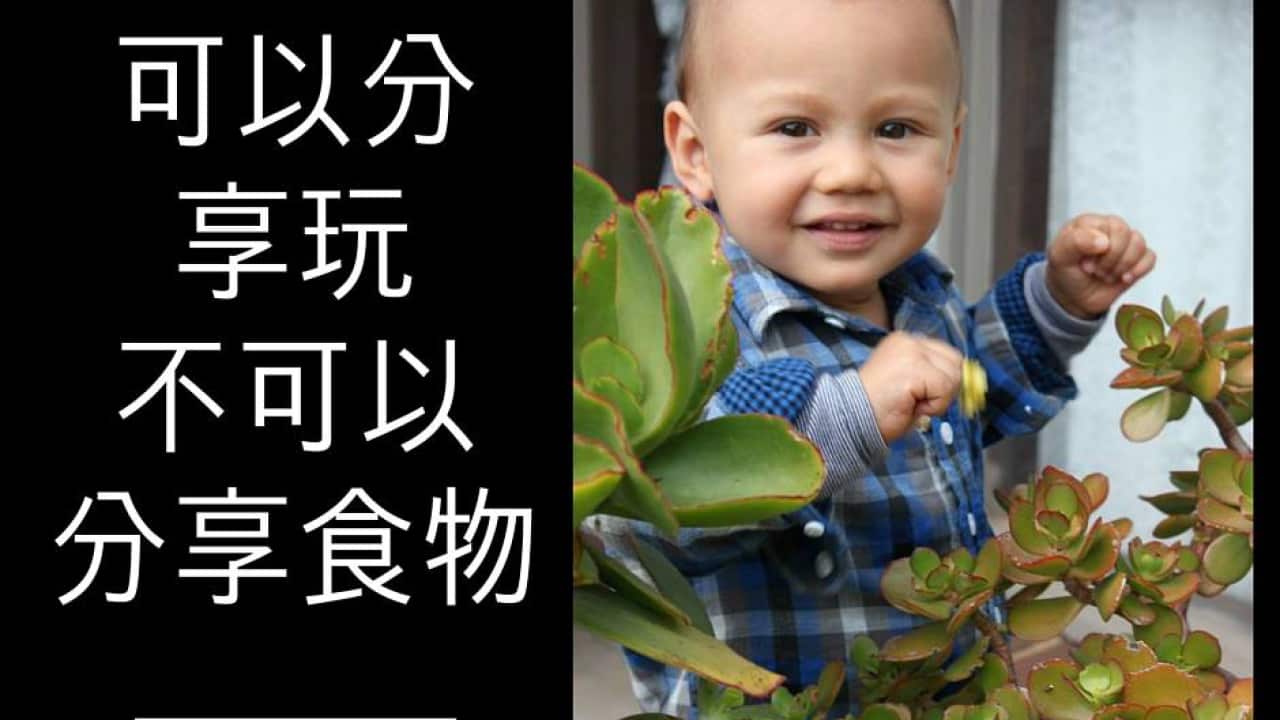
August is now a "poster boy" for multicultural allergy awareness.
His image and the message "Share Toys, Not Food" has been translated into Chinese script and posted online, where it has been shared more than 17,000 times.
Grace O'Neill says, while allergy awareness has improved, more needs to be done for ethnic communities.
"There is a fair bit of awareness in society now, especially with schools and childcares about allergies and being careful with your food. Especially in some cultures, like the Asian and the Greek, food is such a central thing that we really need to move now to a new focus, to encourage other languages to be aware as well."
Maria Said says there's a clear need for more multilingual resources, but funding them is difficult.
"Every time we try to get material translated, we're told it costs a lot of money to get someone who is a professional translator. We're a multicultural society, we are trying to do the best for everybody and optimal care is not just for Australian-speaking people, it's optimal care of all people living in Australia. "
Nhanh Cutajar says the allergy awareness message is one everyone needs to hear.
"Food is such a huge part of life and it's just a reminder that it can be nourishing for people, but it can also kill people."







