(Transcript from World News Radio)
The issue of language proficiency, once again in the news over possible 457 visa changes, has stirred debate in Australia since the earliest days of Federation.
Next month marks the 80th anniversary of a man named Egon Erwin Kisch's arrival in Australia.
And if the Government's current wish is to make the test easier to get foreign workers in, his tale offers the perfect contrast: how a government used its test to keep him out.
Angelo Risso has the story.
News that makes sense
Your trusted source for staying up-to-date with the world around you. Get free daily news updates and analysis, straight to your inbox.
The visit of Czech-born journalist Egon Erwin Kisch to Australia in 1934 began ordinarily enough.
A self-identifying communist, Mr Kisch was invited by a group called the Movement Against War and Fascism to speak at a pacifist congress in Melbourne.
Not a lot was known about him before his arrival in the country.
But he was about to become a national sensation.
Tipped off by Britain to Mr Kisch's political views, the conservative Lyons Government forbade him from leaving his boat, instead leaving him stranded at Port Melbourne.
So, in response, he made a bold and spectacular decision -- to jump overboard onto the dock.
He broke his leg but immediately became the darling of the Australian press, gracing the front pages of newspapers across the country and becoming the talk of the town.
But it was Mr Kisch's role in de-legitimising the government's Dictation Test that earned him the most praise.
The senior curator of migration at Museum Victoria, Dr Moya McFadzean, explains.
"The Dictation Test was basically the mechanism by which the new Immigration Restriction Act of 1901 was administered, and it was a passage of text that was delivered at the discretion of customs officials to any migrant who was deemed undesirable or unsuitable."
The test required selected migrants or visitors to Australia to transcribe a 50-word spoken passage.
This passage could be in "any European language" of the customs official's choosing, and failure to complete the passage resulted in deportation.
Dr James Jupp, who headed the Australian National University's former Centre for Immigration and Multicultural Studies, says it was clearly racially motivated.
"Everybody knew what it was about, that it was about keeping Chinese, in particular, and other Asian people out of Australia. And that was supported by all parties."
But it could also be used to keep out "undesirables" like Egon Erwin Kisch.
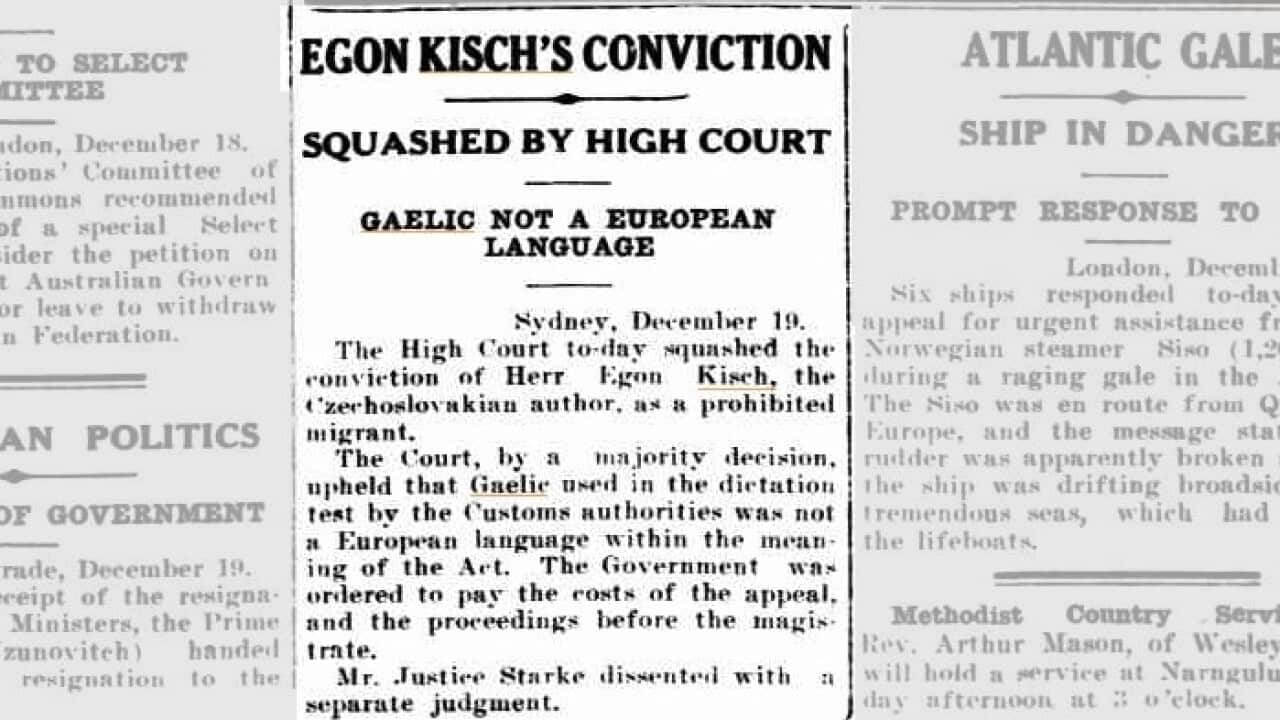
So after being transported to Sydney, where he was briefly allowed ashore, the crippled Mr Kisch was given the test -- in Scottish Gaelic.
Declared an illegal immigrant after failing it, he was thrown into jail with a six-month sentence.
The case was ultimately dismissed in the High Court, though, with help from the communist legal organisation International Labour Defence.
Dr McFadzean says the campaign against Mr Kisch ultimately boosted his speaking audience in Australia and humiliated the government.
"Certainly, there was a great deal of embarrassment for the Federal Government, in that Kisch took the case to the High Court and won that case and was able to remain. And I think he entertained large rallies of people, in terms of who he spoke to. So, you know, it certainly got some serious bad press there, and the government was made to look a little silly."
By February of 1935, the government conceded defeat on the issue and offered to rescind all legal costs if Mr Kisch left the country.
Given it was always his intention to return to Europe, he readily agreed.
Dr Jupp says Mr Kisch had already accomplished exactly what he wanted to do.
"Kisch had already addressed a whole series of rallies, he'd had a lot of popular support, and they just wanted to terminate it rather than continue a whole series of court cases and arguments."
Despite the case, it was not until 1958 that the government completely abolished the DictationTest.
But the humiliation inflicted upon the government went a long way towards its increasing disuse over time and the ultimate abolition of the policy.







