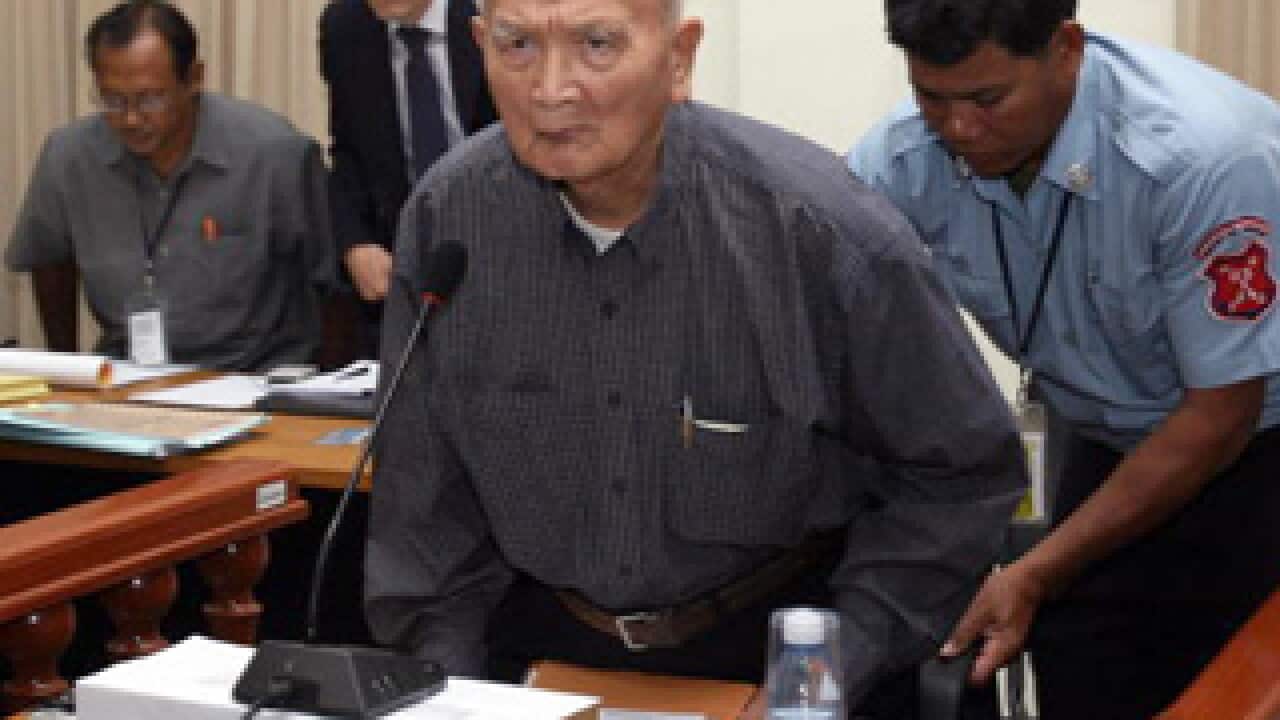
"Brother Number Two" Nuon Chea, 87, and ex-head of state Khieu Samphan, 82, are accused of playing a leading role in the "Killing Fields" atrocities in the late 1970s that left up to two million people dead.
Prosecutor Chea Leang said life in prison was "the only punishment that they deserve".
"On behalf of the Cambodian people and the international community we ask you for justice -- justice for the victims who perished and justice for the victims who survived today who had to live through such a vicious and cruel regime under the leadership of these two accused and other leaders," she added.
News that makes sense
Your trusted source for staying up-to-date with the world around you. Get free daily news updates and analysis, straight to your inbox.
The two defendants are the most senior surviving Khmer Rouge cadres.
Led by Pol Pot, who died in 1998, the communist regime wiped out a quarter of Cambodia's population through starvation, overwork and execution between 1975-79 in a bid to forge an agrarian utopia.
The kingdom's UN-backed court is moving closer to a verdict in the complex trial, which has been split into a series of smaller trials.
Life imprisonment is the maximum sentence it can deliver. There is no death penalty.
The first trial has focused on the forced evacuation of people into rural labour camps and the related charges of crimes against humanity.
The evacuation of Phnom Penh in April 1975 was one of the largest forced migrations in modern history.
More than two million people were expelled from the capital at gunpoint and marched to rural labour camps.
"It's a crime against humanity to send millions of people out into the hot countryside, to walk for days, weeks, sometimes months without any organised transportation or any provision of food, water or medical assistance," said co-prosecutor William Smith.
The Khmer Rouge leaders "implemented their criminal program with utter brutality," he said.
"They decided on who lived and who died. They decided where and how their slaves lived."
The trial, which began hearing evidence in late 2011, is widely seen as a landmark in the nation's quest for justice.
Closing statements are scheduled to be completed by the end of the month, with a verdict expected in the first half of next year.
Other charges of genocide and war crimes are due to be heard in later hearings although no date has yet been set.
The defendants deny the accusations, saying they were not aware of the atrocities committed under the regime -- a claim rejected by prosecutors.
Nuon Chea was "a man willing to kill even his own relatives and revolutionary brothers," said Smith.
Khieu Samphan was also "very involved in crimes," he added.
"The accused were certainly aware of the inhumane conditions faced by the evacuees sent out of the city into the countryside," Smith said.
The trial, which began hearing evidence in late 2011, is widely seen as a landmark in the nation's quest for justice.
Observers and survivors have long raised fears about the speed of proceedings and the advanced age of the accused.
Another defendant, former foreign minister Ieng Sary died aged 87 in March this year, while the case against his wife Ieng Thirith -- also an ex-minister -- was suspended after the court ruled dementia left her unfit to stand trial.
In its historic first trial, the court in 2010 sentenced former prison chief Kaing Guek Eav to 30 years in prison -- later increased to life on appeal -- for overseeing the deaths of 15,000 people.
Reliant on funding from donor nations, the court was established in 2006 after nearly a decade of negotiations between Cambodia and the UN, which provides technical assistance.







