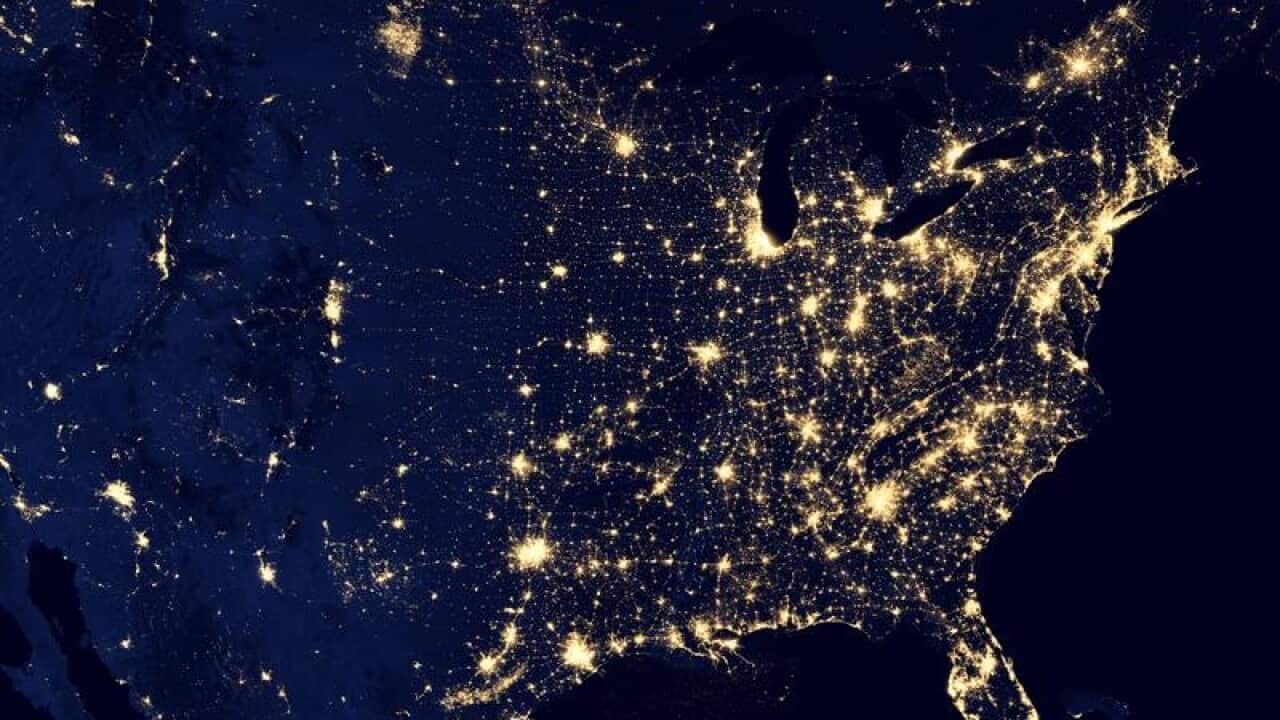
The world is getting brighter, but US scientists say that may not be a good thing.
Researchers say satellite data shows the Earth's artificially lit outdoor surface at night grew by about two per cent annually in brightness and area from 2012 to 2016, underscoring concerns about the ecological effects of light pollution on people and animals.
The rate of growth observed in developing countries was much faster than in already brightly lit rich countries.
The researchers say the US National Oceanic and Atmospheric Administration weather satellite data may understate the situation because its sensor cannot detect some of the LED lighting that is becoming more widespread, specifically blue light.
"Earth's night is getting brighter. And I actually didn't expect it to be so uniformly true that so many countries would be getting brighter," Christopher Kyba of the GFZ German Research Centre for Geosciences, who led the research published in the journal Science Advances, said on Wednesday.
News that makes sense
Your trusted source for staying up-to-date with the world around you. Get free daily news updates and analysis, straight to your inbox.
With few exceptions, growth in night-time light was observed throughout South America, Africa and Asia.
It found Australia's lit area decreased due to wildfires.
Light remained stable in only a few countries. These included some of the world's brightest such as Italy, Netherlands, Spain and the United States, although the researchers said the satellite sensor's "blindness" to some LED light may mask an actual increase.
Night-time light declined in war-hit Syrian and Yemen.
Ecologist Franz Holker of Germany's Leibniz-Institute for Freshwater Ecology and Inland Fisheries (IGB) said light pollution has ecological consequences, with natural light cycles disrupted by artificial light introduced into the nighttime environment. Increased sky glow can affect human sleep, he noted.
"In addition to threatening 30 per cent of vertebrates that are nocturnal and over 60 per cent of invertebrates that are nocturnal, artificial light also affects plants and microorganisms," Holker said. "It threatens biodiversity through changed night habits, such as reproduction or migration patterns, of many different species: insects, amphibians, fish, birds, bats and other animals."
Kyba said nighttime lighting also obscures the stars that people have witnessed for millennia.







