
It was 6am when I set off from my apartment, still pitch black in the dead of China’s winter. I had packed two cameras, a tripod, a camera light and car-mount - as well as my laptop to do some work on the long train ride back. I move awkwardly, but don’t look out of place. I’m just as burdened as every other resident heading out of Beijing for the Lunar New Year, or the Spring Festival Holiday.
I was on my way to meet Jessica Ma, a young migrant worker who’s lived in Beijing for four years. She was about to make her four-hour journey by car back to her home town in neighbouring Hebei province, and had allowed me to tag along to film for my SBS report.
Our driver waited patiently outside as I quickly filmed an interview with Jessica and she packed the last of her things. Before we get into the car she runs back upstairs for a giant monkey toy she’s bought for her new niece to coincide with the Year of the Monkey. She’s sharing the driver with one other passenger, an agreement organised via smartphone app. Car-pooling has debuted this year as a popular option for travellers looking for ways to avoid the stress and squeeze of “chunyun” or the ‘Spring Festival journey home.’
The catchphrase commonly used to describe this mass journey home is the world’s “biggest human migration.” But according to Chinese internet giant Baidu, which live maps journeys made across the country every year, it’s more accurately described as the world’s biggest “mammalian migration”. The scale is almost impossible to imagine: 2.9 billion trips, including 2.5 billion by road, 330 million by train and 55 million by plane.
We have started the drive from Beijing early enough to avoid the notorious traffic queues leaving the city, and sleepy morning quiet soon turns into lively conversation as the passengers get acquainted. Discussion touches upon many of the typical social concerns of today’s millennial Chinese: the price of buying a house in the city, country vs urban culture, salary and job satisfaction (or lack of), and the unavoidable: marriage and dating.
News that makes sense
Your trusted source for staying up-to-date with the world around you. Get free daily news updates and analysis, straight to your inbox.
“Next year, I’ll consider renting myself out as a pretend-girlfriend, just for the experience,” says Jessica, referring to the growing trend of embarrassed singles ‘renting’ partners to impress parents. All passengers are single and talk about how many blind dates their parents have organised for them during the holiday. The driver boasts how he never went to university, yet now owns a car and apartment in Beijing - but is somehow still unmarried. “It’s hard to settle down in the city as a country person,” he sighs.
The view outside the window is a seemingly endless horizon of dry fields dotted with billboards. The north of China is notoriously parched and bone-chillingly cold in winter. But the sun is shining, albeit through a slightly hazy blue sky. Hebei is home to many of the regions worst-polluting factories, which will soon shut down over the holiday.
After the first passenger alights, I’m told by Jessica that her place is close by. “I hope you’ll be ok with it. My parents wanted me to warn you we don’t really live in good conditions.”
The apartment is made up of an Asian squat toilet, semi-outdoor balcony kitchen and the main bedroom, which doubles as the TV and dining room. It’s simple, but warm and welcoming.
“Chi, he, zuo, zuo!” her parents tell me (“eat, drink, sit, sit!”), saying “ni bie keqi” (“don't worry about being too polite with us!”) while at the same time being affectionately over-polite to me. Lunch is soon being prepared.
To my delight it’s handmade dumplings, a very traditional lunar new year dish particularly served in the country’s north. Accompanying them are preserved meats and cherry tomatoes which are eaten raw and on their own as sour fruits. After I film their family meal, I join them and they tell me about their village. “We’re humble people,” Jessica’s mother tells me, while speaking about her daughter who she is obviously proud of for making it in the capital city.
Hong bao, or customary red envelopes are then given from the parents to the kids, packed with about $20 cash. But as the grown child working in the big city it’s really Jessica who’s expected to bring the gifts.
For her niece, a cute Kung Fu Panda bag, and for her parents: packets of snacks, nutritional milk powder, and the piece de resistance, a brand new tablet computer. “My mother has always wanted a computer, now we can speak over video when I’m in Beijing,” says Jessica. The family gathers around as she shows them how it works, but in a few minutes it’s her 11-year-old niece who’s dominating the technology, quickly learning how to load and play a game.
It’s soon time for me to return to Beijing and the family generously offer to accompany me to my train before they go out to shop for more food and fireworks. After a few cups of tea and smartphone photos with the family I feel like my Chinese Lunar New Year experience is almost complete.
Almost. It seems I can’t quite escape the holiday without experiencing the crowds and rush that come with it. I’m ushered into my carriage which turns out to be a sleeper train.
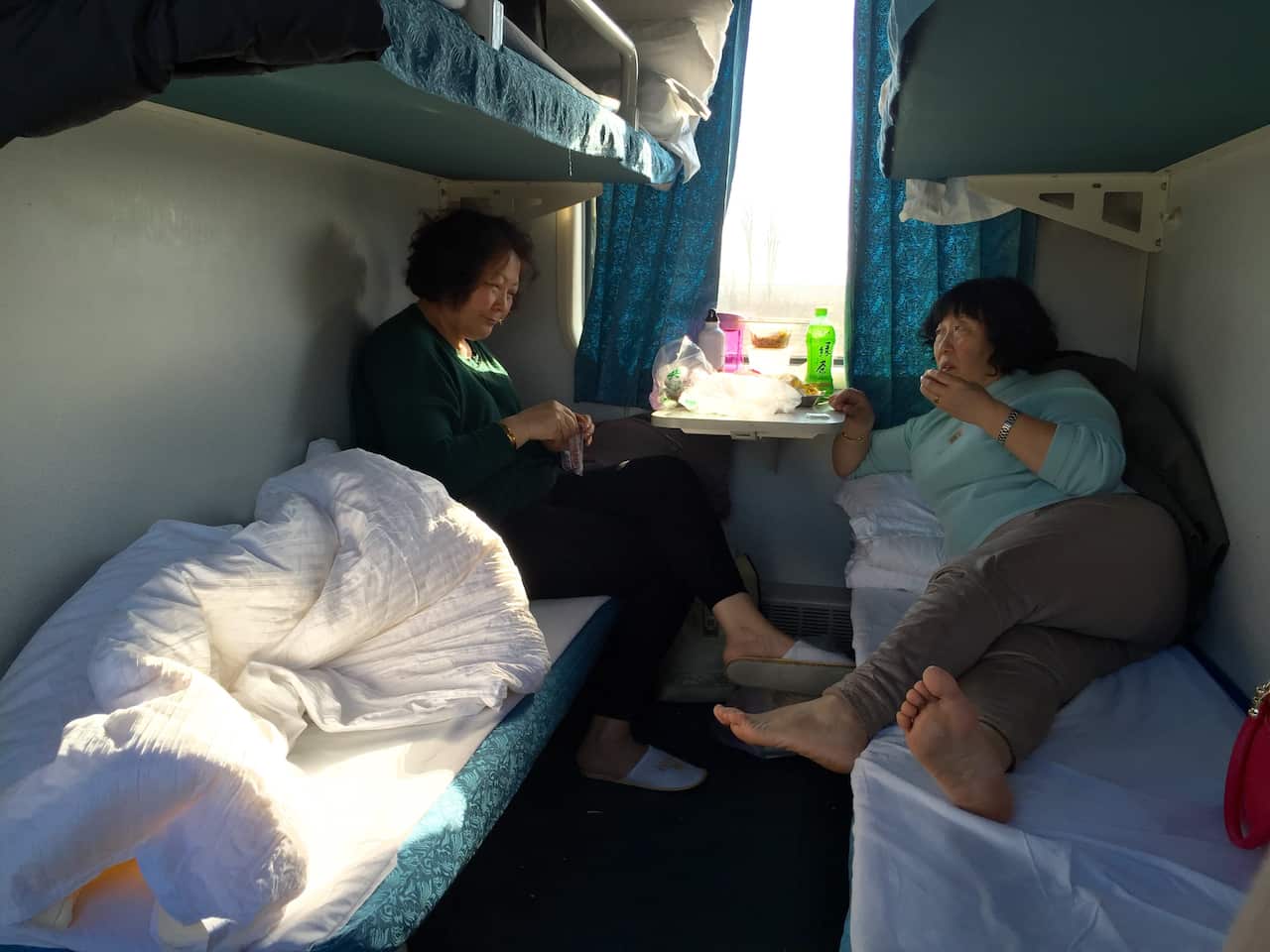
No private and quaint booths here. Instead there are three levels of crowded bunk beds and a distinct lack of privacy. I cram my gear and somehow, myself, into my allocated middle bunk and get flashbacks of being in a treehouse as a kid. The simple bed is unexpectedly comfortable for lying down, and even comes with a doona. But a nap will have to wait. It’s five hours to Beijing and I have a lot of work to do for my report on SBS.







