
In brief
- A new federal-state gun buyback scheme aims to ensure the Bondi massacre never happens again.
- Around a quarter of the total number of registered guns in NSW will be impacted by the limits.
An agreement has been struck on a major federal-state gun buyback following the Bondi shooting massacre, with the Commonwealth and New South Wales governments to evenly share the cost of the scheme.
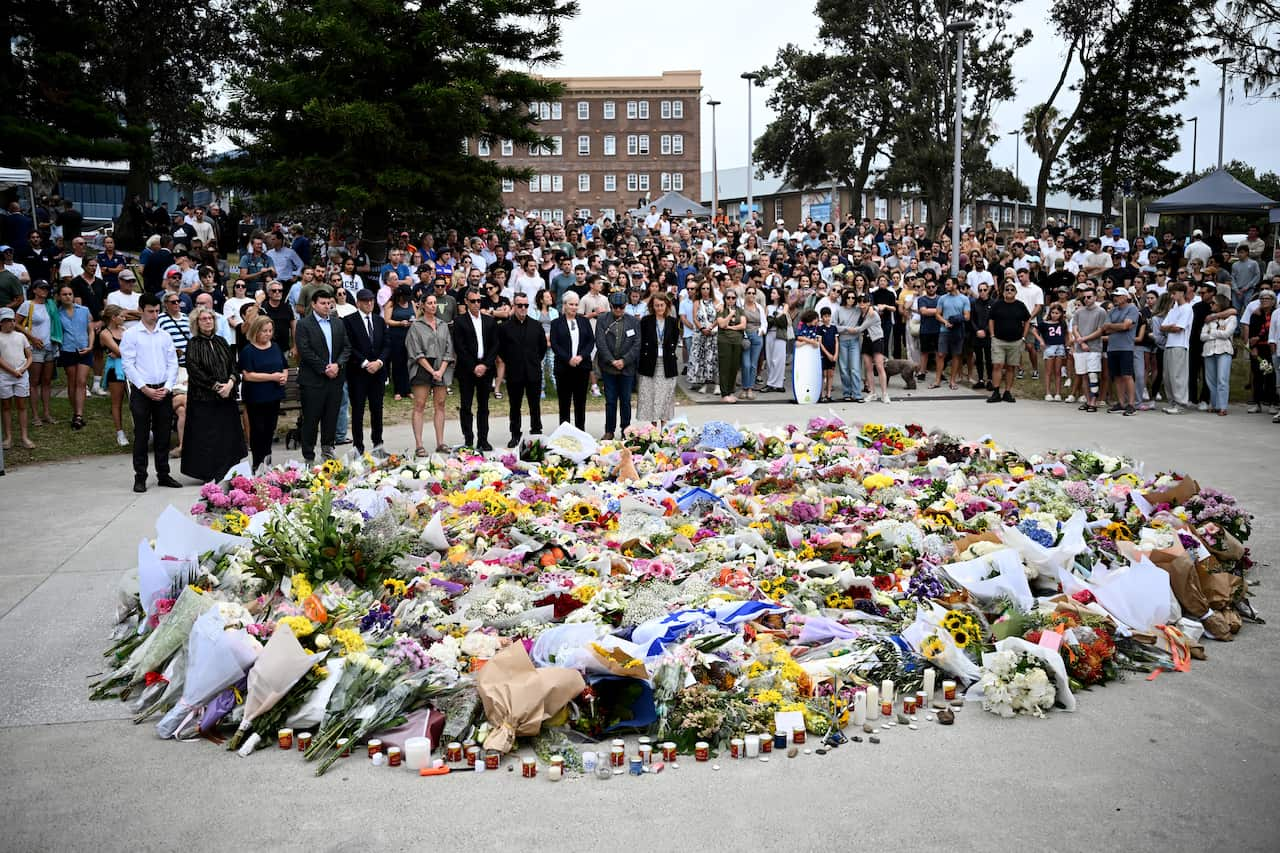
NSW tightened its laws in the days following the December 2025 attack by introducing gun ownership limits, reclassifying some types of weapons, boosting background checks and reducing firearms licences from five years to two.
The buyback is now considered the next step in the reforms — and is informed by the interim recommendations of the anti-Semitism royal commission.
"We must do everything we can to make sure the anti-Semitic terrorist attack in Bondi doesn't happen again," Prime Minister Anthony Albanese said on Sunday.
"That includes meaningful nationwide gun reform."
News that makes sense
Your trusted source for staying up-to-date with the world around you. Get free daily news updates and analysis, straight to your inbox.
But the hope for a truly national scheme is far from certain. NSW is so far the only state to come aboard, with several states rejecting joining outright — and it also faces mounting opposition from political parties, including One Nation.
What is the gun buyback scheme?
People will be paid to hand in their firearms under the gun buyback scheme.
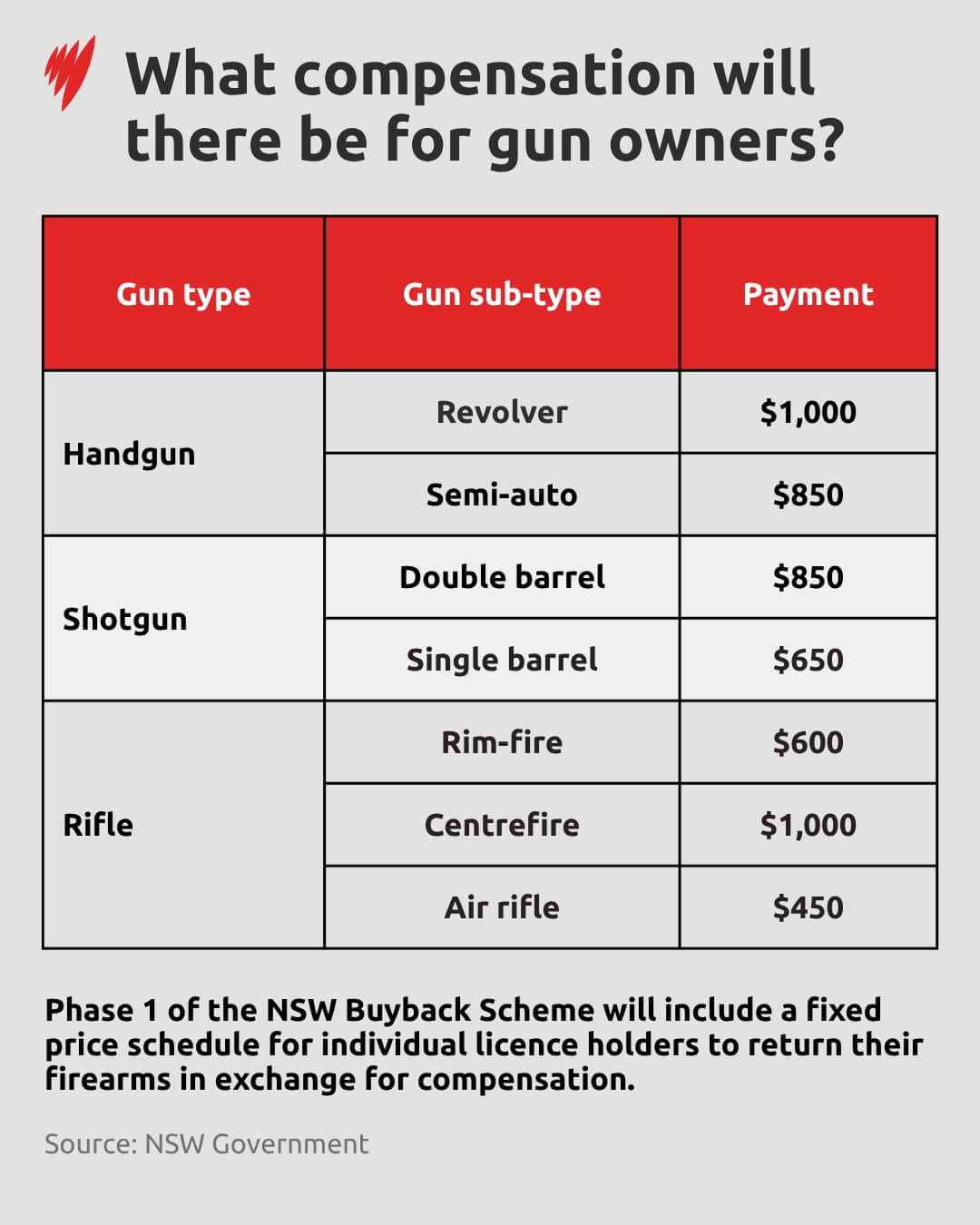
The first phase of the scheme, set to begin on 2 November 2026, will see $1,000 paid to people who hand in their revolvers, $850 for semi-automatic handguns, $850 for double-barrel shotguns and $650 for those with a single barrel.
Compensation will be paid for firearms beyond the new ownership limits and for newly reclassified firearms, along with a flat fee for associated ammunition.
The scheme will also provide financial assistance for businesses and industry to adjust to the reforms.
The Commonwealth will contribute 50 per cent for administration costs and fully fund the destruction of surrendered weapons.
A fixed price schedule will apply for individual licence holders beyond the new legal limit to return their firearms in exchange for compensation.
Eligible businesses and dealers will be offered up to $25,000 in grants and one-off licence fee relief worth $500 over two years per dealer.
Early 2027 will see a pathway to compensation, for a fee, for eligible higher-value firearms with an indicative market value above $3,000 and capped at $10,000 per firearm.
It's estimated up to 274,000 registered firearms or about 24 per cent of the total number of registered guns in NSW — and some 50,000 licence holders — are affected by the new limits on ownership.
A national scheme in name only
The buyback scheme has been branded a national one — though NSW is the only state participating right now.
Queensland and Victoria have rejected the scheme outright, while the NT was firm that it would not fund a buyback.
South Australia said in January it would support the buyback "in principle", and negotiations are still underway with Tasmania and ACT.
Western Australia said it was "keen" to participate, having just completed its own two-year buyback scheme in January. Its scheme saw over 83,000 firearms surrendered by dealers and owners and gun ownership reducing in the state by 24 per cent in two years.
Asked about whether he was "disappointed" by the opposition from multiple states, Albanese reassured states they would have a "willing partner" in the Commonwealth.
"I'll continue to work constructively with states and territories," Albanese said. "They will make their own decisions under our federation system. They are responsible."
"But what I would say and reiterate is that in the Commonwealth, they have a willing partner."
NSW Premier Chris Minns believes the laws will mean NSW will have the toughest gun laws of any state in Australia and pointed to Western Australia's scheme as a model he wanted to see replicated.
"I'll do everything we possibly can to ensure we don't have another terrorism event in our state," he said.
He acknowledged the scheme "isn't universally supported" and would be "controversial" and "opposed" — but said he wasn't waiting for every state to come on board.
"It'd be better if every state was on board, but we're responsible for NSW here and I'm not going to let perfection be the enemy of the good," he said.
"If it means we're the first mover, or even the only mover, that's what we need to do."
A 'knee-jerk' reaction
But even with just one state committed, the scheme is facing pushback.
One Nation leader Pauline Hanson has opposed the scheme outright, arguing "law-abiding Australians" shouldn't be punished.
"I don't think there should be a buyback. These are law-abiding Australians that want their guns," Hanson said on Saturday.
She later said the Bondi Beach terror attack was the result of individuals, not guns.
"It wasn't the guns," she told News24 on Sunday. "It was the people behind the guns that are responsible for the Bondi massacre."
One Nation MP Barnaby Joyce said the scheme would be "an intrusion of the state into the right of the individual".
Leader Matt Canavan called the reforms a "knee-jerk and unnecessary piece of legislation that was never properly consulted on" as the rural party accused the government of unfairly targeting law-abiding gun owners.
Minns said he would be willing to fight a state election on the issue.
"One Nation have said they're scrapping all of this and they'll remove the regulations, the laws ... but this is too important for NSW," he said.
"I have been concerned to hear that the NSW opposition have said in recent weeks that they're open to changes or reforms or watering down the legislation," he added.
— With additional reporting by Australian Associated Press.
For the latest from SBS News, download our app and subscribe to our newsletter.







