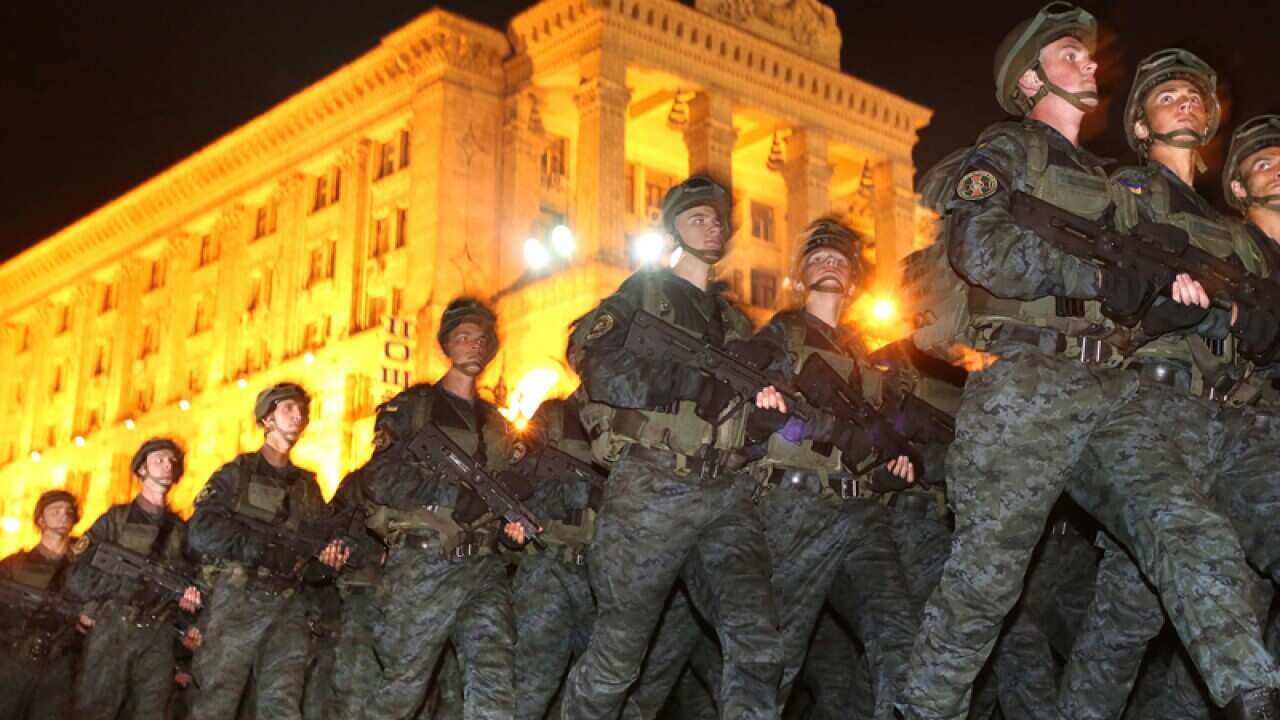
Marching can have the psychological effect of making soldiers more fearless, a study has shown.
Volunteers were less physically intimidated by a threatening "criminal" when they paired up and walked in step, psychologists found.
After marching side-by-side, they rated the owner of an angry face mugshot less formidable in terms of his estimated size and strength.
From a squaddie's perspective, it means there might be a point to all that square-bashing after all.
Well-disciplined soldiers who regularly drill may both operate more efficiently as a cohesive unit and be less likely to flinch in the face of danger, the study suggests.
But there might also be a "dark side" to the military benefits of marching, warn the scientists, led by Dr Daniel Fessler from the University of California at Los Angeles.
They point out that as well as reducing fear, synchronised behaviour - in a variety of situations - is likely to increase aggressiveness to a perceived foe.
Writing in the Royal Society journal Biology Letters, the researchers conclude: "Given the ubiquity of institutionalised synchronisation in contexts as diverse as athletic competitions and police formations, this disturbing possibility merits investigation."
Synchronised behaviour in both humans and animals has previously been shown to encourage co-operation between individuals, especially during conflict.
The new research went further by exploring how alliances born from synchronised behaviour might affect the way people respond to a dangerous adversary.
Participants in the study were asked to walk a distance of 244 metres with a "confederate" before being shown a cropped "mugshot" of an angry male face.
Volunteers were randomly assigned either to "march" in sync with their partners, or to walk at their own pace.
After studying the mugshot, they had to assess the owner's likely height, size and muscularity.
The results were combined to produce a "formidability" rating which turned out to be lower after participants had been marching together.
"Men who walked synchronously with another man envisioned a purported criminal as less physically imposing than did men who engaged in the same task without synchronisation," the researchers wrote.
"Thus, synchrony diminished the perceived relative fighting capacity of the foe."
Although synchronised behaviour increased social bonding, it appeared to have a separate impact on fearlessness, the study found.
The scientists added that, since in conflict situations individuals are more likely to attack a foe viewed as weak, it followed that "the experience of synchrony may also up-regulate the motivation to aggress".
Share


