(Transcript from World News Australia Radio)
The year is 1963.
The Beatles are at the top of the charts in Australia and overseas, and the civil rights movement in the United States is gaining momentum.
In Australia, a federal election on the last day of November sees Sir Robert Menzies' Coalition government returned with an increased majority.
That election also marked a major turning point for Australia's Indigenous people.
News that makes sense
Your trusted source for staying up-to-date with the world around you. Get free daily news updates and analysis, straight to your inbox.
Peggy Giakoumelos reports.
(Click on audio tab above to hear full item)
"I am going into office with one thing clearly on my mind, and that is to make and keep Australia safe."
So said Sir Robert Menzies, Australia's longest serving Prime Minister.
The 1963 election that saw him retain power was also the first time all Indigenous Australians had the right to vote in a federal election.
Prior to that, the right to vote at federal and state levels for Indigenous Australians was a complicated matter that varied from state to state.
The Australian Electoral Commission says from around 1850, Australian colonies made laws about who could vote.
Queensland and Western Australia, for example, were the only states that had laws specifically preventing Indigenous people from voting while South Australia gave all adults, including Indigenous adults, the right to vote.
At the Commonwealth level, voting rights for Indigenous people took a step backward with the introduction of the White Australia Policy in 1901.
Norman Abjorensen, a Visiting Fellow in the Policy and Governance Program at the Australian National University, explains.
"It was a very complex arrangement under the new electoral laws. And if the Indigenous Australians were on the electoral rolls in their state or territory before 1901, it was interpreted that they could vote in Commonwealth elections. And of course that meant all Indigenous people in South Australia, but provisions were fairly ambiguous. Now the business of that first parliament that met after Federation, their number one priority was the Immigration Restriction Bill which we came to know as White Australia. In a very grim irony, the original Australians were caught up in that. The legislation basically excluded all coloured people from the electoral roll. All non-Caucasian people were excluded and of course that extended to Australian Aborigines."
In 1949 the Commonwealth Parliament granted the right to vote in federal elections to Indigenous people who already had the right to vote in their state, or who had completed military service.
But Indigenous people in Queensland, Western Australia and the Northern Territory still could not vote in their own state or territory elections.
The Northern Territory also imposed further restrictions on the rights of Indigenous people.
Norman Abjorensen explains.
"The Northern Territory, long before self-government was administered by the Commonwealth and the Commonwealth moved to declare all Aboriginal people in the Northern Territory wards of the state, a very old paternalistic approach which held that they were not capable of exercising a vote. A lot of people were starting to look at integration issues, segregation in America. There was a big push to try and get rid of this racial divide which had been a very dominant part of the culture. And in 1961 there was a Commonwealth parliamentary committee which was set up to look at Indigenous voting rights and what the committee recommended quite unanimously was voting rights for all Aboriginal Australians who wanted to vote. It wasn't going to be compulsory. If they sought to enrol on the electoral roll they shouldn't be prevented from doing so."
The next major change occurred in 1962, when all Indigenous people won the right to vote in federal elections.
Associate Professor of History at James Cook University Russell McGregor says changes to federal laws occurred as a result of a growing movement of Indigenous and non-Indigenous activists who were actively pushing for change.
"Certainly the voting rights were pushed by both. By this time there was an active political movement, although most of the Aboriginal political groups of the time had membership of both Aboriginal and non-Aboriginal people. So yes there was both Indigenous and non-Indigenous people pushing. The prelude to it was that there was a parliamentary select committee on voting rights, it must've been appointed in 1961 and they're the ones that reported and recommended that Aboriginal people be given a uniform vote."
Despite this amendment, the Australian Electoral Commission says it was still illegal under Commonwealth legislation to encourage Indigenous people to enrol to vote.
Jo Coghlan is a Lecturer in Politics at Southern Cross University in New South Wales.
She says it's impossible to know exactly how many Indigenous people actually voted in the 1963 election.
"Even after the changes to the 1962 Commonwealth Electoral Act when it was amended, one of the problems that the Australian Electoral Commission faced, and one that was created for them, was that it was up to Australian Commonwealth officials to determine who was Indigenous and who was not. And you can image that was quite a fraught process: it was then and it would be today, if the same requirement was to be made. There is no data in who was included and who wasn't."
Even though laws were in place in 1962, compulsory enrolment for Indigenous people did not come into effect until 22 years later, in 1984.
Jo Coghlan explains some of the reasons why this occurred.
"Now, I don't know if that was a decision made in term of the Australian Electoral Commission's role. That is, a recognition for example Indigenous peoples in outback regional Australia, the logistics of enrolling Indigenous peoples on the rolls. So I don't know if it was a bit of 'throw our hands in the air' (give up) and it was a little bit too hard - as in if we don't force compulsory enrolment, then there's not really the requirement for us to establish the infrastructure that's required for us not only to encourage Indigenous peoples to vote, but also provide voting facilities for them to vote. I have to say the AEC has been quite good in the last 20 years or so at rural and outback voting services. But that has only been in the last 10 or 20 years."
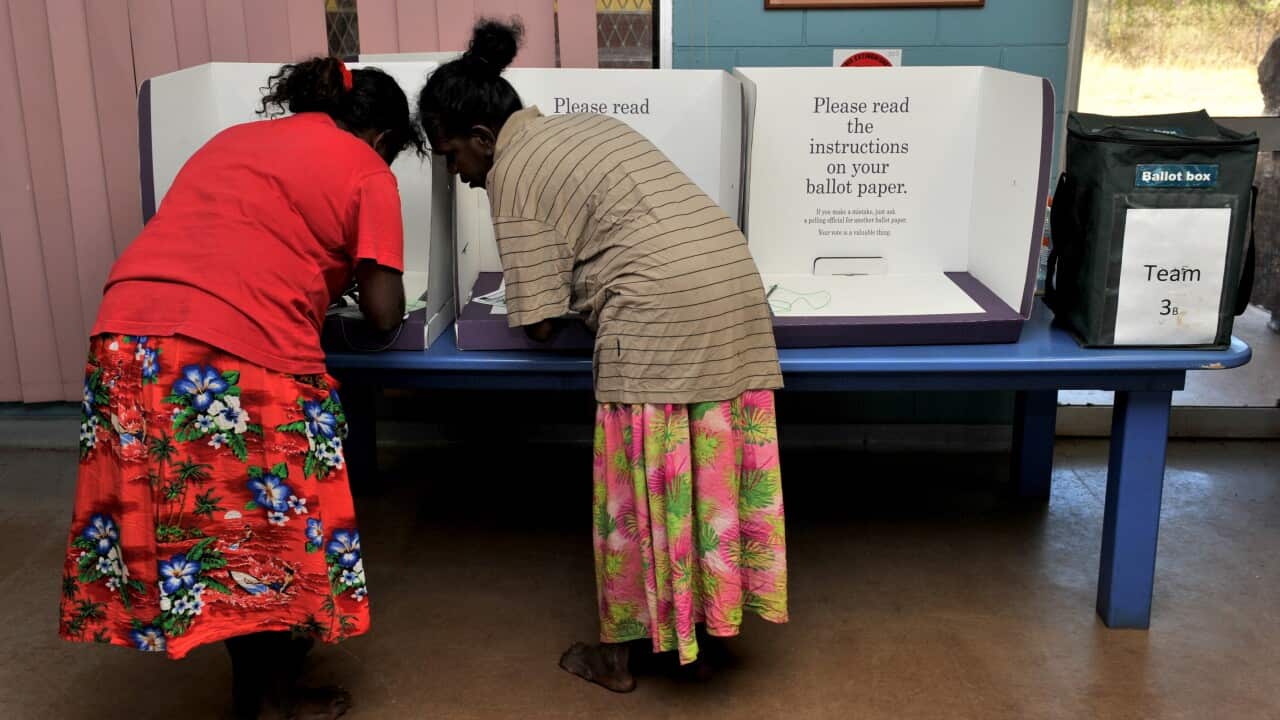
In 2010 the Australian Electoral Commission established the Indigenous Electoral Participation Program to close the gap in Indigenous electoral participation.
In the lead-up to the most recent election, the AEC's Bob Eckhardt said there's a reason the Commission went to great lengths ensure Indigenous Australians had their say.
"They're 50 per cent less likely to be enrolled to vote in federal elections. If they are enrolled to vote, they're 50 per cent less likely to turn out to vote. And if they're enrolled and they do turn out to vote, they're three time more likely to vote incorrectly than non-Indigenous Australians. So that's a pretty significant under-representation and it's particularly sad given that last year was the 50th anniversary of Indigenous Australians winning the right to vote."







