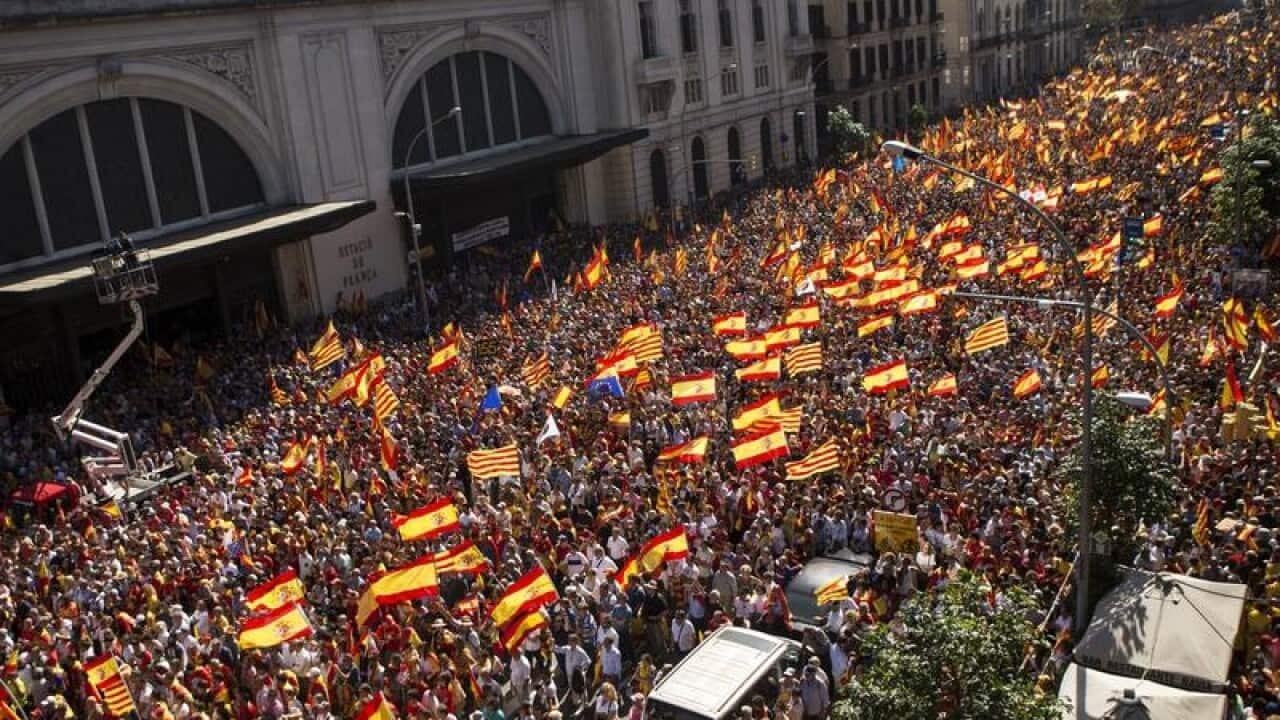
Hundreds of thousands of people have taken to the streets of Catalonia's capital Barcelona to express their opposition to declaring independence from Spain, showing how divided the region is on the issue.
A crowd estimated by local police to number 350,000 waved Spanish and Catalan flags and carried banners saying "Catalonia is Spain" and "Together we are stronger".
They poured into the city centre on Sunday after politicians on both sides hardened their positions in the country's worst political crisis for decades.
Spanish Prime Minister Mariano Rajoy said on Saturday he would not rule out removing Catalonia's government and calling a fresh local election if it claimed independence, as well as suspending the wealthy region's existing autonomous status.
Catalan leader Carles Puigdemont is expected to address the region's parliament on Tuesday, when he could unilaterally declare independence.
Catalonia, which has its own language and culture and is led by a pro-independence regional government, held a referendum on October 1 over secession, in defiance of Spain's constitutional court which had declared the vote illegal.
The Catalan authorities say the referendum showed voters overwhelmingly support independence.
More than 90 per cent of those who voted backed secession, but opinion polls on the issue suggest the region is more closely divided.
Turn-out for the referendum was just 43 per cent, with most residents who wish to remain in Spain staying home.
The anti-independence demonstration, which included Catalans and people from other parts of Spain, underlined how the dispute has riven the region itself. A month ago, a million people rallied in the city to support independence.
"We feel both Catalan and Spanish," Araceli Ponze, 72, said during Sunday's rally.
"We will see what happens this week but we have to speak out very loudly so they know what we want."
Puigdemont said that a law passed by the Catalan parliament preparing the way for the October 1 referendum requires a declaration of independence in the event of a "yes" vote.
"We will apply what the law says," he said, according to advance excerpts of the interview released by TV3 on Sunday.
Puigdemont said he had not been in contact with the Madrid government for some time because Spain refused to discuss independence.
"What is happening in Catalonia is real, whether they like it or not. Millions of people have voted, who want to decide. We have to talk about this," he said.
Rajoy has said repeatedly he will not talk to the Catalan leaders unless they drop their plans to declare independence.
The Spanish government sent thousands of national police to the region to prevent the vote.
About 900 people were injured when officers fired rubber bullets and charged crowds with truncheons in scenes that shocked Spain and the world, and dramatically escalated the dispute.
The political stand-off has pushed banks and companies to move their headquarters outside Catalonia.
Concern is growing in EU capitals about the impact of the crisis on the Spanish economy, the fourth largest in the euro zone, and on possible spillovers to other economies.
Some European officials are also worried that any softening in Spain's stance towards Catalan independence could fuel secessionist feelings among other groups in Europe such as Belgium's Flemings and Italy's Lombards.
Sunday's demonstration in Barcelona was organised by the anti-independence group Catalan Civil Society to mobilise what it believes is a "silent majority" that opposes independence.
"The people who have come to demonstrate don't feel Catalan so much as Spanish," said 40-year-old engineer Raul Briones.
"We like how things have been up until now and want to go on like this."
The rally was addressed by Nobel prize-winning novelist Mario Vargas Llosa, who has dual Spanish and Peruvian nationality.
He told reporters it showed many Catalans "don't want the coup d'etat the Catalan government is fostering".
Share


