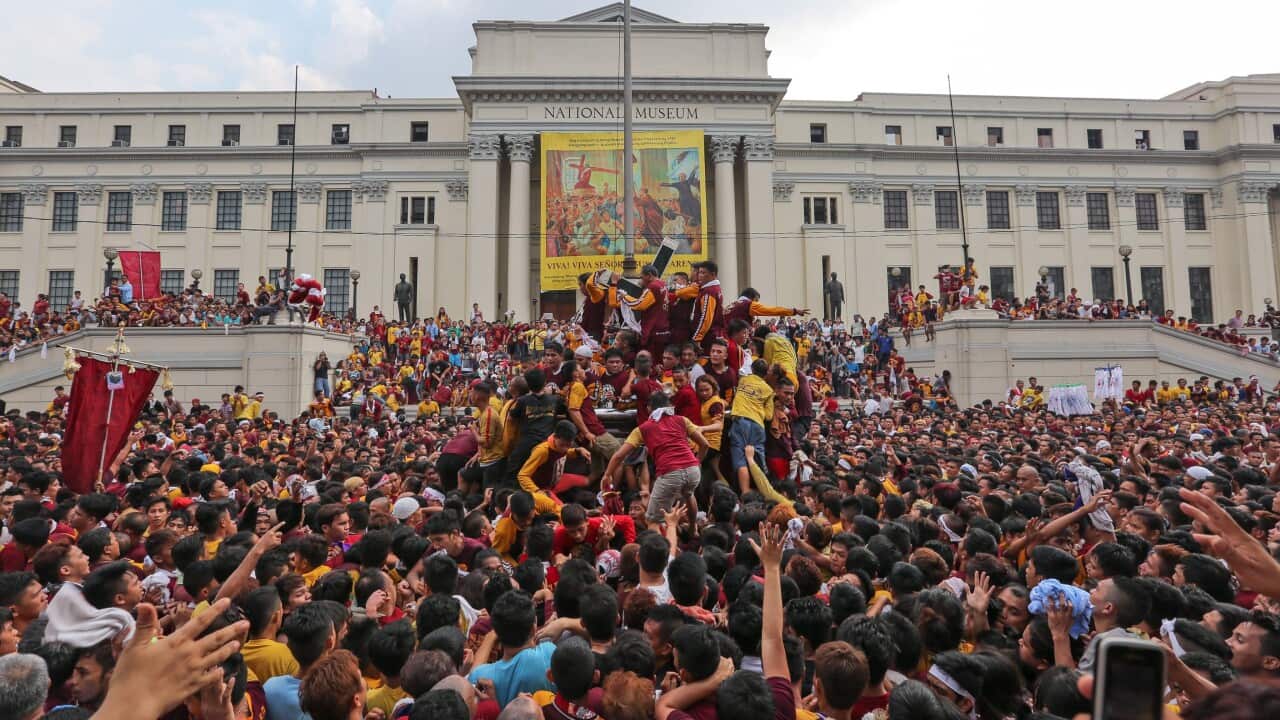
More than a million devotees have flocked to the streets of Old Manila for the procession of the Black Nazarene of Quiapo in the hopes of witnessing a miracle and having prayers answered by the life-sized 17th century statue of Jesus Christ.
A huge crowd converged at the gates of the Quiapo Church and nearby streets at 6am local time on Saturday to partake in the annual parade of the 200-year-old idol, which is believed to hold divine powers.
An hour later the crowd had grown to 1.2 million and by 10am the numbers surged to 1.5 million, according to Kim Molitas, the spokesman for the Manila police department.
Officials estimate this year's attendance has become one of the most celebrated full-day religious events in the Philippines. Many in the predominantly Catholic country believe attending the procession, which can last up to 22 hours, will bring an answer to their prayers.
"If there are problems we just pray to the Nazarene. Then, like magic, there will be a solution," parishioner Girlie Gonzaga, 42, told the local Philippine Daily Inquirer news.
Throngs of men, women and children - mostly barefoot, wearing maroon T-shirts - threw handkerchiefs, hand towels or pieces of clothing at the statue to have them blessed.
Devotees even risk being crushed by the masses of avid worshippers for the chance to touch either the statue or one of the two ropes hoisting the carriage it rests in.
One 27-year-old believer reportedly died on Saturday at 11.30am, when he suffered a seizure and collapsed after pulling one of the carriage ropes, according to local news.
"Despite performing CPR, he did not survive," the Philippine Red Cross secretary-general Gwendolyn Pang reportedly told local GMT news station.
The wooden statue, which is crowned with thorns and bears a cross, is believed to have been brought from Mexico to Manila in 1606 by Spanish missionaries.
The ship that carried it caught fire, but the charred statue survived and was named the Black Nazarene.
Devotees say the fact that the statue has withstood countless wars and natural disasters - including major earthquakes in 1645 and 1863, two fires in Quiapo Church in 1791 and 1863, as well as the bombing of Manila during World War II - is proof of its miraculous powers.
"I became a believer of the Black Nazarene when he healed my child 20 years ago. Since then, I have been faithful and will continue participating in the procession as long as my body allows me," said devotee Michael Santos Martin, 43.
Share


