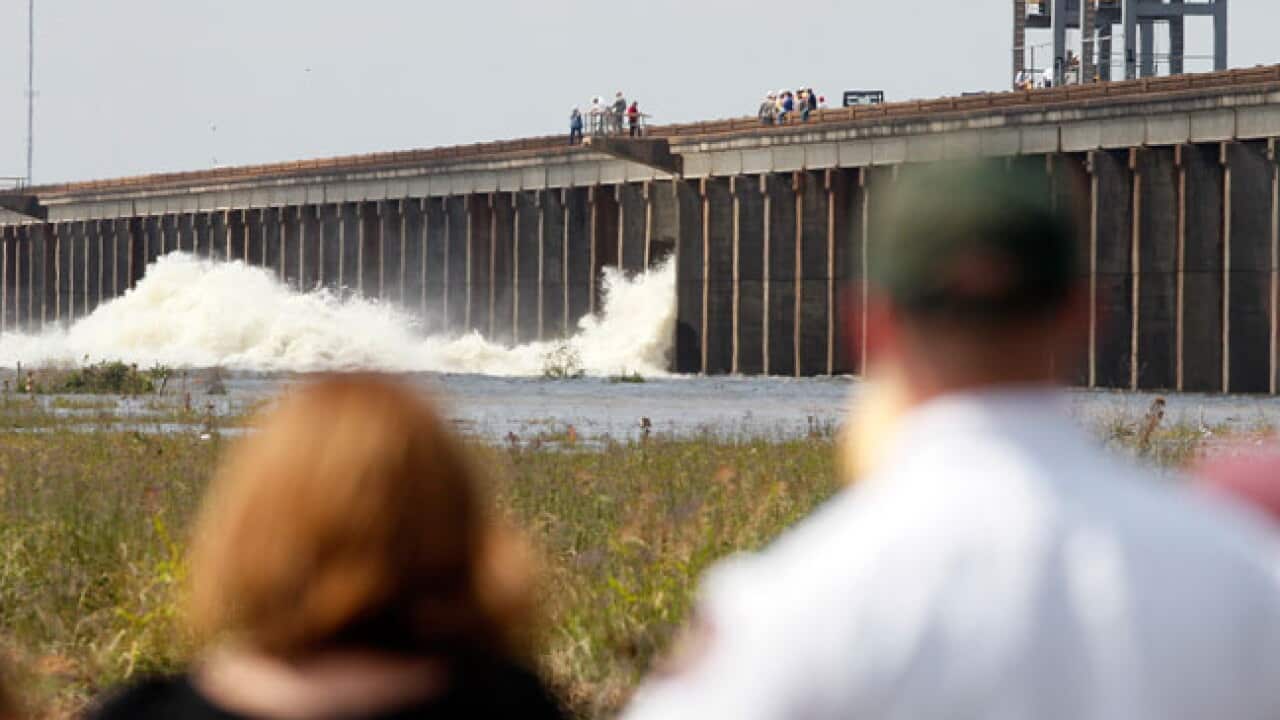
The US Army Corps of Engineers opened a single bay at the key Morganza Spillway, allowing a relatively small amount of the river through, to avoid unleashing what Louisiana Governor Bobby Jindal described as a "wall of water" slamming thousands of homes and farmland in the state's rural south.
It marked the first time the spillway has been opened since 1973, and only the second time since its completion in 1954.
News that makes sense
Your trusted source for staying up-to-date with the world around you. Get free daily news updates and analysis, straight to your inbox.
"This is certainly going to be a marathon and not a sprint," Major General Michael Walsh told a press conference, noting the "tremendous pressure on the entire system."
Opening the Morganza Spillway completely would divert some 600,000 cubic feet of water every second -- about six times the daytime volume of Niagara Falls.
But in order to prevent a massive wave from being unleashed, the one bay opened Saturday was allowing out 10,000 cubic feet per second. One or two more bays were set to be opened Sunday.
The Bonnet Carre spillway between the major urban areas of Baton Rouge and New Orleans will be at full capacity Saturday, officials added, diverting 250,000 cubic feet per second into Lake Pontchartrain.
Rural communities sacrificed
Jindal said officials expected around three million acres (1.2 million hectares) to be flooded by the diversion into the Gulf of Mexico to keep the rising Mississippi waters from swamping Baton Rouge and New Orleans.
Some 25,000 residents were set to be affected by the controlled flood, officials said.
The 20-foot (six-meter) levees protecting New Orleans are now holding back the river at 17 feet, considered a flood stage. If the Morganza Spillway did not open, river levels were predicted to reach 19.5 feet.
New Orleans Mayor Mitch Landrieu said he was aware of the sacrifices residents of rural communities were making to save more populous communities.
"We believe the city of New Orleans is going to be safe," he said, but added: "This is a very tragic situation, really, for everybody in America and, of course, the people that live along the Atchafalaya basin, as well in Morgan City. So our hearts go out to them.
"It doesn't make us feel any good that (by) protecting New Orleans, other folks are going to get hurt."
Cindy Prejean of Gibson, Louisiana, some 70 miles (112 kilometers) southwest of New Orleans, said she was expecting five feet (1.5 meters) of water at her house.
"What gives them the right to flood us? I understand it, but there are so many communities, and so many farmers and so many businesses," she told AFP.
"Everybody pray for us," she asked.
The Army Corps said its top priority was to protect people first, and property second.
According to flood projections, a flood as high as 15 feet (4.5 meters) was to bear down on some communities at its height after the spillway is opened.
The American Red Cross is already readying shelters for thousands of expected evacuees.
So far, the major New Orleans port is continuing normal operations, while oil and gas companies have about 2,200 wells in the region at risk of flooding.
The trigger for the opening, Jindal said, would be when 1.5 million cubic feet (42,00 cubic meters) of water per second was flowing down the Mississippi at Red River Landing -- a point nearly reached by Friday with the level at 1.423 million cubic feet.
Historic flood
The rising river, swollen by heavy rains last month and the melting of a thick winter snow pack, is set to eclipse the high water records set in the epochal floods of 1927.
Near its height, the Mississippi town of Vicksburg is expecting a forecast 57.5-foot (17.5-meter) crest on May 19, topping the 56.2-foot historic crest set 84 years ago this month, National Weather Service data said.
The Mississippi is the third-longest river in North America and its watershed is the fourth-largest in the world, according to the US National Park Service.
The worst floods to hit the central United States in more than 70 years have already swallowed up thousands of homes, farms and roads in Illinois, Missouri, Kentucky, Tennessee, Arkansas and Mississippi, and the mighty river is expected to remain above flood stage along hundreds of miles (kilometers) for many more days.
The American Red Cross said back-to-back disasters over the past two months has prompted it to launch 23 separate relief operations backed by over 7,700 relief workers in 18 US states.







