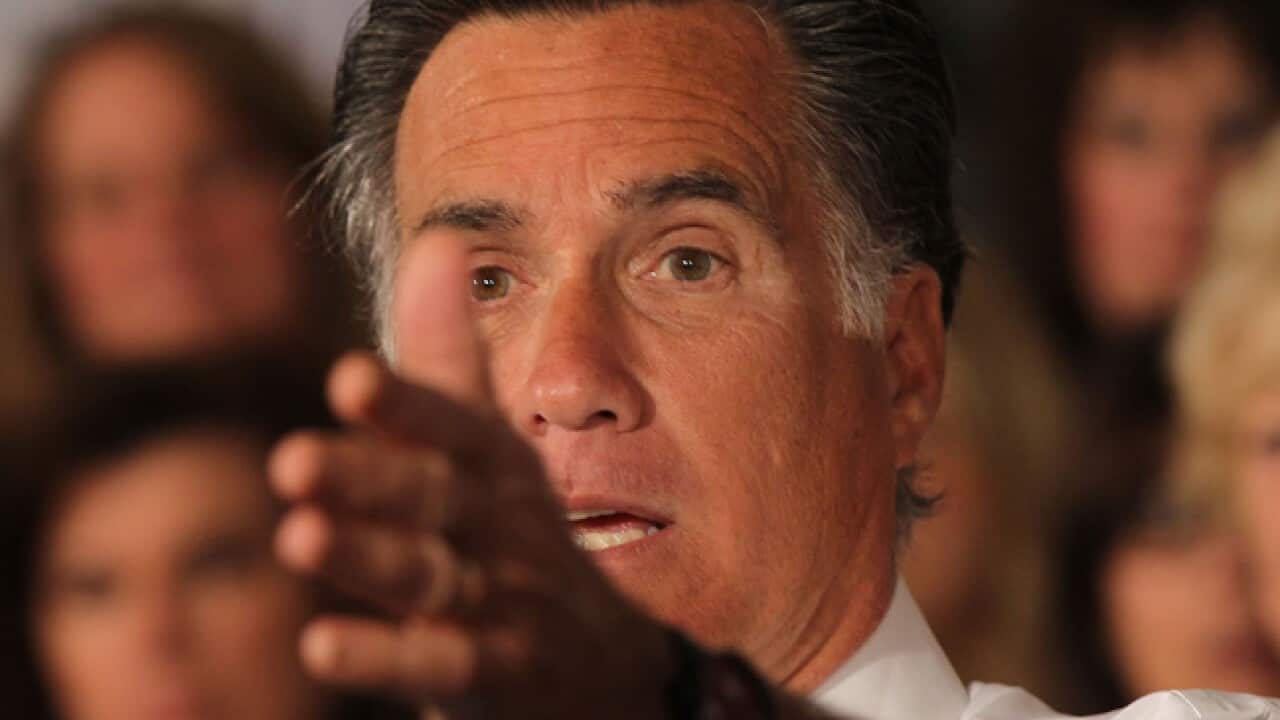
Republican White House hopeful
Romney's address to the National Association for the Advancement of Colored People (NAACP), America's largest civil rights group, was billed as a brave appeal to a voting demographic that overwhelmingly favors his opponent.
It was certainly a tough crowd and some cackled when the presumptive Republican nominee declared: "If you want a president who will make things better in the African-American community, you are looking at him."
News that makes sense
Your trusted source for staying up-to-date with the world around you. Get free daily news updates and analysis, straight to your inbox.
Polite applause for his jobs pitch was accompanied by some raised eyebrows when he said the nation's first black president had left the economy "worse for African-Americans in almost every way."
But he ran into what was perhaps the most negative reaction to anything he has said on his year-long White House campaign when his pledge to repeal Obama's landmark health care reforms was met with loud and sustained boos.
"I think we expected that of course, but you know I'm going to give the same message to the NAACP that I give across the country," Romney told Fox News hours later.
"Obamacare is killing jobs and if jobs is the priority then we're going to have to replace Obamacare with something that actually holds down health care costs, as opposed to causing more spending for the government and more spending for American families."
Blacks voted overwhelmingly for Obama over Republican John McCain in 2008, but with US unemployment above eight percent for 41 straight months and a recent spike up to 14.4 percent jobless among blacks, Romney hopes to win over disaffected voters.
The dissent vocalized at the annual convention of the NAACP exposed the uphill battle Romney faces in coming months to convince minority voters he is the best man for the White House.
In his speech, Romney spoke about the need to tamp down excessive government spending. "To do this," he said, "I will eliminate expensive non-essential programs like Obamacare."
Before Romney could finish his sentence, the boos rained down loudly, lasting more than 20 seconds.
Romney recovered, and his supporters took to Twitter to praise the candidate's determination to lay out his political platform before a deeply pro-Obama crowd.
The former Massachusetts governor argued that Obama's presidency, while historic, has not lifted enough Americans from poverty, and is leaving many black families behind.
"If equal opportunity in America were an accomplished fact, then a chronically bad economy would be equally bad for everyone," Romney said.
"Instead, it's worse for African-Americans in almost every way. The unemployment rate, the duration of unemployment, average income, and median family wealth are all worse for the black community."
Romney said he was confident his policies "will help hundreds of millions of middle-class Americans of all races, will lift people from poverty, and will help prevent people from becoming poor.
"My campaign is about helping the people who need help. The course the president has set has not done that -- and will not do that. My course will."
He also argued that the Obama camp was telling Americans that Romney was "running for office to help the rich.
"Nonsense. The rich will do just fine whether I am elected or not," he said. "I want to make this a campaign about helping the middle class."
Blacks are widely expected to back Obama, the first African-American president, in November, but the crucial question in a neck-and-neck race is whether Romney can lure enough black voters to make a difference in swing states like Florida and North Carolina.
McCain won a dismal five percent of the black vote, and Romney is aiming to bring the figure closer to the 11 percent that George W. Bush won in 2004.
His address to the NAACP can be seen as an effort to make Romney, a multimillionaire former businessman and investor with a reputation of not connecting with everyday voters, appear more attractive to a diverse electorate.
He has a daunting task. Republican-led efforts in several states to require voters to present government-issued ID at polling booths is seen as having a disproportionate effect on minorities and the poor, who vote more Democratic.
And he wants Bush-era tax cuts extended for all Americans including the rich, a position that might not sit well with working class voters.







