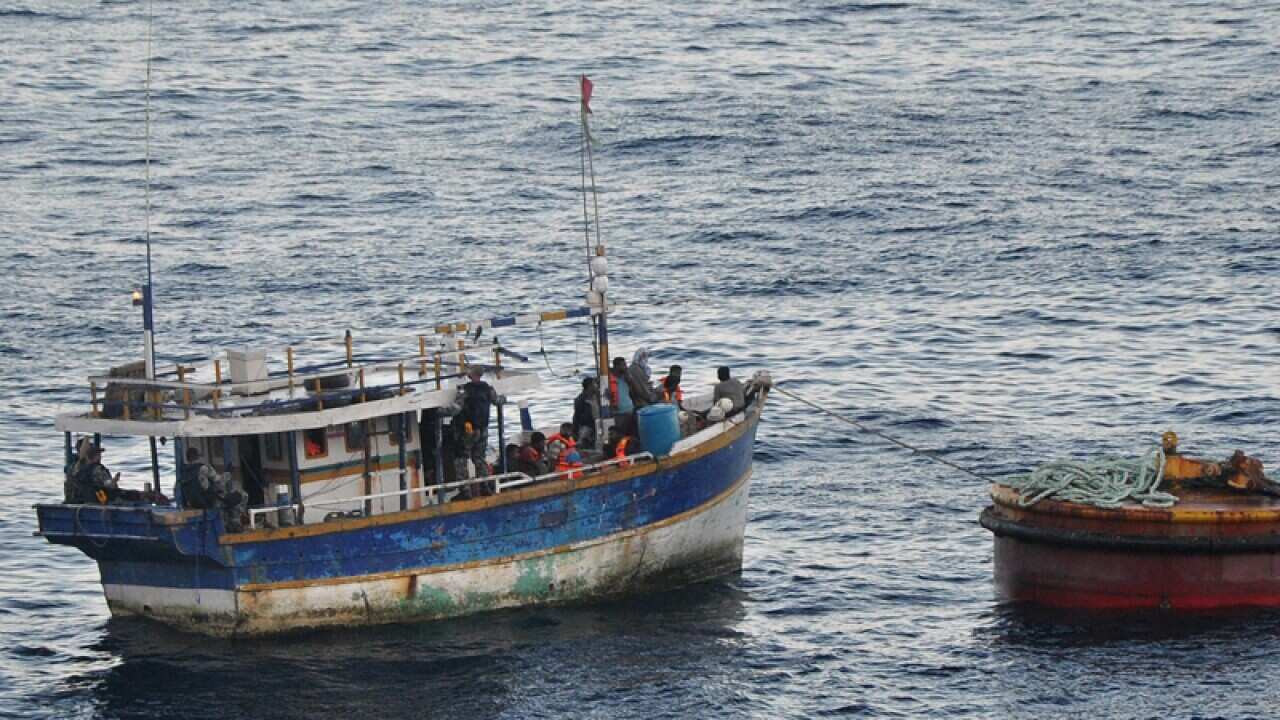
The treasury and finance departments are not banking on the Rudd government's hardline plan to resettle asylum seekers in the Pacific working any time soon.
The Pre-election Economic and Fiscal Outlook (PEFO) compiled by the departments showed more people are now expected to arrive by boat than was predicted in the May budget.
The PEFO document, released on Tuesday, says 15,600 people are now expected to arrive in 2013/14 - up from the May budget estimate of 13,200.
The estimates for the next three financial years are also higher, despite Prime Minister Kevin Rudd's hardline declaration in July that people arriving by boat will never again be settled in Australia.
The departments said forecasting arrival rates was inherently difficult and imprecise.
News that makes sense
Your trusted source for staying up-to-date with the world around you. Get free daily news updates and analysis, straight to your inbox.
They decided it would be "prudent" to retain their assumption that 1100 boat people would arrive per month in 2013/14.
"It reflects an on-balance judgment that incorporates recent arrival rates on the one hand and the likely impact, over time, of recent policy announcements on arrival numbers on the other hand," the PEFO statement said.
But the departments insisted that recent policy announcements, such as the plan to resettle asylum seekers in Papua New Guinea and Nauru, were expected to provide a "material deterrent on future arrivals over time".
Treasurer Chris Bowen backed the decision not to reduce the boat arrivals forecasts, saying the government did the same with its economic statement released earlier this month.
"We are confident in the arrangements we've put in place," he told reporters in Sydney.
"The prudent thing to do is to keep these forecasts as they were in budget time."
The statement also outlined two scenarios of how the budget might be impacted by the number of people arriving by boat.
The first scenario assumed a drop in arrivals to the long-term average of 370 per month for 2013/14 - sooner than would occur under the PEFO approach.
The second scenario assumed an increase in arrivals to the recent average of 3000 people per month, with a transition to the long-term average by 2015/16.
The first scenario would provide the government with over $1 billion of savings over four years while the second case would strip more than $3.5 billion from its bottom line.
Almost 5000 asylum seekers have arrived by boat so far this financial year.
Opposition immigration spokesman Scott Morrison said the PEFO figures suggest there could be a further $3.5 billion blowout in managing boat arrivals over the next four years.
"That is the cost of Labor's failure," he told reporters in Sydney.
"The warning in this document is you need a government on the other side of this election that can do what is required on border protection."