in brief
- Dolphin made landfall near Yuhuan in Zhejiang province on Sunday evening, packing winds of up to 151km/h.
- More than one million people were evacuated as authorities prepared for flooding, landslides and storm damage.
Typhoon Dolphin brought heavy rain to eastern China on Monday, causing hundreds of flight cancellations even as the storm weakened and some cities resumed public transport.
The typhoon had already swept across Japan’s southern Okinawa prefecture, injuring six people and cutting power to more than 50,000 buildings.
It then made landfall near Yuhuan in eastern Zhejiang province on Sunday evening, China's meteorological authorities said.
The storm packed maximum sustained winds of 151km/h near its centre at landfall, equivalent to a Category 1 hurricane on the Saffir-Simpson scale.
Authorities had moved offshore workers to safety, ordered vessels back to port and increased checks at reservoirs, mountain streams, landslide-prone areas, construction sites and tourist locations.
News that makes sense
Your trusted source for staying up-to-date with the world around you. Get free daily news updates and analysis, straight to your inbox.
The weather system lost power after making landfall, with China's National Meteorological Centre (NMC) issuing its least severe typhoon alert on Monday morning.
However, the NMC warned that parts of east and central China would continue to receive heavy rain for the next day.
The typhoon had triggered a top-level alert over the weekend, prompting over 1,000 flight cancellations and tens of thousands of evacuations.
One million people evacuated, others left stranded
Transport was widely disrupted across the east of the country, and more than one million people were evacuated from their homes.
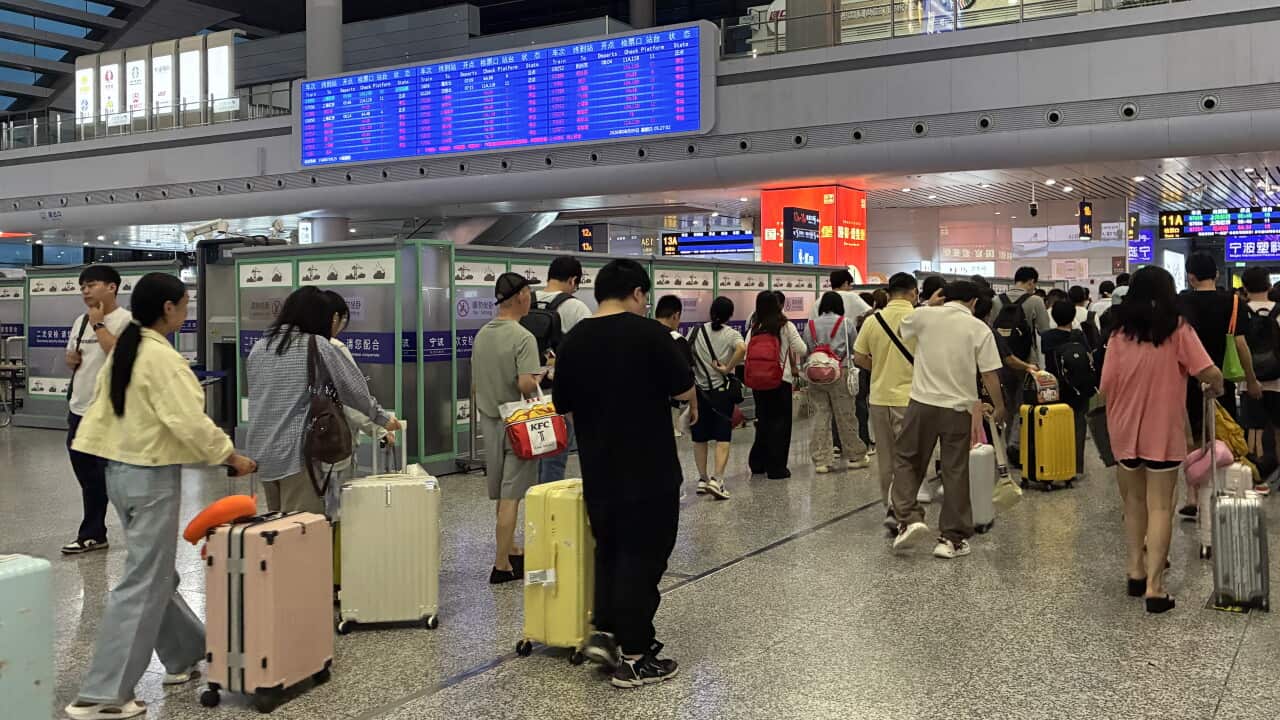
Nine hundred and forty-three flights from Shanghai's two main passenger airports were cancelled, the airport authority said in an online post.
A 42-year-old tourist from Guangdong said he was stranded in Shanghai after his family's flight, scheduled to depart on Sunday, was cancelled due to Typhoon Dolphin.
He said the family had been rebooked on a flight at 10pm on Monday, although they were unsure whether it would be able to take off.
"To us Guangdong people, this typhoon is as ordinary as having a meal and feeling the wind. It's just part of everyday life," he said, adding that the storm did not appear particularly strong by the standards of China's southern coast.
In neighbouring Zhejiang province, the city of Wenzhou relocated more than 900,000 residents and opened more than 1,000 emergency shelters.
In Fujian province, authorities evacuated 98,900 people from high-risk areas after raising the typhoon emergency response to Level 3, according to Xinhua. Zhejiang, Shanghai and Jiangsu have also activated Level 3 emergency responses.
Fujian maritime authorities said 55 coastal passenger ferry routes had been suspended, all 115 offshore construction projects had been halted, and 290 construction vessels had been moved to sheltered waters.
The water resources ministry said the Qiantang, Yong, Jiao and Shuiyang rivers could experience major flooding, while smaller rivers in the hardest-hit areas could rise above warning levels.
Authorities warned of a high risk of geological disasters in parts of Zhejiang, while residents in areas covered by a red mountain-torrent warning were told to follow local evacuation orders.
Shanghai's Yangshan port cleared ships from its berths and moved more than 500 small and medium-sized vessels to shelter ahead of Dolphin, the city's maritime safety administration said.
Scientists say global warming has made extreme weather more likely, including stronger typhoons.
For the latest from SBS News, download our app and subscribe to our newsletter.







