
This audio is voiced by AI and may occasionally mispronounce words.
Share your feedback and help us improve this feature. Read more about how we use AI at SBS here.
Damian Hole's last mortgage repayment is due when he's 80.
The 52-year-old bought his first home about a decade ago and refinanced it in 2024, locking in a new 30-year loan term just before he turned 50.
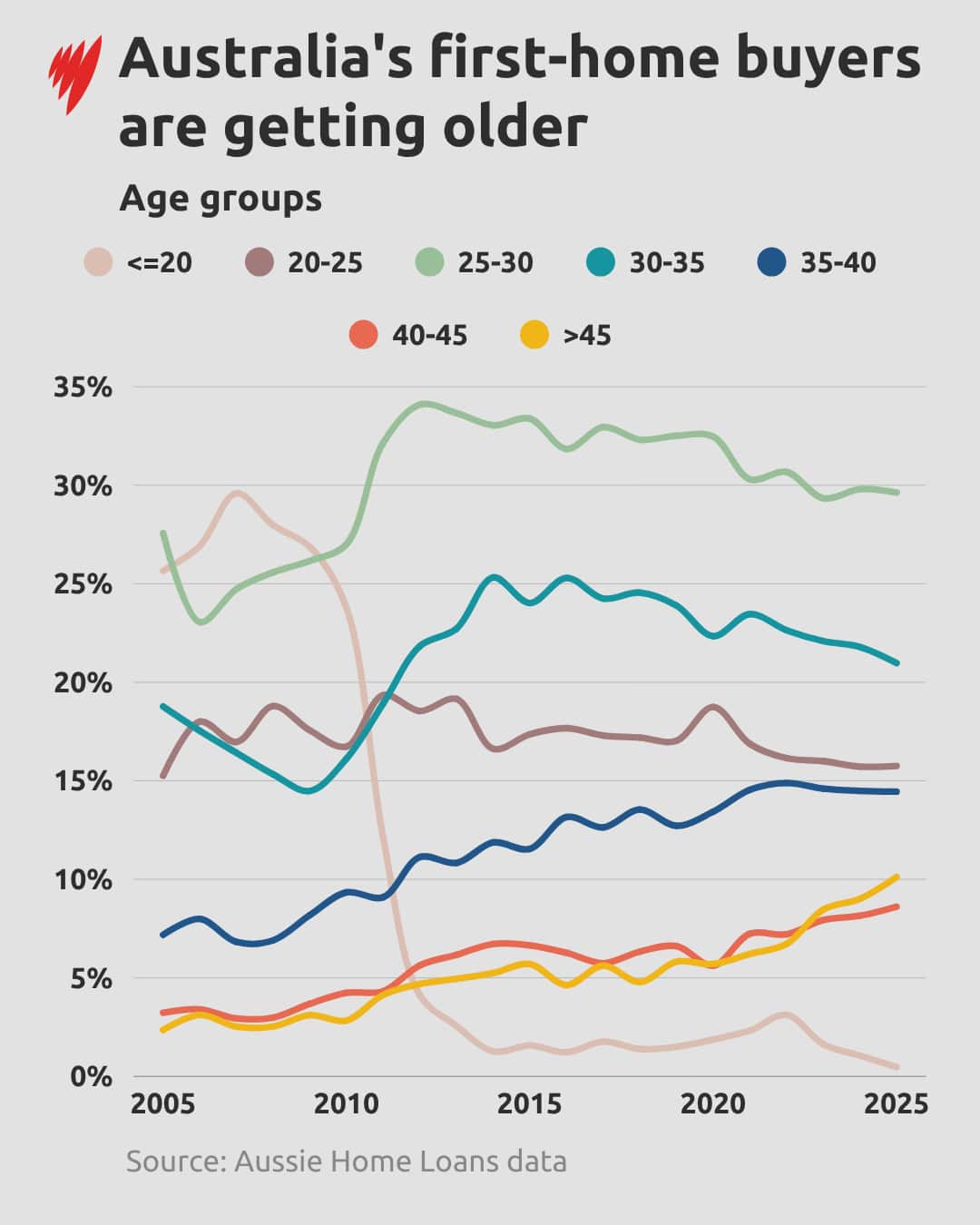
He's among a growing cohort of Australians buying their first home later in life. People over the age of 40 accounted for nearly one in five first-home buyers last year (18.7 per cent), according to data from one of Australia's largest mortgage brokers, Aussie Home Loans.
That's up from just over 5.5 per cent in 2005.
At the other end, people under the age of 20 made up around a quarter of first-home buyers in 2005, compared with less than 0.5 per cent in 2025.
News that makes sense
Your trusted source for staying up-to-date with the world around you. Get free daily news updates and analysis, straight to your inbox.
As housing affordability pressures make it harder for young Australians to enter the market, solutions designed to ease the path to home ownership have increasingly focused on expanding access to credit — allowing buyers to borrow more, with smaller deposits or longer mortgage terms.
Low-deposit loans can be accessed through the federal government's 5 per cent deposit scheme, while family guarantor loans allow first-time buyers to borrow up to 100 per cent of the purchase price.
Meanwhile, more lenders are offering 40-year mortgage terms, meaning some borrowers could be signing up to make repayments well into their later years.
If a growing number of Australians are buying homes later while taking on larger loans for longer, what happens when they reach retirement still saddled with mortgage debt?
'A cat and mouse game'
Making it easier for people to borrow can fuel higher house prices.
According to James Graham, a housing economics expert at the University of Sydney, without massively expanding housing supply, broadening access to credit alone is not a sustainable solution.
"It's just sort of a cat-and-mouse game," Graham tells SBS News.
"The prices go up, so we change mortgage credit. That pushes prices up further.
People are just borrowing more to buy more expensive houses, and they're not really any better off.
When the government introduced its 5 per cent deposit scheme last year, designed to help first-home buyers, the Reserve Bank of Australia (RBA) predicted the measure would likely "put at least some further upward pressure" on housing price growth.
By March, the value of new loans taken out by first-home buyers was around 11 per cent higher than before the scheme was expanded in October, with the increase largely reflecting bigger average loan sizes, according to the RBA.
The costs of delayed home ownership
Graham says buying a first home later in life could have consequences beyond carrying mortgage debt into retirement. Entering the market at 40 or 50 leaves less time to build housing wealth and can reduce people's ability to move as their lives change.
"People are likely to be locked in for longer," he explains, warning that some buyers may end up remaining in homes that were intended as a first step into the market rather than a last stop.
"Less moving has its own social consequences," he adds.
"It means that people can't move back to communities that they wanted to be part of; they're further away from their children than they wanted to be; they're not near jobs that they want to be near.
"Maybe they've moved far out of the city because that's the only place they could buy. But now they're away from amenities and doctors."
Delayed home ownership and larger mortgages could also have implications for the aged care sector. Traditionally, many older Australians have relied on accessing housing equity (the portion of a property that is owned outright) to help fund retirement living or aged care, often through selling the family home. Unsettled mortgage debt could affect this transition, reducing the overall equity available.
Another concern is long-term mortgage stress, which can reduce the wellbeing of older Australians and may lead retirees to draw down their superannuation to pay off housing debt, according to 2019 research from the Australian Housing and Urban Research Institute (AHURI).
This, in turn, could place additional pressure on the pension system.
Currently, the Age Pension excludes the primary home from its assets test.
Paying down mortgage debt on a primary home with super can, therefore, reduce a person's assessable assets and potentially make them eligible for the pension.
"We have an ageing population in Australia, so the fiscal pressure on government will increase with that if government is supporting people through the pension system," AHURI managing director Tom Alves tells SBS News.
"The compulsory superannuation system is designed to address that issue, and if people are not having enough income through their super because they've used it to pay off their mortgage, obviously that's an issue."
AHURI's research notes that mortgage debt was uncommon among people aged 55-64 as early as the 1990s. Between 1996 and 2013, however, the proportion of Australians in that age bracket still paying off a mortgage rose from under 20 per cent to 45 per cent.
Home ownership has long underpinned Australia's retirement system, with policies, including the Age Pension, built on the assumption that most retirees own their home.
Widely used superannuation savings targets typically assume that people will own their homes outright by the time they reach retirement. While some modelling also considers renters, retirees still paying off a mortgage are largely left out of the picture.
"They do assume that people own their home," Susan Thorp, a retirement finance specialist at Monash University, tells SBS News.
"They're not allowing for the idea that someone may have, say, $150,000 of mortgage debt at the time they're retiring."
Yet a growing share of Australians may not fit those assumptions. In a January survey of 1,020 people by Loan Market Group, 58 per cent said they planned to own their home before retirement.
The rise of the 40-year mortgage
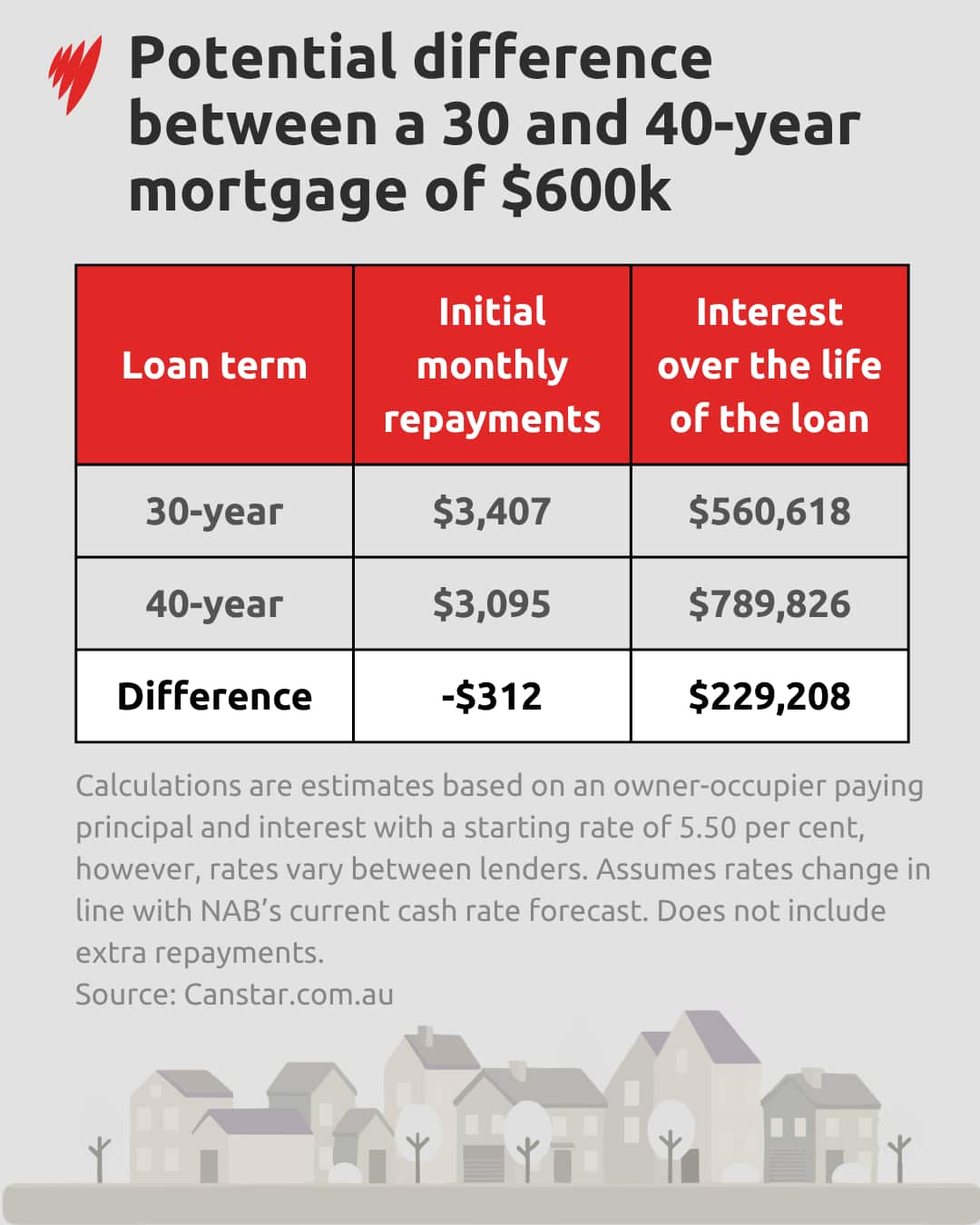
A small but growing number of Australian lenders have started offering 40-year mortgage terms, which can give borrowers access to loans they might not otherwise have been able to afford — but can add staggering extra interest costs over the life of the loan.
Richard Brown, a Mortgage Choice broker in the Sydney suburb of Epping, says many of his clients are eager to find ways to maximise their borrowing power, which is increasing their appetite for longer loan terms despite the downsides.
"There's an appetite for borrowers to get access to the money they need to buy the property they want," he says.
"They don't care what it is."
Sebastian Watkins, CEO and co-founder of mortgage broking giant Lendi Group, says relying on borrowing innovations like longer loan terms risks overlooking the underlying issue of unaffordable housing prices.
"We can't simply respond to people taking longer to save by giving them longer to pay off their loan," he tells SBS News.
If current trends continue, in a decade or two, Watkins expects the average Australian mortgage to be "larger, held later in life and managed much more dynamically".
We are likely to see longer loan terms, more family-supported or multi-generational borrowing and products that adapt as a customer's income, family circumstances and property needs change.
Japan offers an extreme historical example of intergenerational borrowing. Amid soaring housing costs in the 1980s, it experimented with 100-year mortgages designed to be repaid across multiple generations. Researchers who later modelled the loans concluded they did little to improve housing affordability.
What happens when debt stretches beyond careers?
Lenders assessing older applicants will typically look for a credible exit strategy demonstrating the loan can be comfortably managed in retirement, Watkins says.
"They may look at the expected loan balance at retirement age and consider the borrower's projected superannuation and other assets. Another potential strategy could be downsizing, where the borrower could sell the property and purchase a lower-value home," he says.
Hole, who bought his first home at 42, says his bank requested his superannuation balance before approving his mortgage.
"It was almost done, and then they requested my super balance, and then I realised, because my age will go beyond retirement, they're just seeing if I've got enough super to pay off the loan."
He says he should be able to comfortably repay the remainder of his mortgage with a lump sum from his super when he reaches retirement age, at which point he intends to access the Age Pension.

The retirement debt challenge
Alves says there is no single policy fix, but governments need to consider both retirement and housing policy together.
Potential approaches include adjusting Age Pension settings to better reflect the differences between homeowners and non-homeowners, as well as expanding affordable housing options for older Australians, he says.
More broadly, he says improving access to home ownership earlier in life and increasing the supply of affordable rental housing could help reduce the number of Australians entering retirement with housing stress.
Thorp says there are fundamental questions that remain unanswered about what happens when more Australians enter retirement with housing debt.
"The question of how housing policy merges with superannuation and retirement policy is not fully worked out," she says.
For the latest from SBS News, download our app and subscribe to our newsletter.







