
This audio is voiced by AI and may occasionally mispronounce words.
Share your feedback and help us improve this feature. Read more about how we use AI at SBS here.
Every time the Reserve Bank of Australia (RBA) meets to discuss the cash rate, millions of Australians hold their breath, knowing the outcome could affect their mortgage repayments, savings and household budgets.
Some economists say there's another way to cool spending — one that builds your retirement savings instead of handing more money to the bank through higher interest rates.
But it's one almost nobody talks about.
The RBA left rates on hold when it handed down its cash rate decision on Tuesday. Financial markets and most economists expected it to leave the cash rate unchanged as inflation continues to ease, although the board has indicated it remains focused on returning inflation to its 2 to 3 per cent target.
Cooling inflation means squeezing demand somewhere. While governments can also influence demand through fiscal policy, such as changing taxes or government spending, it's now largely the RBA's job to adjust the cash rate to make borrowing more expensive. Higher interest rates can also strengthen the Australian dollar, making imports cheaper and reducing the demand for exports.
News that makes sense
Your trusted source for staying up-to-date with the world around you. Get free daily news updates and analysis, straight to your inbox.
But this design hits homeowners in Australia harder than it does in many other countries, economist Chris Richardson says.
"Because we haven't built enough homes, Australia has really high housing prices and a lot of debt around that. And our interest rates are tied to short-term interest rates. So when we fight inflation, it tends to fall more on the shoulders of mortgage holders than you see in most other nations," he tells SBS News.
Richardson believes there's another lever that could be used instead of or alongside the cash rate: superannuation. Lift compulsory super contributions temporarily, and households would have less money to spend, helping cool demand, he says.
The difference is where the money goes — not interest to a bank, but savings for your own retirement.
Supporters say it could spread the burden of fighting inflation beyond borrowers. Critics argue it would simply shift the costs elsewhere. Here's how the idea stacks up.
Could super help fight inflation?
The super guarantee (SG) is the compulsory minimum share of wages employers pay into eligible workers' superannuation. It's climbed steadily for over a decade — from 9 per cent in 2014 to its legislated final rate of 12 per cent on 1 July 2025 — with the aim of giving Australians a more comfortable retirement.
Right now, that 12 per cent is fixed. But under this theory, it wouldn't have to be — the super guarantee could become a temporary economic lever instead, raised when inflation runs hot and lowered when spending weakens, or unemployment climbs.
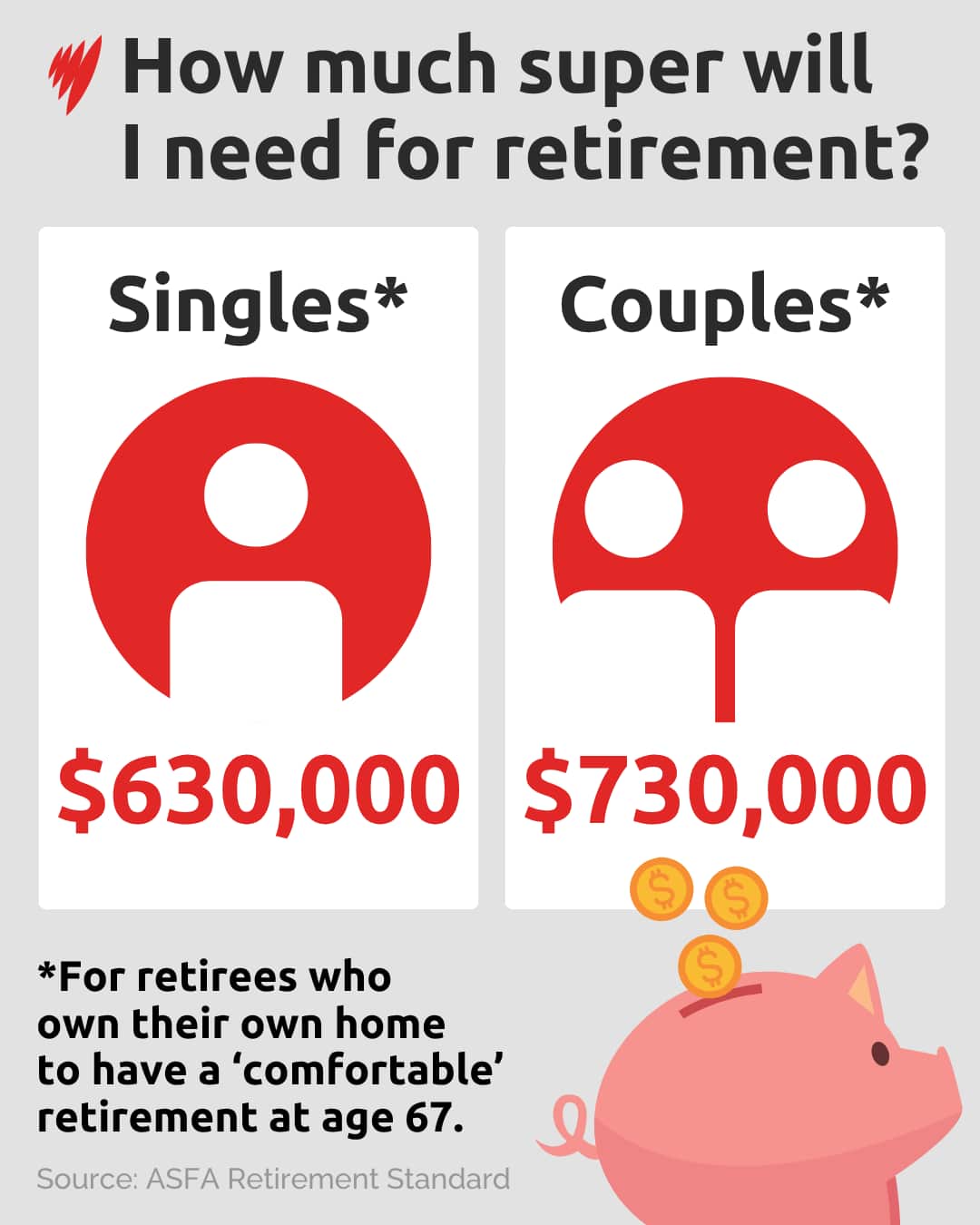
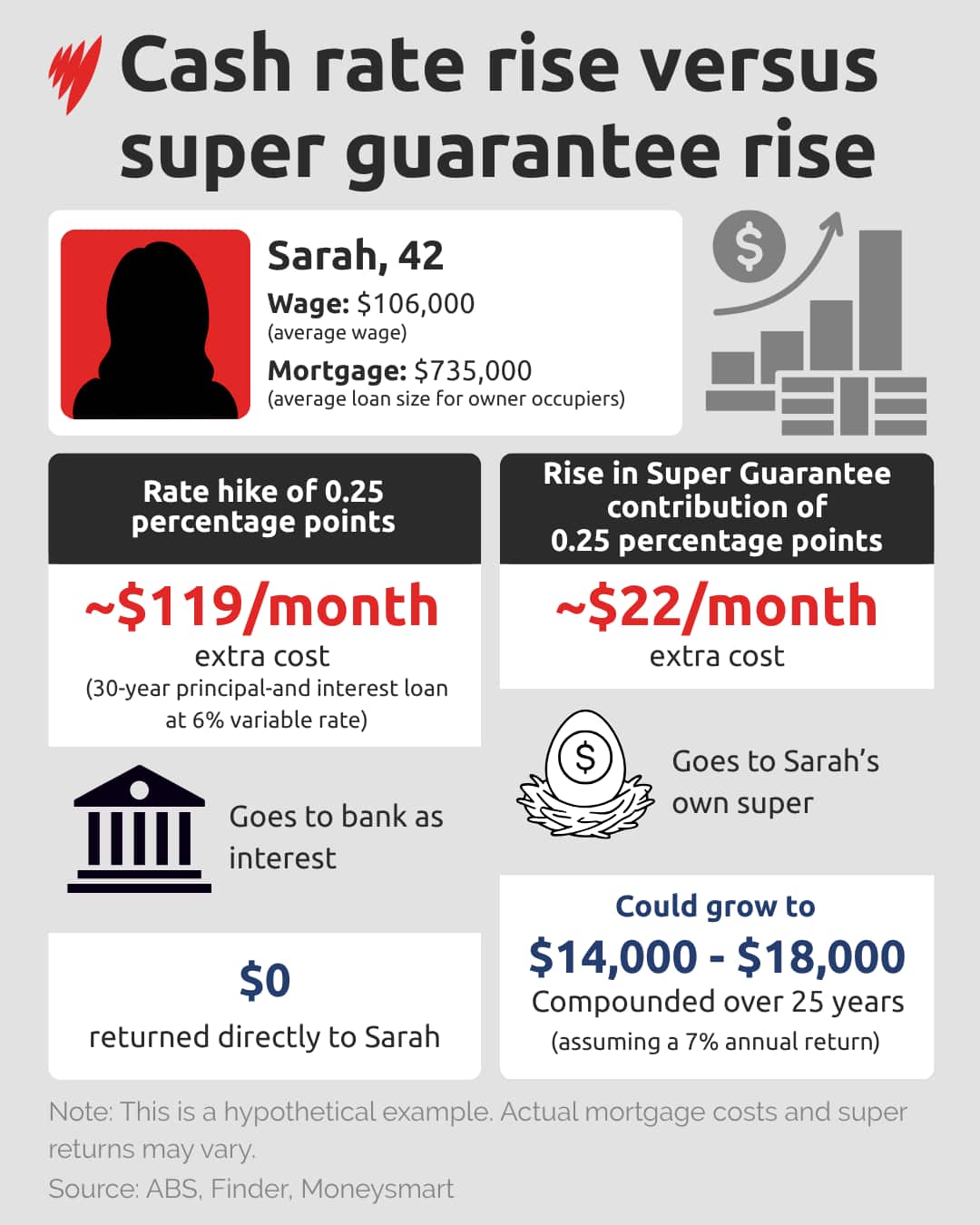
In practice, the impact would depend on a worker's income and the size of the temporary increase. For some workers, it could mean an extra $20 a month being redirected into super during periods of higher inflation, and returned to take-home pay when inflation eases and contribution rates fall.
Economist Saul Eslake sees merit in the idea.
"If people's super contributions are raised temporarily as an alternative to increasing interest rates, they'll have less disposable income for as long as that applies," he tells SBS News.
But it's still your money — it will give you more in retirement. You get it back. Whereas when you pay higher interest on your mortgage, you don't.
Any change to the SG would require legislation, meaning it would be a decision for government and parliament rather than something the RBA could introduce.
Spreading the inflation burden
Richardson argues the most efficient lever to dampen spending is the one that reaches the broadest share of the population — and on that measure, super has the edge over mortgages.
Roughly a third of Australians have a mortgage, compared with around 40-45 per cent who receive compulsory super contributions through employment. That makes wage earners the largest single group affected by any squeeze, Richardson says.
If you want a wider set of shoulders than just the borrowers, then it would come out of the take-home pay of wage and salary earners. That is the largest single set of shoulders in the economy.
A super lever wouldn't directly affect businesses, gig workers, the self-employed or freelancers — many of whom have different super arrangements and may not receive compulsory employer contributions in the same way — or older Australians, since fewer are still working (or paying off a mortgage).
However, sharing the burden more broadly means less pain per household for the same cooling effect. Put simply, "you can spread that pain", Richardson says.
That's backed by 2023 modelling from economist Tim Toohey at Yarra Capital Management, which found a 1-percentage-point rise in compulsory super could have a similar impact on household savings as a 1 per cent rise in interest rates — the equivalent of four standard 0.25-percentage-point cash rate hikes.
But while a 0.25 percentage point rise in super contributions could have a similar impact on household saving — and therefore spending — as a 0.25 percentage point interest rate rise, it would leave a lot more money in the family budget because the money is redirected into the worker's retirement savings rather than paid as additional mortgage interest.
There is a catch, of course: because Australians can't touch their super until retirement, this extra saving wouldn't help households who need more cash to cover immediate expenses.
But it would ease the squeeze on borrowers, Eslake says.
If they have a mortgage, it reduces the extent to which they might be impacted by increases in interest rates. This would help people in their 20s and 30s who have big mortgages.
Broader gains — and losses
There could be broader gains too, such as a possible boost to investment and productivity, Richardson says. More money flowing into super funds means more capital available to reinvest in the economy.
But where there are winners, there are losers — with some households potentially better off and others worse off depending on their circumstances. Savers relying on higher interest rates are one example.
"Those with money in the bank wouldn't win as much when interest rates go up, because their savings won't go up by as much," Richardson says.

There's a more direct trade-off too: pushing more wages into super would dampen wage growth, he says — and if Australians end up feeling wealthier under this strategy, that extra spending power could push prices back up anyway.
A super levy is not necessarily a magic pudding. It's a complex problem. There are no simple solutions.
Furthermore, the mechanism would be designed to adjust to the economic cycle. Because the economy moves in cycles, contribution rates would rise and fall with it — periods of higher super contributions balanced by periods of lower contributions, with the aim of roughly evening out over a working lifetime.
"With this theory, there would be periods when you'd be contributing more, others less," Eslake says.
"On average, if the combination of using this tool and using interest rates works to keep inflation stable at 2.5 per cent, they should even out over someone's working lifetime."
Is the super lever even a possibility?
If there's merit in this idea, why aren't we doing it — or even talking about it?
Economists agree the idea could boost savings in the long term, but convincing people to accept lower take-home pay today is another matter entirely.
"Payroll systems would have to adjust. You have to convince the unions, because what you are saying is that tomorrow's wage in the hand is lower than today's," Richardson says.
"And remember that on average, people with a mortgage are wealthier than people with a wage. You can imagine some in the union movement saying, 'Why are we helping out the richer people by leaning harder on the poor people?'"
Then there's the question of who would actually manage a super guarantee lever.
Richardson and Eslake point to the RBA as the obvious candidate since it already manages inflation through the cash rate. Though Eslake concedes giving the central bank another tool would raise questions about accountability and oversight.
"How would you, in a democratic system, hold them to account for how they use that power? Do you just call them before parliament twice a year, like we do with the governor of the Reserve Bank?" he asks.
"You'd probably have to put some limits around how far and how often they could move it. You wouldn't want to end up with, say, 25 per cent of people's income being contributed to super for two years as a solution to inflation."
The RBA is clear this isn't on its radar. A spokesperson told SBS News the cash rate remains the Monetary Policy Board's primary tool for influencing financial conditions and inflation, and confirmed the bank hasn't modelled temporary super guarantee changes as an alternative.
RBA chief economist Sarah Hunter, speaking at a recent Q&A, defended the current framework.
"Every single part of the economy will be impacted by whatever the interest rate settings — that's people with a mortgage to people with savings, to what happens with the exchange rate ... they get everywhere. And that's why it's a tool that does work ultimately. But it is blunt and it is hard," she said.

Furthermore, the SG rate is set out in the Superannuation Guarantee (Administration) Act 1992, meaning any adjustment would require an Act of Parliament.
Treasury told SBS News it has not modelled the idea of a super guarantee lever, and says the RBA's monetary policy remains fit for purpose.
It believes the super system is designed to provide income in retirement, not to serve other purposes. Treasury also noted that using super contributions as an economic management tool could create risks, including workers saving too little or too much for retirement, as well as additional administrative costs for businesses and payroll providers.
And would the super industry even support the idea?
Mary Delahunty, CEO of the Association of Superannuation Funds of Australia, says this idea "isn't something the superannuation sector is contemplating".
"The purpose of super is clear and enshrined in law: to deliver income for a dignified retirement, and that's where the sector's focus is," she tells SBS News.
"How to encourage saving and dial down spending in pursuit of macroeconomic objectives like managing inflation is a question for policymakers, not for the super sector."
Eslake says there would be little political appetite for a super guarantee increase as an inflation tool.
"Politicians are wary of owning decisions that make people [initially] worse off."
One lever to pull
Richardson and Eslake are careful to say the super levy wouldn't be a replacement for interest rates —, but they believe it should be on the discussion table.
"Think of the old saying about investments — don't put all your eggs in one basket," Richardson says.
"When it comes to controlling inflation, Australia has a lot of eggs in the basket of pain that hits homeowners. There's some advantage in having more baskets we can use."
Eslake says a lever would be "a complement to rather than a complete substitute for movements in interest rates".
"You might still need rate rises — if, say, business spending is part of what's driving inflation. But I think it's worth having a conversation about it."
He's also unfazed by the fact that no other country has tried this idea.
"I can't think of any other countries in the world who have something like this. But we don't necessarily need a template from another country to do something that might be sensible.
We could be a pioneer.
For the latest from SBS News, download our app and subscribe to our newsletter.







