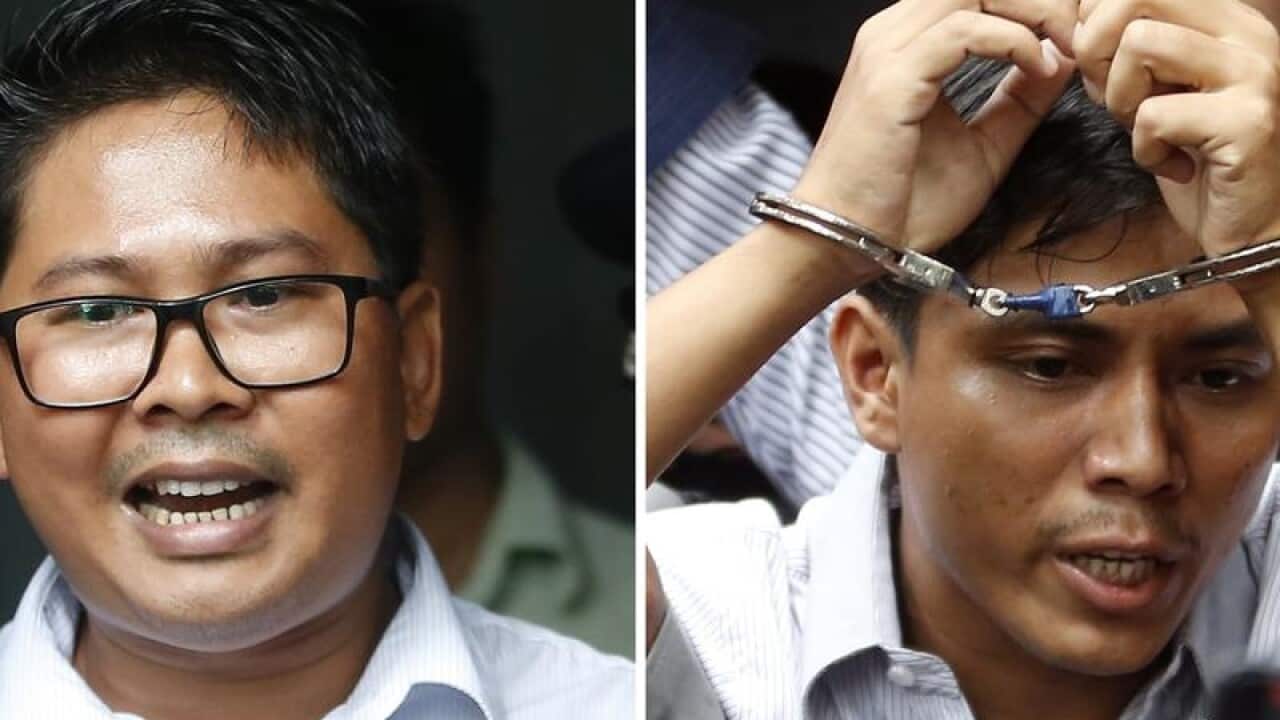
A Myanmar court has heard arguments in the appeal of two Reuters reporters sentenced to seven years in jail on charges of breaking the Official Secrets Act.
Wa Lone, 32, and Kyaw Soe Oo, 28, were found guilty in September in a landmark case that has raised questions about Myanmar's progress towards democracy and sparked an outcry from diplomats and human rights advocates.
Lawyers for the reporters filed an appeal against the conviction in early November, citing evidence of a police set-up and lack of proof of a crime.
Lawyers for the reporters and the prosecution presented arguments for more than an hour on Monday before the hearing was adjourned. The court did not give a date for a decision.
Appeal lawyer L. Khun Ring Pan, asked the judge, Aung Naing, to overturn the lower court's decision and release the reporters.
News that makes sense
Your trusted source for staying up-to-date with the world around you. Get free daily news updates and analysis, straight to your inbox.
The lawyer said the lower court had wrongly placed the burden of proof on the defendants, and prosecutors had failed to prove the reporters gathered and collected secret information, sent information to an enemy of Myanmar, or that they had an intention to harm national security.
Before their arrest, the reporters had been working on a Reuters investigation into the killing of 10 Rohingya Muslim men and boys by security forces and Buddhist civilians in Myanmar's Rakhine State during an army crackdown.
The operation sent more than 730,000 Rohingya fleeing to Bangladesh, according to UN estimates.
L. Khun Ring Pan said the lower court had ignored flaws in the prosecution case, including inconsistencies regarding the reporters' arrest.
Police said the two were seized when they walked past a routine police traffic stop holding confidential documents.
But during eight months of hearings, Wa Lone and Kyaw Soe Oo testified that two policemen they had not met before handed them papers rolled up in a newspaper during a meeting at a Yangon restaurant on December 12, 2017.
Almost immediately afterwards, they said, they were bundled into a car by plainclothes officers and taken into detention.
"The arrest at the traffic stop is a lie. The truth is they were arrested in a set up. There cannot be legal action based on a set up," the defence lawyer said.







