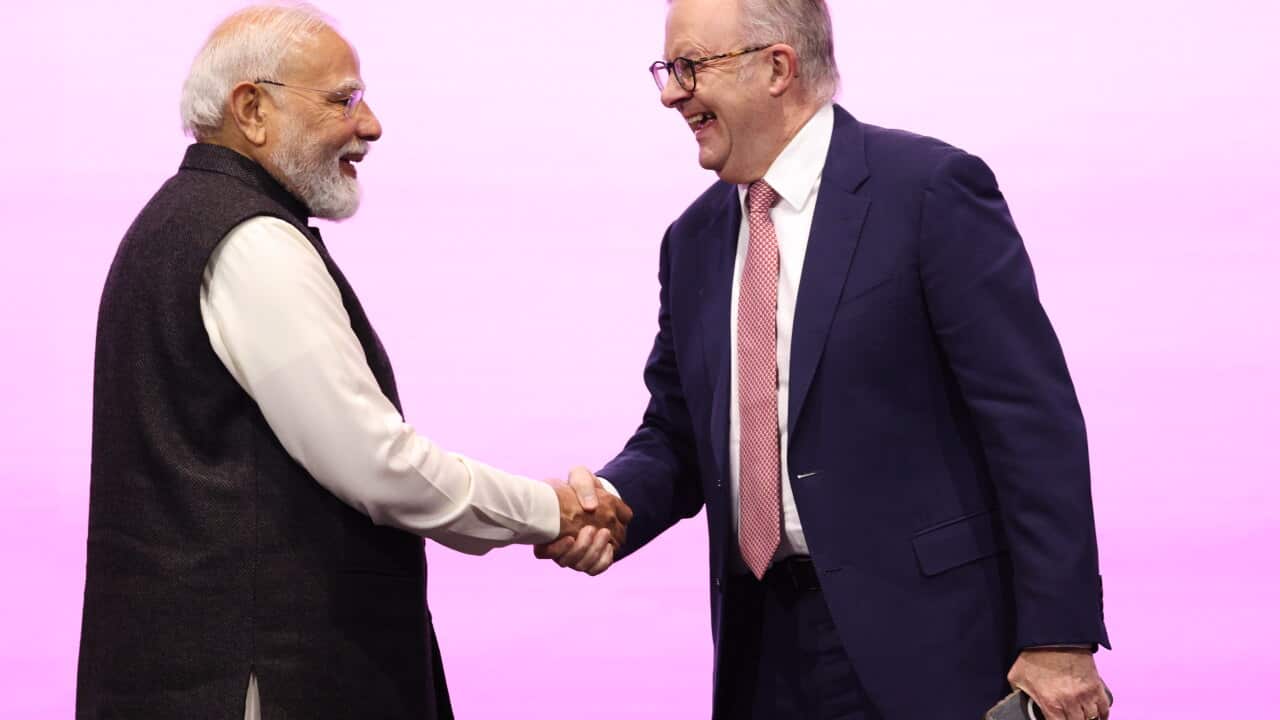
A handshake and a smile sealed the deal between Australia and its "top-tier" security partner, as Prime Minister Anthony Albanese and his Indian counterpart, Narendra Modi, pledged to strengthen ties across trade, education, defence, science and technology.
"While we are separated by an ocean, we are indeed the closest of friends," Albanese told reporters in Canberra during a joint press statement.
"Australia values India as a top-tier security partner, and the Declaration reflects our shared commitment to a peaceful, stable and prosperous Indo-Pacific region."
References to cricket embraced the common ground between the two nations, with Modi likening their partnership to a "long and intense test match".
However, underneath the sports metaphors was an undercurrent of concern around the Indo-Pacific's defence challenges, with one eye on the fallout of war in Iran and economic disruptions, and the other on China, just days after it conducted a missile test in the Pacific.
News that makes sense
Your trusted source for staying up-to-date with the world around you. Get free daily news updates and analysis, straight to your inbox.
Here's what they agreed upon.
Defence
Central to the agreement is the vision of a stable, peaceful and prosperous Indo-Pacific.
To get there, Albanese and Modi both pledged to strengthen defence ties between the two nations.
While no new partnership was announced, the two leaders confirmed their commitment to existing defence pledges, the most recent being the Comprehensive Strategic Partnership established in 2020.
"We will boost strategic coordination, increase the complexity of our defence exercises and further build interoperability between our defence forces," Albanese said.
"We have endorsed a joint maritime security collaboration roadmap and agreed to a new Australia-India partnership on cyber, critical technologies and supply chains."
India and Australia have opened the door to greater aircraft deployment in each other's territories, and there will be more exchanges, education, and training between the defence personnel of each nation.
They will also increase information sharing on terrorist threats in the region, terrorist financing and online radicalisation.
The strengthening of defence ties comes just two days after China tested a nuclear-capable missile in the Pacific.
"There is no doubt that this is a provocative act by China which does destabilise the region," Albanese said at the time.
More uranium to go to India
The biggest announcement was the kick-starting of uranium exports to India.
"Today we can confirm the signing of the administrative arrangement to export uranium to India for peaceful purposes under the 2015 Australia-India nuclear cooperative agreement," Albanese told reporters in Canberra.
The agreement "facilitates Australian uranium exports to India to help increase the share of non-fossil fuel power capacity, providing an additional market for the Australian resources sector".
Australia has had a framework for uranium exports to India in place since 2015, but trade was stifled because Australia's nuclear safeguards meant materials couldn't be exported for potential use in weapons.
It's estimated India possesses 190 nuclear weapons, and is not a signatory to the Nuclear Non-Proliferation Treaty.
It is also a powerhouse of nuclear energy, with 24 operable reactors and eight under construction, according to the World Nuclear Association.
Australia, meanwhile, has the world's largest uranium reserves and is the fourth-largest producer.
Australian unis, Indian campuses
Australian universities will expand their footprint on Indian soil.
The University Grants Commission of India issued a letter of intent allowing Adelaide's Flinders University to establish a campus in Bengaluru, the southern state of Karnataka.
Victoria University in Melbourne will open a campus in Gurugram, south-west of New Delhi.
That means a total of eight Australian universities will have a presence in India.

Speaking through a translator, Modi told the conference Australia is a "preferred destination for Indian students".
"The opening up of campuses of Australian universities in India marks a new chapter in our knowledge partnership."
Over 140,000 Indian international students studied in Australia last year, making India the second-largest source of international students. There was no mention of changes to Australia's international student visa restrictions, after crackdowns recorded a 32.5 per cent rise in visa refusals in early 2026.
In the technology sector, Canada will join Australia and India in a trilateral Technology and Innovation Partnership to drive innovation on emerging technology.
Australia is also supporting India's space ambitions with a space tracking terminal on Cocos Keeling Islands to help India's Gaganyaan Human Spaceflight Program, which aims to put humans in space by 2027.
The facility in the remote Australian territory, located in the Indian Ocean south of India and west of Australia, will help track the first launch of four key missions.
For the latest from SBS News, download our app and subscribe to our newsletter.







