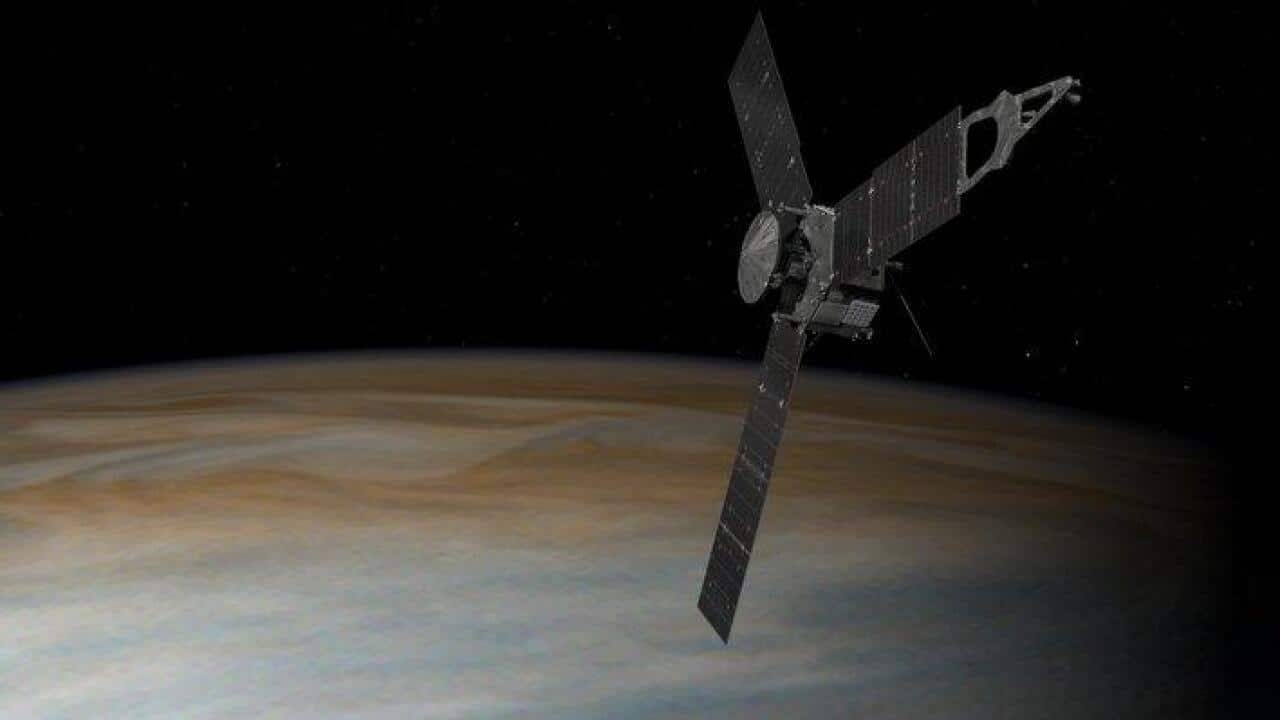
NASA's Juno spacecraft has flown closer to Jupiter than any other space probe and sent back data and images of the giant of the solar system.
Juno made its closest approach over Jupiter on Saturday at a distance of 4,200 km above the planet's swirling clouds, a NASA news release said.
Early indications are that everything worked as planned, said Rick Nybakken, Juno project manager at NASA's Jet Propulsion Laboratory in Pasadena, California.
The flyby brought the spacecraft closer to the planet than at any other time during its prime mission.
It will take days for the data collected during the flyby to be received and even more time for scientists to comprehend it, said Scott Bolton, head of NASA's Juno team.
News that makes sense
Your trusted source for staying up-to-date with the world around you. Get free daily news updates and analysis, straight to your inbox.
Bolton said Juno was sending "intriguing early data returns".
A handful of images are expected to be released the next couple of weeks.
"We are in an orbit nobody has ever been in before, and these images give us a whole new perspective on this gas-giant world," said Bolton.
The flyby was the first of 36 planned during Juno's mission, which is scheduled to end in February 2018. Juno has been orbiting Jupiter since July 4.
Bolton said in an earlier NASA news release that the flyby was the first opportunity to take a close-up look at "the king of our solar system" and begin to understand it better.
It was the first time Juno had its entire suite of science instruments activated and looking at the giant planet.
Juno blasted off on August 5, 2011, from Cape Canaveral, Florida.







