An unmanned version of an Orion space capsule will lift off aboard a Delta 4 Heavy rocket later today, seen as the first step of many on the way to landing humans on Mars.
There are currently five active probes either on Mars or orbiting around it, including the Opportunity and Curiosity rovers, which are still busily exploring the planet's surface.
But as useful as these probes are in helping us learn about Mars, they're no substitute for boots on the ground – space boots, to be precise.
Astronauts have not ventured beyond Earth's orbit since the Apollo moon program in the late 1960s and early '70s.
But the exploratory slumber appears to be at an end.
The US space agency, NASA, is taking what it says is its most important milestone in more than 40 years by launching the Orion test flight.
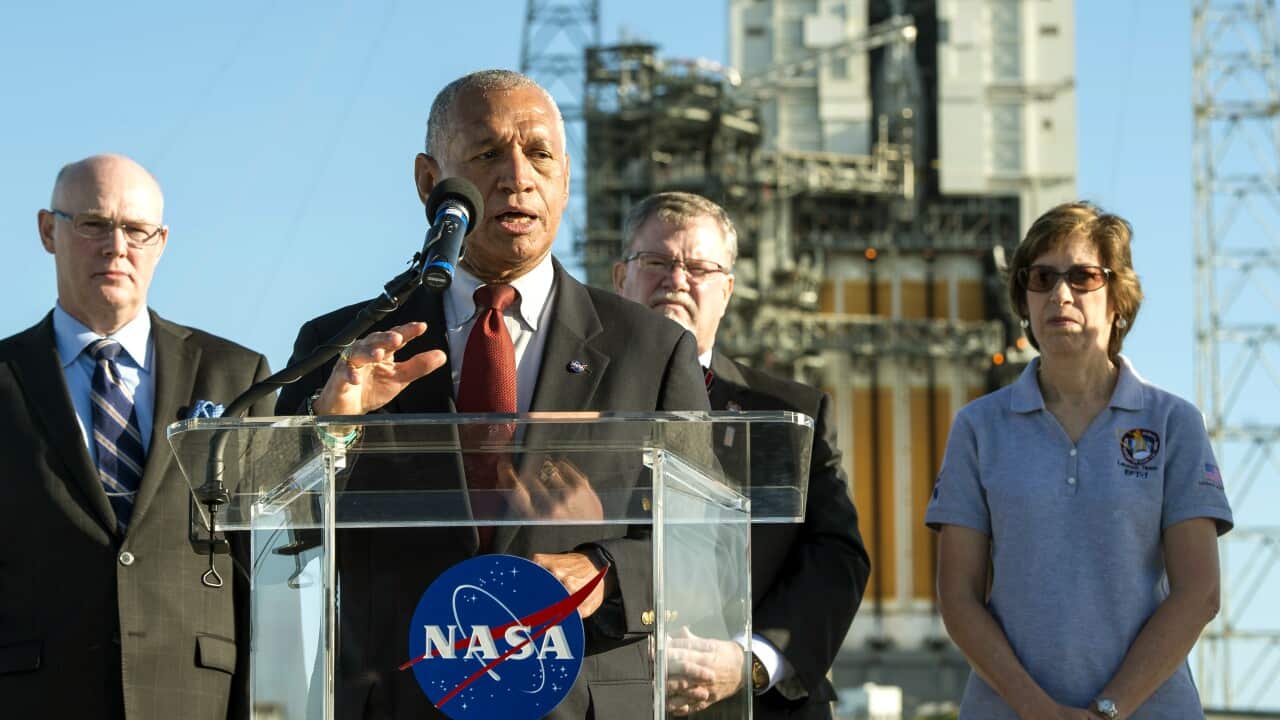
Ellen Ochoa, a former astronaut and the director of the Johnson Space Center, says this mission is about testing out the riskiest parts of the new spacecraft.
"This is really an exciting and important mission for us. We will in the future be putting our astronauts on board and we are testing some of the highest risks," Ms Ochoa says.
One of the primary goals of the 4.5 hour flight is to test how well Orion's heat shield withstands temperatures of about 2,200 degrees Celsius it will experience during re-entry.
Another key test comes when the capsule's 11 parachutes deploy to slow its descent to 32 kilometres per hour so it can gently splash down in the Pacific Ocean for recovery.
NASA Administrator Charlie Bolden says the risks involved with the mission are well worth the rewards.
"They wanted to be able to accelerate this vehicle to speeds and energy that we need to be able to test it," Mr Bolden says. "Is it risky? Yes. Is it necessary? Yes, because anything worth having is worth taking a risk for."
Even in the wake of two failed launches just last month, one of them deadly, Mr Bolden says he's optimistic about the Orion launch.
"You know bad things happen once in a while but we just say ok, that's life. Let's press. And (today) you are going to see us press harder than we have pressed before because for the first time in more than 40 years this Nation is going to launch a spacecraft intended to carry humans beyond low earth orbit. That is a big deal."
The Orion test run will be followed in four years with the launch of a second Orion capsule, also unmanned, on the debut flight of NASA's Space Launch System rocket, which is still under development.
That flight will send the capsule around the moon.
Orion's third flight, slated for around 2021, is expected to include astronauts.
The Orion program has also necessitated facility upgrades at the Kennedy Space Center so it can accommodate the new technologies that will be used to support the Orion missions.
"The big picture is that progress is real and if you are driving around the Kennedy Space Center, you can see it," says Kennedy Space Centre Deputy Director Michael Bolger.
"It's happening and it is happening fast. So we are really excited for the EFT-1 launch this week it is certainly a major step for our deep space exploration plans to put astronauts on Mars."
Share


