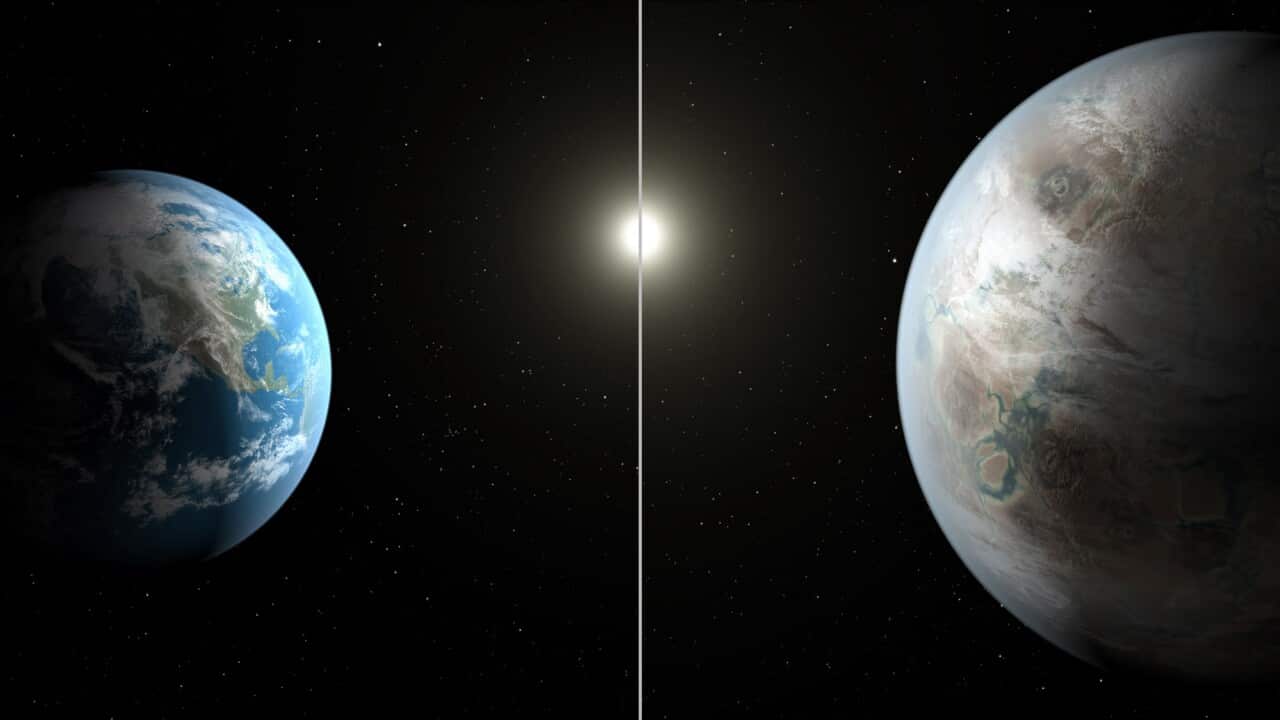
Scientists have found 12 candidate planets beyond the solar system, none bigger than twice the size of Earth, including one that orbits a star that is similar but 1.2 billion years older than the sun.
The planet is at the right distance for liquid surface water, believed to be necessary for life.
It is about 60 percent bigger than Earth and located about 1,400 light years away in the constellation Cygnus, the scientists told a news conference on Thursday.
It was discovered by astronomers using NASA's Kepler space telescope and circles a star that is similar in size and temperature to the sun, but older.
"In my mind, this is the closest thing we have to another planet like the Earth," astronomer Jon Jenkins, with the US space agency's Ames Research Center in Moffett Field, California, told reporters on a conference call.
News that makes sense
Your trusted source for staying up-to-date with the world around you. Get free daily news updates and analysis, straight to your inbox.
The planet, dubbed Kepler-452b, orbits a star that is about 6 billion years old, compared to the 4.6 billion year age of the sun.
"It's simply awe-inspiring to consider that this planet has spent 6 billion years in the habitable zone of its star"
"It's simply awe-inspiring to consider that this planet has spent 6 billion years in the habitable zone of its star," Jenkins said.
"That's considerable time and opportunity for life to arise somewhere on its surface or in its oceans should all the necessary ingredients and conditions for life exist on this planet," he said.
Kepler-452b is positioned about as far from its parent star as Earth is from the sun, completing an orbit in 385 days, compared to Earth's 365-day orbit. At that distance, surface temperatures would be suitable for liquid water, a condition believed to be critical for life.
Scientists previously have found Earth-sized planets orbiting in stars' so-called "habitable zones," but those stars are cooler and smaller than the sun, a G2 type yellow star.
NASA launched the Kepler telescope in 2009 to survey a sampling of nearby stars in an attempt to learn if planets like Earth were common in the galaxy.
"This is great progress in finding a planet like Earth that is similar in size and temperature around a sun-like star," said Kepler scientist Jeff Coughlin, with the SETI Institute in Mountain View, California.
Based on its size, scientists believe Kepler-452b should be rocky, like the Earth, though that theory is based on statistical analysis and computer modeling, not direct evidence.
"With a radius 60 percent larger than the Earth, this planet has a somewhat better than even chance of being rocky," Jenkins said.
If so, Kepler-452b could be about five times as massive as Earth and have gravity that is twice as strong as what exists on Earth's surface. The planet also could have a thick atmosphere, cloudy skies and active volcanoes, Jenkins said.
With the discovery of Kepler-452b, the telescope has found 1,030 confirmed planets and identified about 4,700 candidate planets. The list of potential planets includes 11 other near-Earth twins, nine of which circle sun-like stars.
The telescope cannot see planets directly, but measures minute changes in light coming from target stars. Sophisticated computer programs and follow-up observations with a ground-based telescopes then determine if some of the light dips were caused by planets passing in front of their parent stars, relative to Kepler's line of sight.
A positioning system failure ended the telescope's prime planet-hunting mission in 2013, but it has since been repurposed for other astronomical observations.
Attempts to learn if Kepler-452b has an atmosphere likely will have to wait for a new generation of more sensitive space telescopes, said NASA's associate administrator John Grunsfeld.