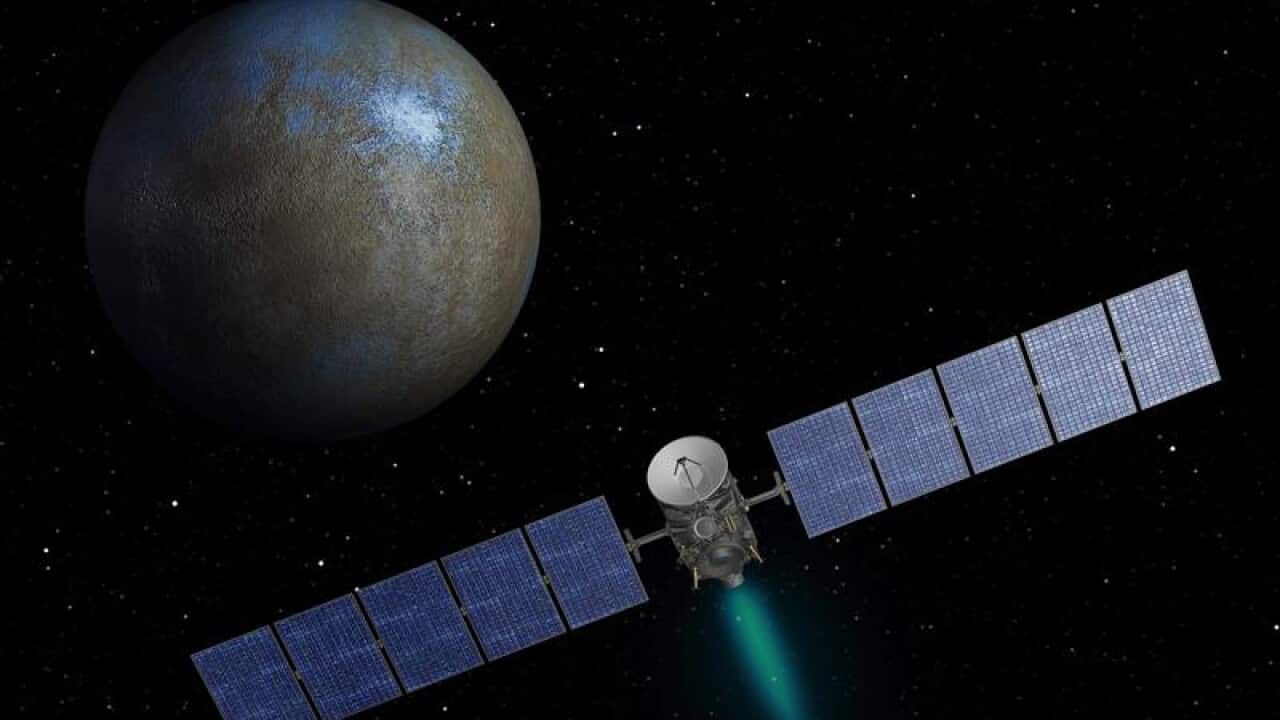
NASA's Dawn mission, which saw the spacecraft become the first to orbit a dwarf planet, will be coming to a close in the coming weeks when Dawn runs out of fuel.
The spacecraft outperformed scientists' expectations, gathering breathtaking imagery and performing unprecedented feats of spacecraft engineering over the course of 11 years, the US space agency said.
Launched from Cape Canaveral in Florida in September 2007, it explored two planet-like bodies, Ceres and Vesta, that makeup 45 per cent of the mass of the main asteroid belt surrounding the Earth.
Dawn is expected to run out of hydrazine, a key fuel, sometime between mid-September and mid-October.
News that makes sense
Your trusted source for staying up-to-date with the world around you. Get free daily news updates and analysis, straight to your inbox.
The craft will then lose its ability to communicate with Earth. But it will remain in a silent orbit around Ceres for decades.
"Although it will be sad to see Dawn's departure from our mission family, we are intensely proud of its many accomplishments," Lori Glaze, acting director of the planetary science division at NASA headquarters, said in Washington.
"Not only did this spacecraft unlock scientific secrets at these two small but significant worlds, it was also the first spacecraft to visit and orbit bodies at two extraterrestrial destinations during its mission," she added.
The mission cost $US473 million from start to finish.
Its primary components originated in Europe.
Two multi-spectral cameras that allow the craft to capture images were made in Germany, and the Italian space agency provided the craft's spectrometer.







