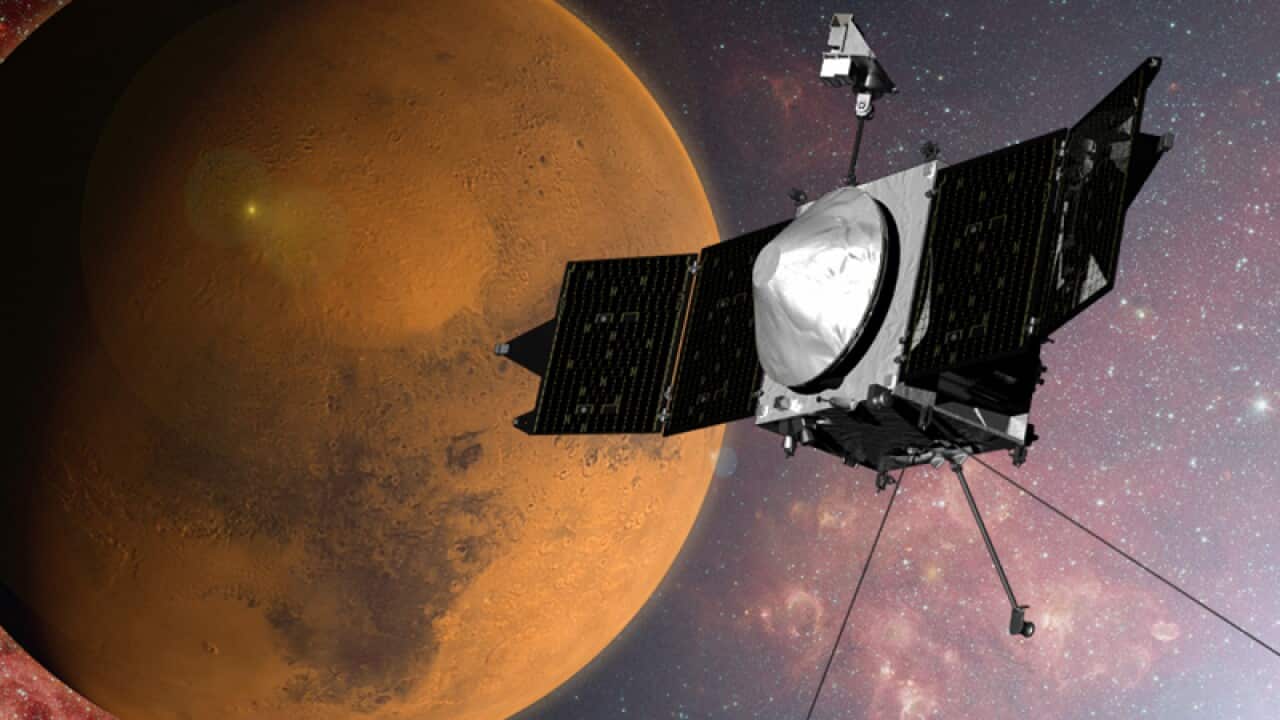
NASA's MAVEN spacecraft has begun orbiting Mars, on a mission to study how the Red Planet's climate changed over time from warm and wet to cold and dry.
"Based on observed navigation data, congratulations. MAVEN is now in orbit," said Dave Folta of NASA's Goddard Space Flight Center said on Sunday.
The unmanned orbiter has travelled more than 10 months and 442 million miles (711 million kilometres) to reach Mars for a first-of-its kind study of the planet's upper atmosphere.
The data from the Mars Atmosphere and Volatile Evolution (MAVEN) spacecraft aims to help scientists understand what happened to the water on Mars and the carbon dioxide in its atmosphere several billion years ago.
How Mars lost its atmosphere is one of science's biggest mysteries. The answers could shed light on the planet's potential to support life - even if that was just microbial life - long ago.
News that makes sense
Your trusted source for staying up-to-date with the world around you. Get free daily news updates and analysis, straight to your inbox.
MAVEN's findings are also expected to help add to knowledge of how humans could survive on a future visit to the Red Planet, perhaps as early as 2030.
"Mars is a cool place, but there is not much atmosphere," said John Clarke, of the MAVEN science team.
"It is very cold, it is well below zero. The atmosphere is about half a per cent of what we are breathing," he added.
"But we know that Mars could change and it was probably different in the past. There is a lot of evidence of flowing water on the surface from Mars's ancient history."
Next, MAVEN will enter a six-week phase for tests.
Then, it begins a one-year mission of studying the gases in Mars's upper atmosphere and how it interacts with the sun and solar wind.
Much of MAVEN's year-long mission will be spent circling the planet 3,730 miles (6,002 km) above the surface.
However, it will execute five deep dips to a distance of just 78 miles above the Martian landscape to get readings of the atmosphere at various levels.







