NATO said Tuesday it asked for more troops in Kosovo days after a trade row with Serbia sparked deadly violence, an apparent signal that it will not allow the situation to deteriorate.
NATO spokesman Hans Dieter Wichter told AFP that the KFOR mission in the territory had asked for one extra battalion.
A battalion is usually around 500 soldiers and a German military spokesman told AFP in Berlin that the troops would be sent from Germany and Austria.
News that makes sense
Your trusted source for staying up-to-date with the world around you. Get free daily news updates and analysis, straight to your inbox.
Wichter explained the additional troops were needed to boost the operational reserve of the more than 5,900 KFOR soldiers currently in Kosovo as "all of them are currently deployed".
He stressed that the request did not mean that KFOR was unable to control the situation in majority-Serb northern Kosovo, where unrest flared last week after the ethnic Albanian government ordered police to seize control of two border crossings.
NATO spokeswoman Carmen Romero also insisted the call for extra troops should not be read as a sign that the crisis is worsening.
"The reason for that is to relieve the forces currently on the ground, so this deployment should not be seen as a sign of escalation," she said.
"The situation is actually de-escalating."
In Pristina, where EU mediator Robert Cooper was meeting prime minister Hashim Thaci to discuss the crisis, NATO's move was seen as a signal that NATO is keen to see the trade row resolved peacefully.
"I think it is a message to Serb extremists that NATO is resolute in maintaining the situation and that no one can impose any solution by violence," Ardian Collaku, a political commentator for the Zeri daily, told AFP.
"NATO is buying time and creating room for a political solution for the north through talks at the political level," he added.
After the meeting with Cooper, Thaci said Pristina has "again made clear (which are) its red lines" not to be crossed in the talks with Serbia.
"Full sovereignty, territorial integrity and public order can not be a part of any dialogue," with Serbia, Thaci said in a statement.
Thaci blamed Belgrade as driving force of the latest deterioration in the north with the aim of dividing the region from Kosovo.
Pristina said it ordered its security forces to wrest control of the border crossings last week to enforce a ban on imports from Serbia which was being ignored by ethnic Serb members of Kosovo's border police.
One ethnic Albanian police officer was killed in the ensuing clashes.
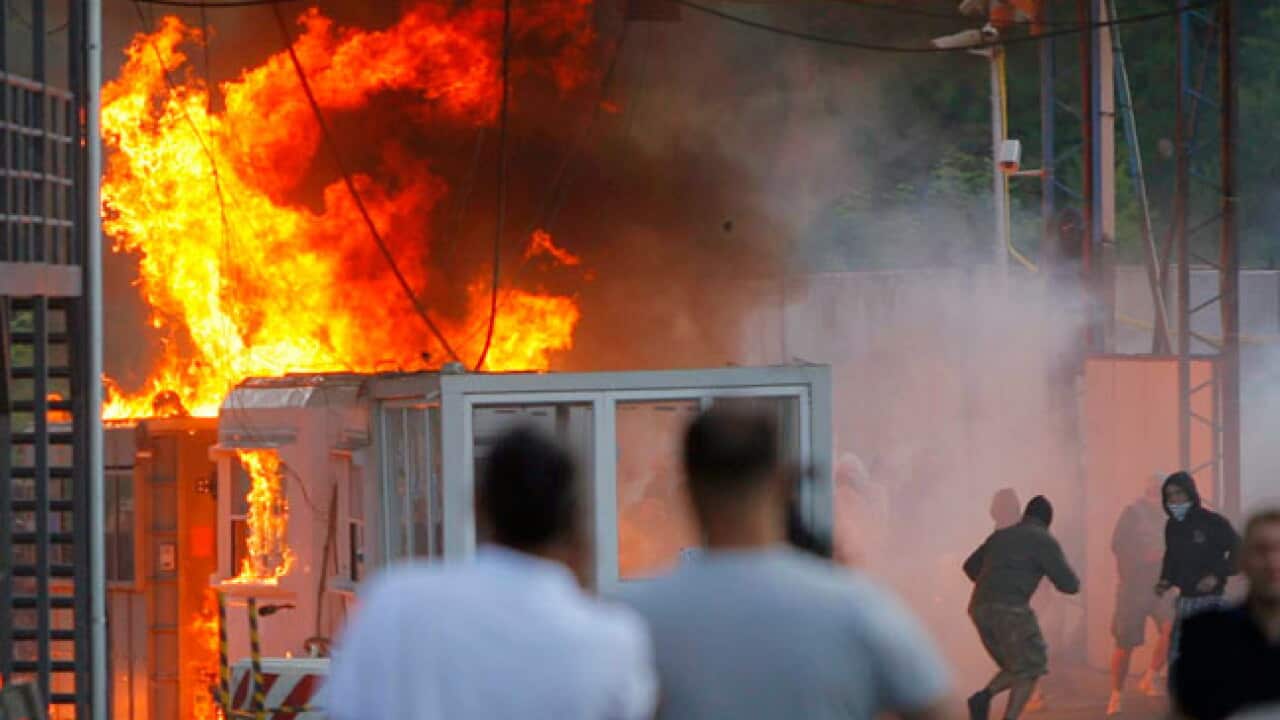
NATO troops stepped in when a border post in Kosovo was set on fire and bulldozed, apparently by ethnic Serbs.
Angry Kosovo Serbs have been blocking the roads leading to the crossing for several days and vowed to remain at the barricades until a solution was found.
Kosovo banned imports from Serbia in response to a similar move by Belgrade in 2008, when the ethnic Albanian majority unilaterally proclaimed its independence from Serbia.
The disputed border crossings are seen as vital by many Kosovo Serbs as they provide a link with Serbia on which northern Kosovo relies almost exclusively for supplies of food and medicine.
Over the weekend, food shortages were reported in some northern Kosovo towns.
The European Union has repeatedly called for restraint on both sides and urged the Belgrade and Pristina to return to the dialogue.
EU mediator Cooper brokered talks between the two sides that kicked off in March aimed at smoothing friction and ending day to day headaches faced by ordinary people stemming from Belgrade's non recognition of Kosovo's break-away.
The talks stalled after both Serbian and Kosovo authorities were criticised at home for making too many concessions after they announced several agreements.
The idea was that the talks would progress from tackling practical issues to building confidence and finally dealing with more problematic issues such as the volatile situation in the north.
According to independent Kosovar analyst Naim Gashi the current crisis in the north makes that the number one issue to be solved in the talks.
"The latest development ... imposed North Kosovo as the priority. There is no sense in talking about technical issues while the north is reaching boiling point," he said.







