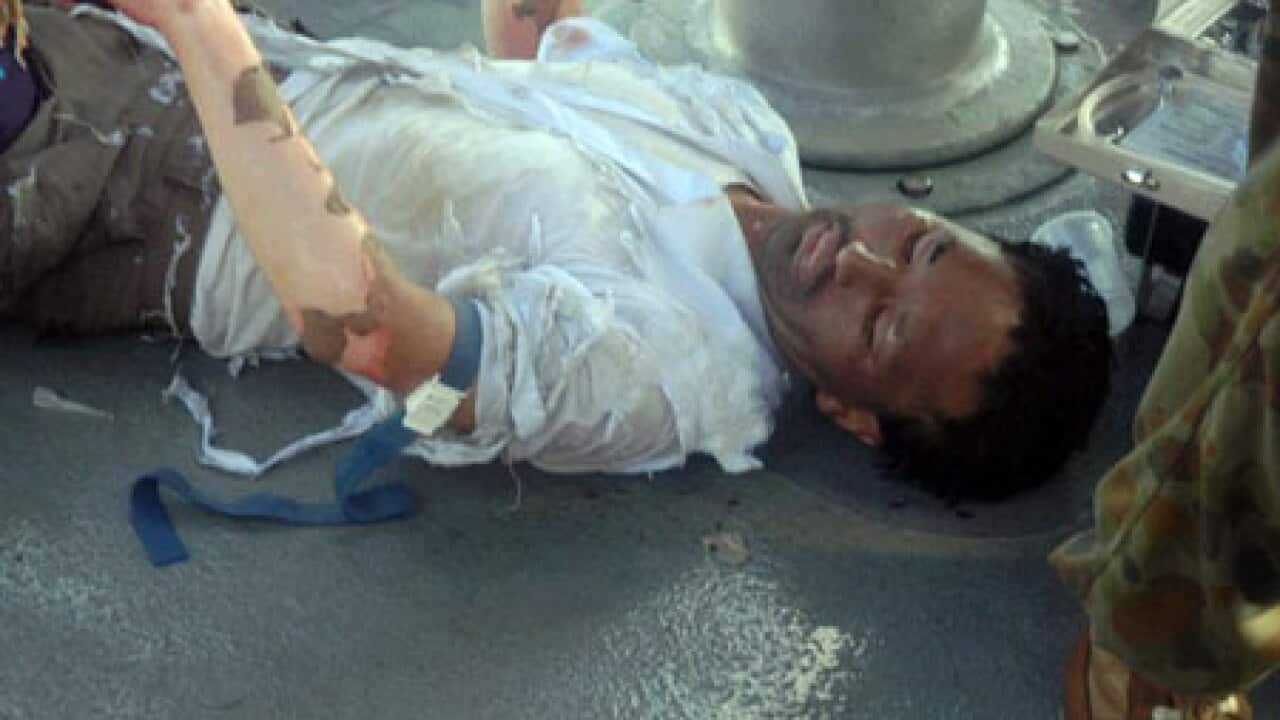
A naval officer has conceded there were deficiencies in the Australian navy's training program when an asylum seeker boat exploded and killed five people in April 2009.
Chief Petty Officer Glenn Alan Lee told a coronial inquest in Darwin on Tuesday that the training manual was an "evolving document" that was adapted as new scenarios emerged.
Asked by counsel assisting the Northern Territory Coroner, Stephen Walsh QC, whether there were deficiencies in training programs at the time of the explosion, Chief PO Lee said the navy was "constantly learning".
News that makes sense
Your trusted source for staying up-to-date with the world around you. Get free daily news updates and analysis, straight to your inbox.
"So yes, that would be a fair assessment," he said.
Past issues that had arisen when the navy boarded any Suspected Illegal Entry Vessel (SIEV) were used to brief boarding parties on what they might encounter, Chief PO Lee said.
He said he had never personally covered any scenario of a boat exploding and throwing people into the water.
Five Afghan men drowned and another 40 people were injured when the wooden fishing vessel they were aboard, known as SIEV 36, caught fire and exploded while it was under the control of the Australian navy near Ashmore Reef.
Earlier the inquest heard asylum seekers could not readily access life-jackets that were still in their plastic wrapping when the boat exploded. Chief PO Lee said naval officers should have shown the asylum seekers how to use the life-jackets.
He said the policy of rescuing their colleagues first, before the asylum seekers, was flexible and that value judgments were to be made on the scene.
Able Seaman Christopher Saville, who helped rescue about 12 of the asylum seekers, told of the "horrifying" aftermath of the explosion.
He said "blood and skin was flowing over the deck" as he assisted medical staff to treat the asylum seekers who were taken to HMAS Childers.
"It was just a mess, there were bodies everywhere," he said.
The inquest was told of several changes that had been made to naval training as a result of the SIEV 36 explosion, including in relation to the volatility of particular fuels.
Chief PO Lee said he would have removed the unleaded fuel used to operate the bilge pump onboard SIEV 36 had he been a member of the boarding party.
However, he said he would not have initially confiscated cigarette lighters or matches from the passengers because they were heavy smokers who had not shown any belligerence.
The inquest heard it was now naval policy to confiscate lighters and matches and to quarantine fuel stocks.
Seaman Matthew Pierce said mobile phones were now taken from passengers aboard all SIEVs because some asylum seekers had been found with the telephone numbers of Australian Defence Force personnel.
"The reason was given that some of the people on board had found out numbers for different personnel in Defence," Seaman Pierce said.
"And to save them calling people, we'd taken the phone off them so that we could process them without any problems."
No further questions were asked of Seaman Pierce about how the asylum seekers had gained access to ADF telephone numbers.
The inquest continues.







