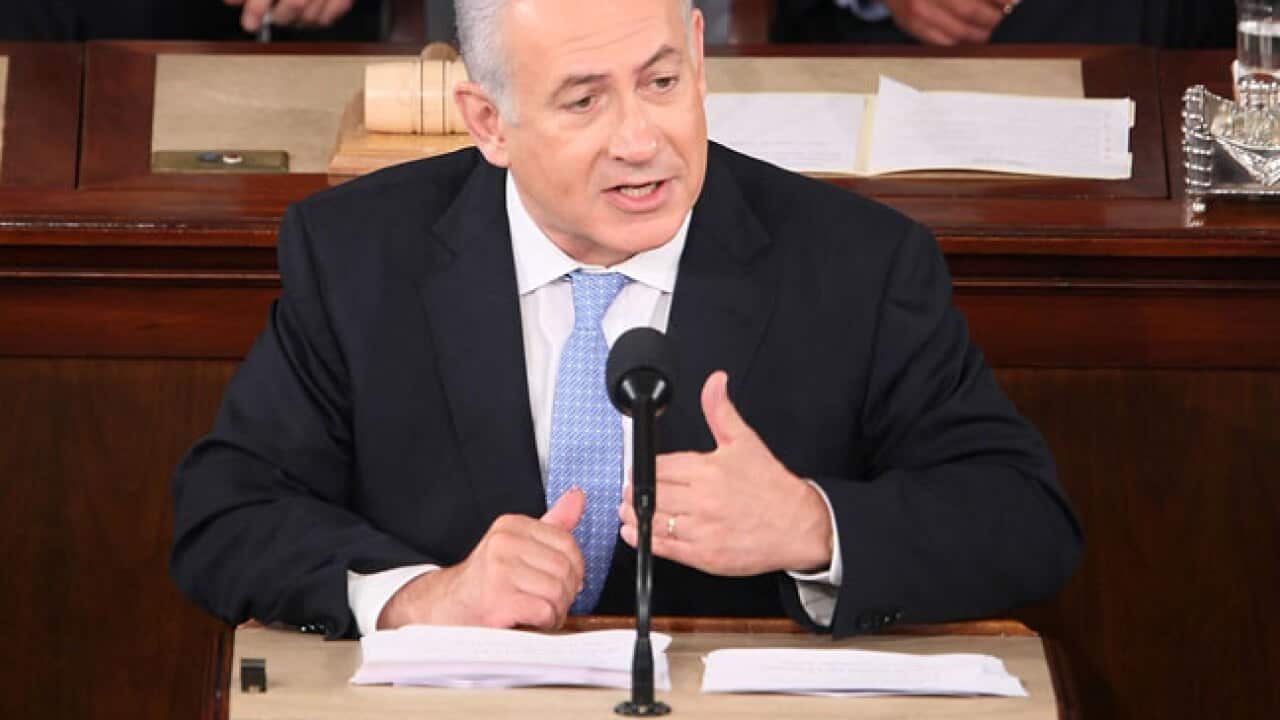
Israel's Benjamin Netanyahu told the US Congress Tuesday he would uproot settlements in a "generous" peace deal with Palestinians, but ruled out international demands to return to the 1967 borders or share Jerusalem.
In his speech to a rare joint session of the US legislature, the Israeli leader broke no substantial new ground in his positions and rejected key calls from US President Barack Obama and the international community, who have been looking for ways to revive the comatose peace process.
Netanyahu also ruled out any return to talks as long as the unity deal between Palestinian president Mahmud Abbas and the Islamist Hamas continues, while saying the real stumbling block to peace was the refusal of the Palestinians to recognize Israel as a Jewish state.
News that makes sense
Your trusted source for staying up-to-date with the world around you. Get free daily news updates and analysis, straight to your inbox.
"In any peace agreement that ends the conflict, some settlements will end up beyond Israel's borders," Netanyahu said, adding he had to be "honest" with the Israeli public.
"We will be very generous on the size of a future Palestinian state," he said in a speech frequently punctuated by warm applause and at least 20 standing ovations from the US lawmakers.
But Netanyahu again ruled out any return to the borders that existed before the 1967 Middle East War or dividing the holy city of Jerusalem. The Palestinians demand east Jerusalem as the capital of their future state.
"Jerusalem must never again be divided. Jerusalem must remain the united capital of Israel," Netanyahu said.
The issue of accepting the 1967 borders basis as a starting point for negotiations has been at the core of an ongoing row between Netanyahu and Obama.
Obama last week gave public voice to the long-held view of the US and international communities that a Palestinian state should be created based on the borders that existed before the 1967 Six Day War.
Such a state would include the Gaza Strip, the occupied West Bank and mostly Arab but Israel-annexed east Jerusalem, with some adjustments and land swaps so that Israel can maintain settlement blocs.
On Tuesday Netanyahu again rejected these calls, saying Israel would not give up its main settlements or compromise on the issue of Palestinian refugees.
"The border will be different than the one that existed on June 4, 1967. Israel will not return to the indefensible lines of 1967," he said.
"Any peace deal must take into account the dramatic demographic changes that have occurred since 1967. The vast majority of the 650,000 Israelis who live beyond the 1967 lines reside in neighborhoods and suburbs of Jerusalem and greater Tel Aviv."
As such Netanyahu's positions are unlikely to entice the Palestinians back to the negotiating table or persuade them to abandon attempts to seek recognition for a Palestinian state when the UN General Assembly meets in September.
In a swift reaction, a Palestinian official said there was "nothing new" in Netanyahu's speech, saying the Israeli leader was just "adding obstacles" on the road to peace.
A far-reaching Israeli initiative has been seen as the only way of heading off a Palestinian attempt to unilaterally secure recognition of statehood.
But analysts said it appeared Netanayahu had not done enough.
"He made peace with Congress (but) there's no formula there for peace with the Palestinians," Israeli analyst Yossi Alpher told AFP.
Obama "pushed all the right buttons on Israeli-American relations and Israel's security needs," but there was "nothing which constitutes a basis for renewed negotiations," Alpher added.
"It was somewhat stingy," Ari Shavit, a commentator with the liberal Haaretz newspaper, told CNN.
The Israeli leader also called on the international community to foil the UN recognition bid.
"Peace can be achieved only around the negotiating table. The Palestinian attempt to impose a settlement through the United Nations will not bring peace. It should be forcefully opposed by all those who want to see this conflict end," Netanyahu said.
But he also ruled out any negotiations until Abbas severs ties with Hamas.
"Israel is prepared to sit down today and negotiate peace with the Palestinian Authority. I believe we can fashion a brilliant future of peace for our children. But Israel will not negotiate with a Palestinian government backed by the Palestinian version of Al Qaeda."
And he blamed the Palestinians for the failure to reach a peace deal over the last two decades.
"President Abbas must do what I have done. I stood before my people, and I told you it wasn't easy for me, and I said 'I will accept a Palestinian state,'" Netanyahu said.
"It is time for President Abbas to stand before his people and say: 'I will accept a Jewish state,'" Netanyahu said. "Those six words will change history."







