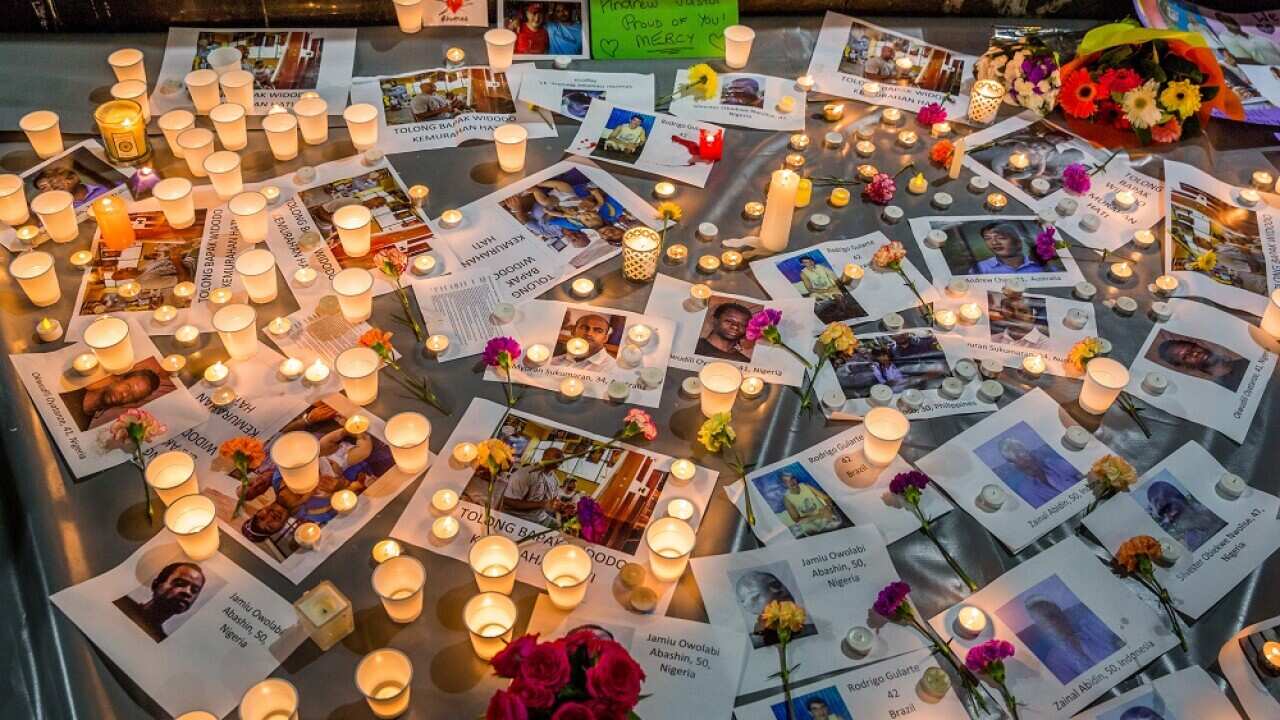
Two weeks after a teary Michael Chan spoke of his executed brother's final wishes, human rights groups have called for a new Australian campaign to end the death penalty.
The groups have proposed a four-step plan for the government to build on its failed stand against Indonesia's executions of Andrew Chan and Myuran Sukumaran.
It calls for developing a new Department of Foreign Affairs and Trade public strategy document, aimed at ending the death penalty everywhere.
The plan suggests using Australia's aid programs to support civil society organisations already campaigning against the death penalty within their respective countries.
It also calls for Australia to join other nations pushing for universal adoption of a global moratorium on the death penalty and for stronger laws to prohibit police from sharing information with other law enforcement agencies which could bring the death penalty.
Human Rights Law Centre researcher Emily Howie said it was time to work on a unified approach.
"What was clear when Chan and Sukumaran were executed was that there was a unity among Australians in opposition to the death penalty," Ms Howie said.
"And, a very strong Australian government voice calling for mercy.
"We have to make sure that that moral opposition to the death penalty is reflected across Australia's laws and policies and practices. So whilst the Australian government should be applauded for the advocacy in support of Chan and Sukumaran's lives being saved, what we would like to see is all government policy - aid, diplomacy, a regional cooperation and police cooperation - that [they] are all consistently on the same message."
At the same time, Ms Howie said that the Australian government's goals in campaigning against the death penalty overseas must be realistic.
She said abolishing the death penalty should be the immediate goal for some countries, but intermediate steps could be the first aim in others.
"It might be reducing the number of crimes for which the death penalty is imposed, with the aim of eventually moving towards [banning] the death penalty," she said.
"But we can establish a strategy which has achievable benchmarks for different countries. This has been something that the UK has done and made part of its foreign policy, and it has had some significant success in doing that."
Human Rights Watch’s Australian director Elaine Pearson cited Vietnam as one example of a country cutting back.
"Vietnam, for instance, recently has adopted a law sort of limiting the scope of crimes and sort of reducing the use of [the death penalty for] drug trafficking and those crimes, and saying that they should be punishable, instead, by life imprisonment," Ms Pearson said.
"Other initiatives that governments could take is if someone is on death row for a lengthy period of time, ensuring that that's commuted to life imprisonment."
Part of Australia's appeal against the executions of Sukumaran and Chan was that they had already been imprisoned for a decade.
Ms Pearson said Australia itself took a long time in fully banning the death penalty even after executing its final victim.
"We in Australia haven't executed anyone here since 1967," she said.
"However, the death penalty was only formally abolished in all states through law in 2010. So I think there are a whole number of practical steps that governments could take which would actually save lives and protect people who have been sentenced to death, particularly in countries in this region with which Australia has strong trade or security relationships."
Amnesty International estimates more than 600 people were executed around the world last year.
Two of Australia's top trade partners, China and the United States, ranked near the top.
Amnesty International Australia's Diana Sayed said that in the end, Australia's policy must be consistent for all to be effective.
"It has to be unequivocal and irrespective of what crimes were committed, for whatever charges, no matter how far-reaching this is, that state-sanctioned killing can never be condoned and it's an abhorrent act," she said.
"They have to condemn it whenever it happens, whether it's the Boston bomber in the US, or it's in Pakistan for, you know, trumped-up charges or juveniles, or it's in our region particularly. We need to maintain this very consistent and principled approach to the death penalty."
"One of Andrew's last wishes was to ensure that we keep fighting to abolish the death penalty even though he lost the good fight."
Share


