
In brief
- A new report has raised the benchmark of superannuation balances for homeowners to reach a comfortable retirement by age 67.
- Expert says one group of Australians are right on track for comfortable retirement, while another group may face more challenges.
The average amount of superannuation recommended for an Australian to retire comfortably has increased amid rising cost of living pressures, according to a new report.
A single homeowner aged 67 needed a lump sum of $595,000 in retirement savings to reach a comfortable retirement three years ago, but now they will need $630,000 to achieve the standard, according to the report by the Association of Superannuation Funds of Australia (ASFA) on Tuesday.
For a couple who own a home, the required amount has increased from $690,000 to $730,000.
Mary Delahunty, chief executive at ASFA, said the change of the lump sum's benchmark is a result of rising living costs, as well as the age pension failing to keep pace with cost of living.
"The age pension has not kept pace with the actual cost increases retirees face, particularly for essential goods and services," Delahunty said.
News that makes sense
Your trusted source for staying up-to-date with the world around you. Get free daily news updates and analysis, straight to your inbox.
"Costs in the categories that retirees tend to spend most on have risen faster than general consumer price inflation. So that means even though the age pension is indexed, a greater burden is placed on retirees' personal super savings."
Inflation, which is tracked using the Consumer Price Index published by the Australian Bureau of Statistics (ABS), rose to 3.8 per cent in the year to December, up from 3.4 per cent in the year to November.
The ABS identified housing, food and non-alcoholic beverages, and recreation and culture as the largest contributors to annual inflation.
Delahunty also noted that the recent increase in deeming rates — which are used to estimate income earned from financial assets for age pension eligibility — led to the revision of the benchmark.
"When deeming rates rise, a person's assessed income can increase even if their actual investment returns have not, which can reduce their age pension. This shifts more of a retiree's budget towards reliance on super rather than Centrelink," she said.
How do you know if you're on track?
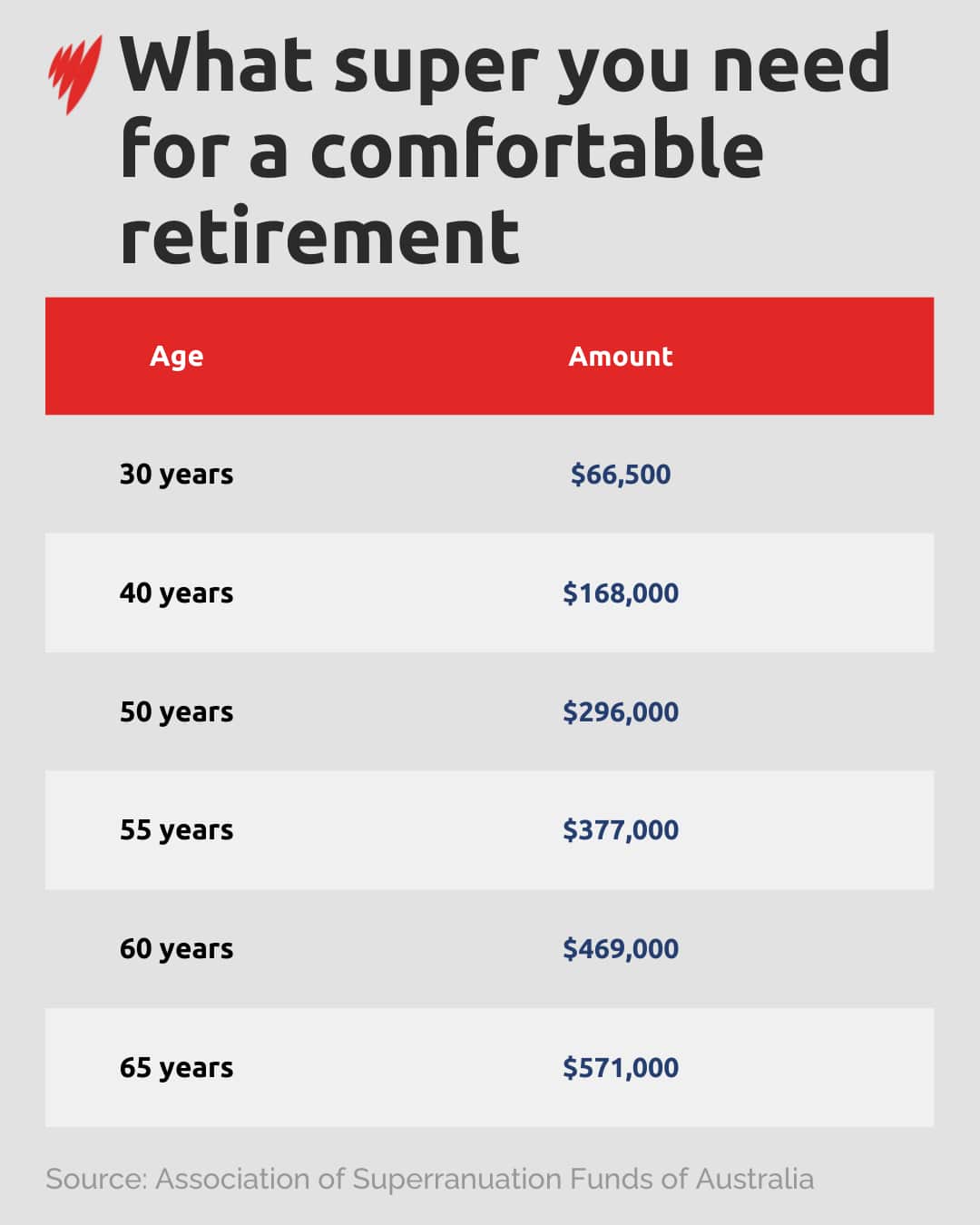
In order to reach the comfortable standard of $630,000 in superannuation, Australians would need to aim for a balance of $571,000 by the time they turn 65 years old, working on the assumption that they have a steady pre-tax annual income of $65,000 that keeps track with inflation.
The recommended balance at 30 years old is $66,500, $168,000 at 40, and $296,000 at 50.
Despite the benchmark revisions, James Koval, ASFA's head of policy and advocacy, told SBS News that Australians are on track to retire with more superannuation than ever.
"Some really important changes have happened to superannuation over recent years," he said.
"The minimum rate of super that people will receive these days is 12 per cent, and people will also receive it in circumstances that they might not have in the past, such as when they take parental leave.
"These are very positive changes that help increase the balance of super that people have in super when they retire."
Koval said the investment return from superannuation has also demonstrated strong performance in recent years, which leads to higher superannuation balances.
"What it actually means is that, for someone who is 30 years old today, with about 30 grand in their super, they are actually on track to retire with $645,000 in their super, which is, of course, above the amount you need for a comfortable retirement."
Older Australians are hit most
While younger Australians have a "really positive" future with the growth of their superannuation balances heading towards retirement, Koval said, older Australians may face more negative impacts of the revised benchmarks for comfortable retirement.
"For a lot of Australians who are retiring today, super plays a very big part in their retirement, but also the age pension is a key factor for a lot of people," he said.
He said the deeming rate in age pension has been updated twice since the COVID-19 pandemic began in 2020, meaning recent retirees may face greater pressures from living expenses on their superannuation balances.
He encouraged Australians approaching retirement to engage more with their super accounts, check investments and ensure payments are arriving.
For the latest from SBS News, download our app and subscribe to our newsletter.







