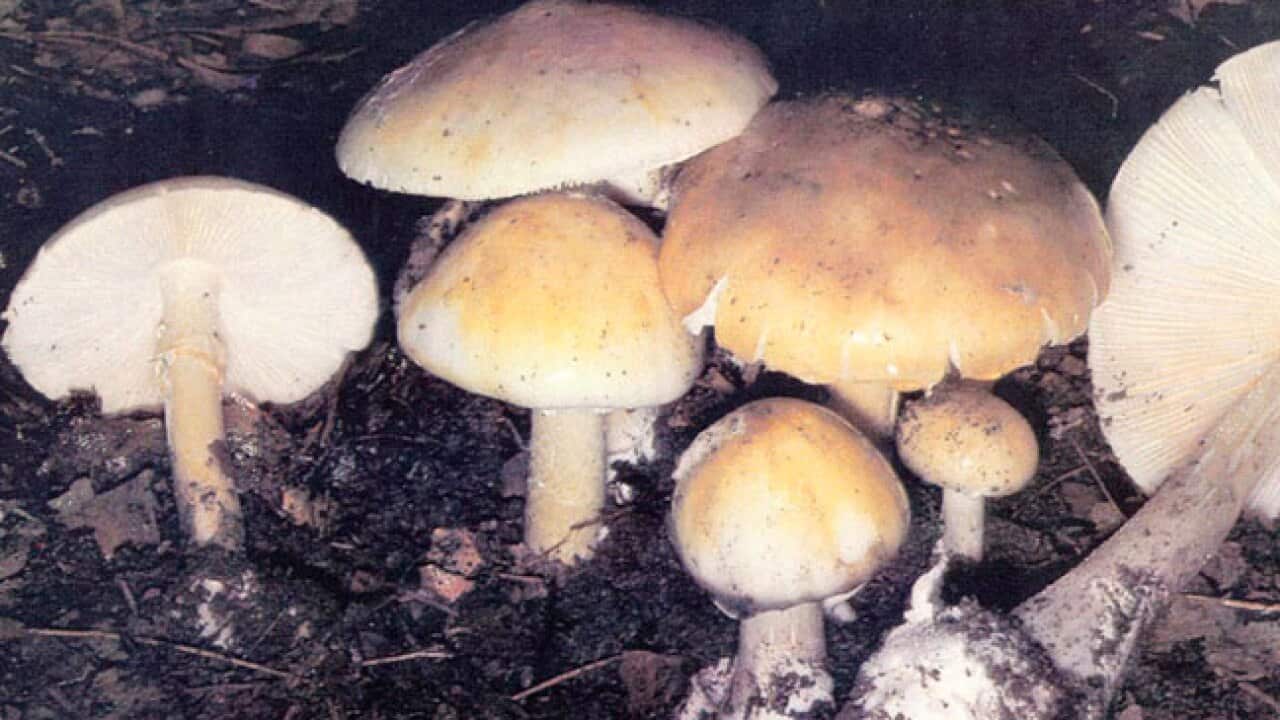
Health officials have again warned people not to eat mushrooms they find growing in the wild.
(Transcript from World News Australia Radio)
The warning comes after a rise in the number of fatalities after people mistakenly ingested the Death Cap mushroom.
News that makes sense
Your trusted source for staying up-to-date with the world around you. Get free daily news updates and analysis, straight to your inbox.
Visitors and recent migrants to Australia are the most likely to be accidentally poisoned.
A spate of poisonings over the past 10 years, including the deaths of two Chinese nationals in Canberra last year, have prompted regular warnings by authorities against people picking and eating wild mushrooms.
They've cautioned that eating even a small piece of the Death Cap mushroom can cause irreparable liver damage, or even death.
Canberra Hospital's director of emergency medicine, Dr Michael Hall, says symptoms of poisoning can appear similar to those of a gastrointestinal upset, while some people may not present any symptoms at all for up to 12 hours.
He says people with Asian backgrounds are particularly at risk, as they may not be aware of poisonous varieties growing in Australia.
"The problem I guess is that in southeast Asian cultures in particular mushrooms is probably a more traditional part of their diet, and hunting and eating wild mushrooms is a more traditional part of their day-to-day diet and part of their culture. In Southern China, Vietnam, Northern Thailand there aren't really toxic mushrooms as such so any mushrooms that can be found can be eaten, whereas in many other parts of the world the mushrooms are dangerous. What we tend to see is groups of people either new to Australia or not from the ACT that come in and do what is probably perfectly reasonable practise where they live but is a dangerous thing to do around our region."
Dr Hall says Death Cap mushrooms often appear after warm, wet weather.
"They're found mostly where you find oak trees, now in Australia the majority of them are around the ACT, but they are being seen in other areas, so down on the south coast, in Adelaide and in Victoria."
Senior mycologist at Melbourne's Royal Botanic Gardens Dr Tom May says people can find it difficult to tell toxic and non-toxic mushrooms apart.
"In particular with the Death Cap it's quite similar in appearance to the paddy straw mushroom which is widely cultivated in Asia. But there are a few subtle differences between them. Death Cap mushrooms is mushroom-shaped, and the gills underneath the mushroom are white. The top of the mushroom is usually a kind of yellowish to greenish colour, that sometimes can fade out to be white or can be a little bit brown, and at the base of the stem there's a cup of tissue that the stem comes out of."
He also warns people to stay away from the more common yellow staining mushroom, which is also poisonous.
"The most common cause of poisoning in Southern Australia is the yellow staining mushroom, so this is a mushroom that looks pretty much like a conventional field mushroom or like the button mushroom that you would buy in the greengrocer or the supermarket, so these are whitish mushrooms that underneath have the pink to deep chocolate brown gill colour. Unfortunately the field mushrooms themselves which are the edible ones aren't particularly common, the yellow staining mushroom is very common and the thing that's distinctive about that is if you just scratch the cap or inside the base of the stem there's a bright yellow staining reaction, and they also have a bit of a peculiar chemical smell. So you won't die from eating them but they make people quite sick."







