Forces loyal to President Daniel Ortega asserted control over a key opposition stronghold on Wednesday after a long battle that has sharpened international condemnation and alarm over Nicaragua's violent political crisis.
Paramilitaries with assault rifles drove honking through the center of Masaya, south of the capital, and hoisted the flag of Ortega's ruling Sandinista party over a main square in the flashpoint Monimbo district. It had been hastily cleared of debris from the hours-long fighting that took place Tuesday.
Police were seen driving off with several prisoners in the back of their vehicles.
There was no reliable death toll from the battle. A few locals reported "many deaths" or even a "massacre," but paramilitaries speaking to journalists denied these accounts. A Nicaraguan rights group said on Tuesday there were at least two deaths, one of them a policeman.
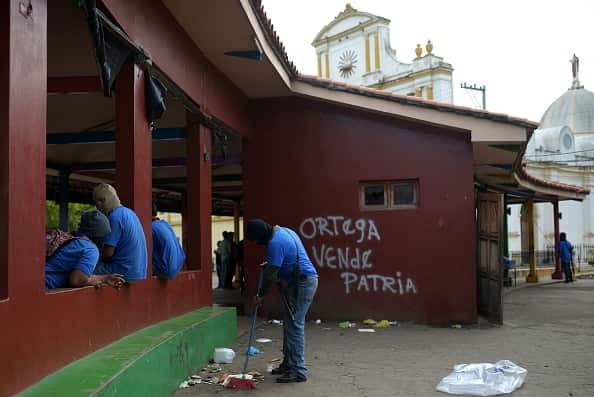
Alvaro Leiva, head of the Nicaraguan Association for Human Rights, said around 200 people had fled Masaya and were being "chased by police and paramilitaries using dogs to track them."
The taking of Masaya was a significant development in three months of unrest against Ortega and his government that has left some 280 people dead.
The city, Nicaragua's third-biggest, was a cradle of opposition to the US-backed dynasty of Anastasio Somoza that ruled until 1979, when it was toppled by the leftwing Sandinista guerrillas partly led by Ortega.
More recently it had become the main hub for opposition demands that Ortega step down after years of increasingly autocratic rule.
By crushing that opposition days after waging a similarly lethal operation against student protesters holed up in Managua, Ortega was seeking to project a picture of returning to normalcy under his authority on the eve of the 39th anniversary of the Sandinista revolutionary victory.
Thursday is expected to see a traditional, massive pro-government march in honor of that anniversary.
One pro-government militiaman in Masaya told AFP that the battle there had been lengthy.
"It was a battle that lasted nearly six hours on Tuesday," said the fighter, who identified himself only as Francisco, 45.
"The idea was to dislodge them (opposition groups) so that the city was free of roadblocks," he said. He added that residents "thanked us" for the intervention.
Locals posted on social media claims that the government operation involved 1,000 armed men, and videos of sustained exchanges of gunfire. But Francisco denied seeing any deaths, "only wounded on both sides."
Livia Castillo, a 38-year-old resident of the city, said she feared for her family during he battle, especially her teenage son who she believed could have been taken away.
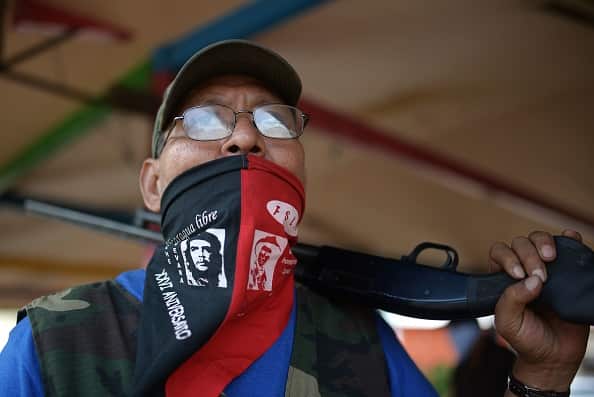
The pro-government forces "won the battle (but) the (local) men say they are not defeated, that they will continue. But as mothers we are worried about our sons," she said.
Other residents hailed the police and militia, hoping they would restore order so that Masaya's activity catering to tourists could return.
"Thank God for what happened, because peace has come back," said one woman who gave her name as Antonia, 34. "We only want better times and to work, nothing more. And that the tourists return, that they not be afraid."
The Masaya battle was waged despite sharp criticism from the US government, the European Union and UN chief Antonio Guterres over the worsening violence in Nicaragua, one of the poorest countries in the Americas.
A senior US State Department official for Western Hemisphere affairs, Francisco Palmieri, tweeted that Ortega must stop the violence. "The world is watching," he said.
On Wednesday, the head of the Inter-American Commission on Human Rights, Paulo Abrao, told AFP: "The situation in Nicaragua is alarming and growing worse by the day."
Ortega's aim in using force, he said, appeared to be to cut off any opportunity for dialogue with the opposition, which has remained firm in insisting the president go and be replaced through early elections.
In Washington, the Organization of American States called Wednesday on Ortega to set a date with the opposition on early elections. As it stands they are not due til 2021.