The pilot of a light plane that smashed into waters off the Victorian coast in bad weather, killing all on board, will remain a mystery.
Daniel Flinn, Donald Hateley and Ian Chamberlain and his partner Dianne Bradley all died when their Piper aircraft heading for King Island in Bass Strait nosedived near Point Lonsdale on the Bellarine Peninsula on January 29, 2016.
All three men were pilots but after more than a year of investigation, the Australian Transport Safety Bureau still can't say who was flying the plane.
"There was insufficient evidence to definitively identify the pilot in command for this flight," according to an ATSB report released on Friday.
Of the three pilots, two held the necessary qualifications to undertake the flight but none had instrument flying proficiency, increasing the risk.
As the plane entered the Bellarine, visibility became poor and the pilot initially made a 180-degree turn to backtrack to Point Lonsdale before heading south over the ocean.
After about two minutes the plane turned again and went into a rapid descent, hitting the water.
"Witnesses that saw the aircraft recalled that the visibility at that time was very low, such that it prevented them seeing the land," the report says.
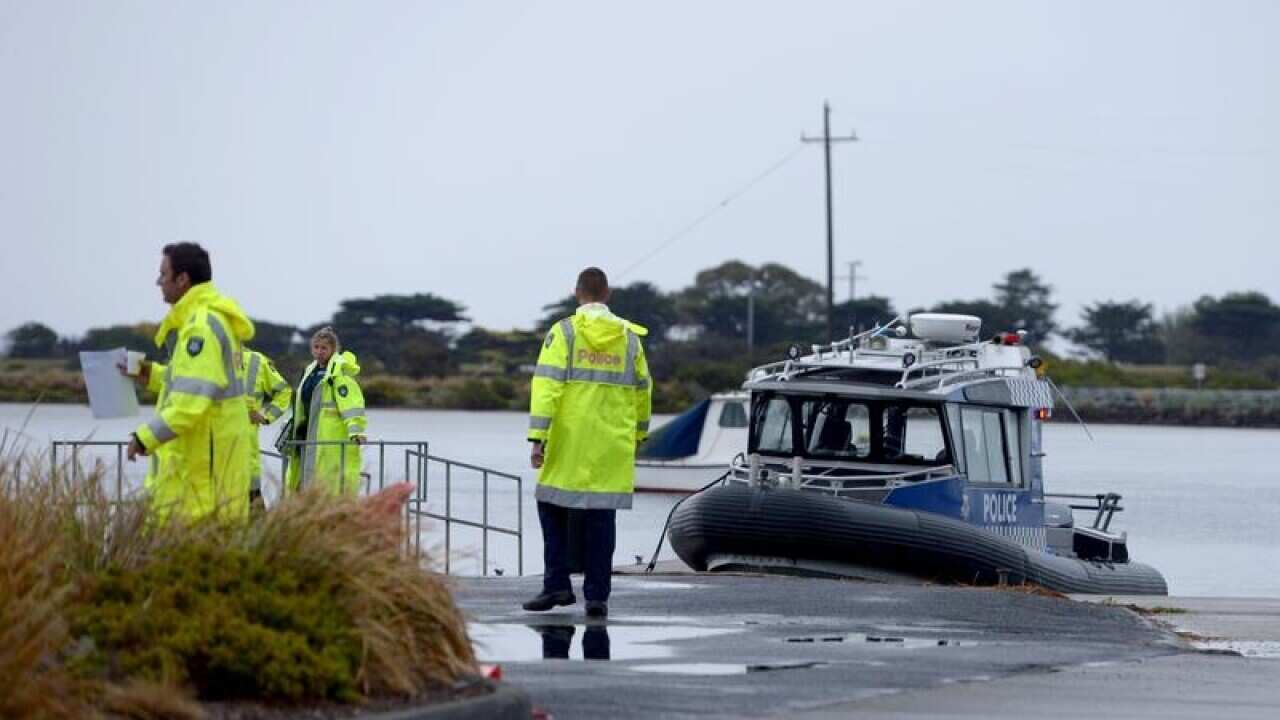
The main wreckage was not recovered until February 6, brought to the surface by police divers, a barge and lifting machinery.
The bodies of Mr Hateley, Mr Chamberlain and Ms Bradley were found soon after the crash and remains believed to be Mr Flinn's were recovered in late February 2016.
The ATSB found the continued flight beyond Point Lonsdale was probably influenced by the difficulty of assessing visibility and the loss of visual clues probably led to the pilot becoming "spatially disorientated".
The Bureau says education and training can help a pilot respond to deteriorating conditions.
"It is always possible that the actual weather conditions will be different to those forecast," the report says.
"The ATSB cautions that, on entering an area of reduced visual cues, the risk of experiencing spatial disorientation and a loss of control is high.
"This risk is highest for those without proficiency or recent experience in instrument flying. Requesting assistance from air traffic control can increase the chances of re-establishing visual cues."
Share


