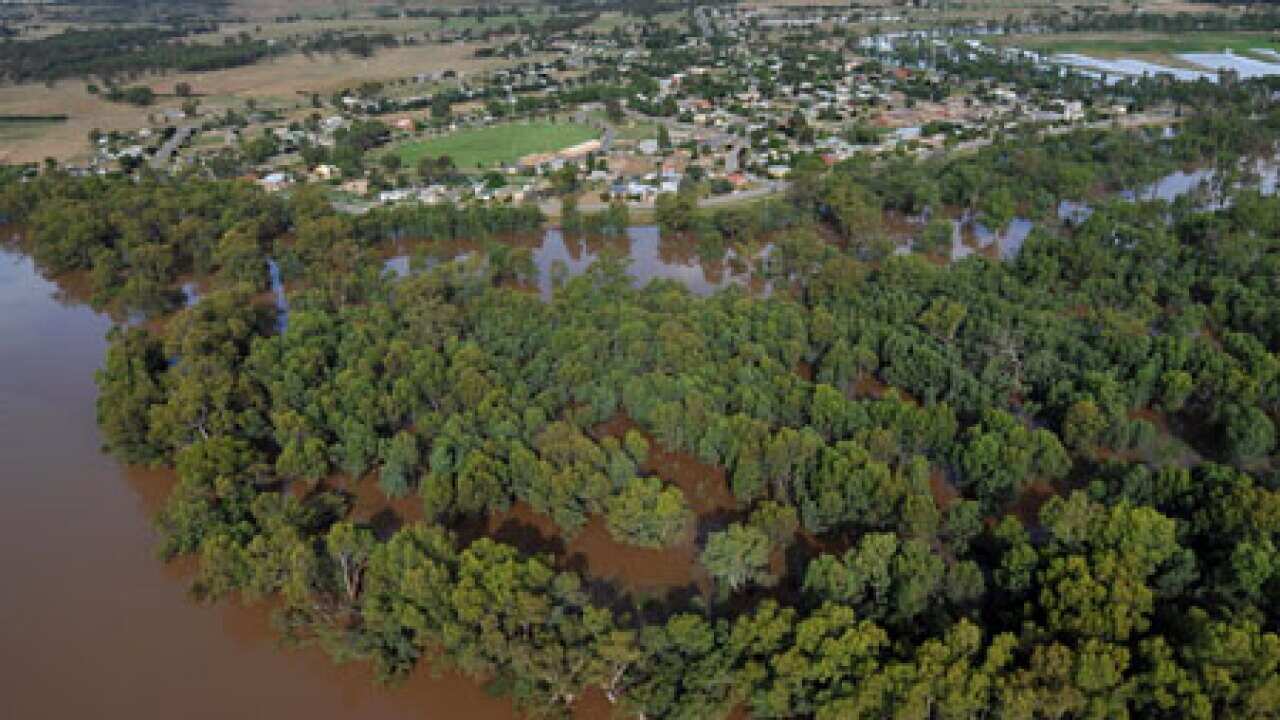
Authorities are confident levees at flood-ravaged Wagga Wagga and Coonamble will hold, with waters expected to peak below levels originally feared.
More than one thousand residents of Wagga Wagga in the state's central west have been evacuated as floodwaters continue to rise.
However, SES Commissioner Murray Kear said on Monday he was confident the levees in the Riverina city would hold on the Murrumbidgee River, with the flood expected to peak around 9.7 metres, below the major peak of 10 metres.
At Coonamble, where many residents have ignored evacuation warnings, the flood peak on the Castlereagh River reached on Monday morning was 5.3 metres, with the levee also expected to hold.
"The levee is holding here in Wagga Wagga, and ... we have predicted that it won't go through to the major peak of 10 metres," Mr Kear told reporters at Wagga Wagga.
News that makes sense
Your trusted source for staying up-to-date with the world around you. Get free daily news updates and analysis, straight to your inbox.
"Right about now (the Murrumbidgee) is about 9.7 metres, and it is moving slowly, and so our latest discussions with the Bureau (of Meteorology) ... indicate it might peak around this, maybe around 9.7, 9.8 (metres), but we're confident it won't reach the full 10 metres at the moment."
However, the reprieve may prove temporary for Wagga Wagga and other flood-affected towns across the state, with heavy rains forecast for later in the week.
"We're predicting, and the Bureau of Meteorology is forecasting, again heavy rain, Wednesday to Friday - up to 50 to 100 millimetres in some areas," he said.
"What that will mean to the already charged river systems across this part of the state, and certainly across most of the western slopes and into the north coast ... is that these rivers will again be in flood by the end of the week."
Mr Kear expressed frustration that people continued to ignore warnings to stay out of floodwaters, and cautioned them about the dangers of entering either on foot or in a vehicle.
"The SES is currently responding to nearly 1300 calls for assistance. Unfortunately 66 of those have been flood rescued, predominantly because people are still driving their cars through floodwater," he said. "Unfortunately the message doesn't get through, it seems, to everybody.
"We're saying never enter flood water, no matter how shallow or how familiar you are with a particular area.
"Please do not ride, drive, or walk through flood water." During a tour of the Wagga Wagga region on Monday, NSW Premier Kristina Keneally declared a further six shires as natural disaster areas - the Upper Lachlan, Wagga Wagga, Parkes, Narromine, Gilgandra and Warren.
Seventeen shires have been declared since the weekend, and another 17 are still declared after flooding rains in October.
"With a projected half a billion dollars wiped off the value of crops in NSW it is a sting in the tail for our farmers who have endured a decade of drought, and many of them expecting a bumper crop and the returns that would have brought," Ms Keneally said.
"The natural disaster declaration ensures that assistance will be provided, and as the waters recede, we'll be in a better position to judge the impact, to understand the impact and to consider what other assistance can be provided." However, farmers say the figure of $500 million is an underestimate.
"The true cost of the damage won't be known until people can get back in their paddocks and survey the damage," NSW Farmers Association president Charles Armstrong told AAP.
"But I suspect (the figure of $500 million) is a significant underestimation."
It was possible up to half of the state's $2.5 billion wheat crop could be wiped out, Mr Armstrong said.
Under the natural disaster declaration, shire councils will receive funds for the repair of roads, estimated to cost tens of millions of dollars, and for capital works and repairs.
Low interest loans will also be available for farmers and small businesses.
Speaking about her aerial tour of the Wagga region, Ms Keneally said it was "quite humbling to witness what nature can do to a town, to property and to people's livelihoods".
She urged Wagga Wagga residents who had so far refused to follow an SES evacuation order to "consider it strongly".
"We take a decision to issue an evacuation order based on the evidence and based on our concern for the preservation of human life," she said.
"So when those emergency services personnel knock on the door and issue an evacuation order, it is for people's own safety."







