In brief
- More than 2,400 people remain missing after catastrophic floods along the Nepal-Tibet border.
- Australian families have travelled to Nepal to help search for loved ones missing in the disaster.
The death toll from a devastating flash flood in Nepal and Tibet has risen to 626 as search and rescue operations were suspended due to bad weather.
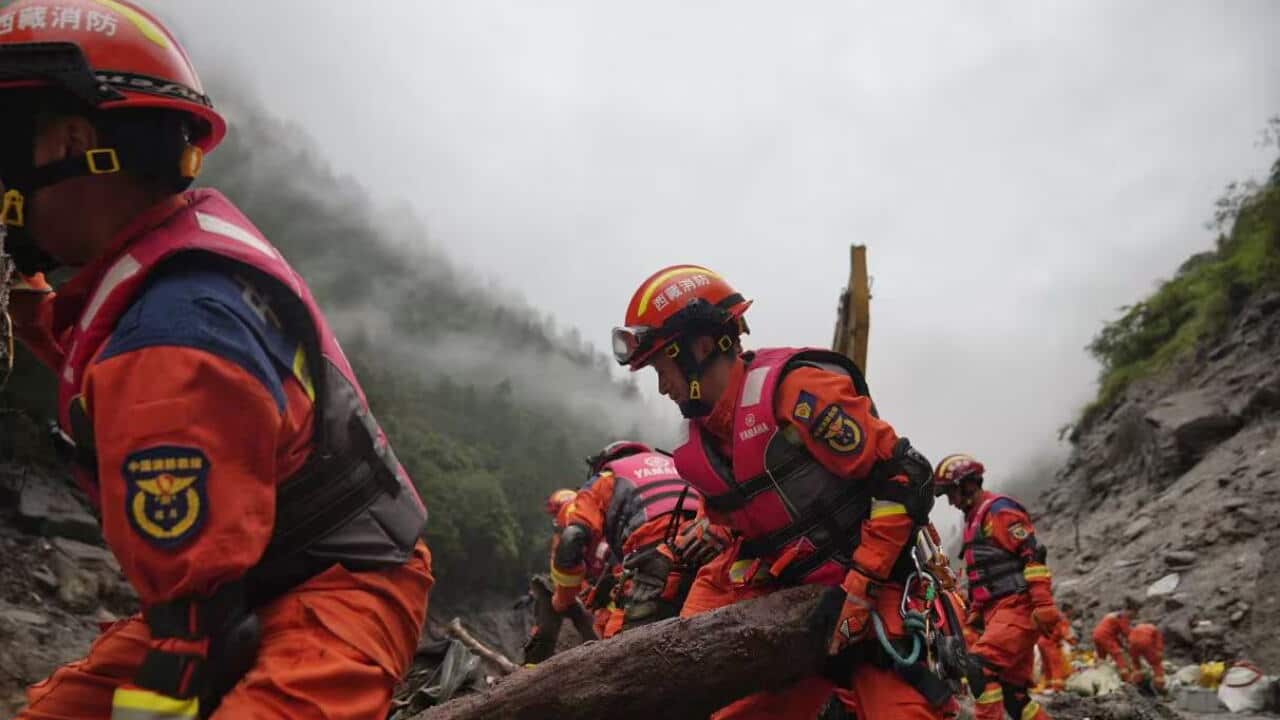
Rescue workers have been working around the clock since Wednesday's disaster after a glacier collapse unleashed a huge torrent of rock, ice, mud and debris through Himalayan mountain river systems as it swallowed buildings, bridges and power stations in its path.
Nearly 3,000 people are still missing — about 2,426 in Nepal and at least 558 in Tibet's Gyirong County — many of them Hindu pilgrims from India. Of those missing in the disaster, at least 540 are foreigners, including 41 Australians.
Only on Friday were rescuers able to reach Gyirong. State media reported the Chinese team of 21 rescuers and a search-and-rescue dog crossed mountains and valleys and used ropes to navigate forests and cliffs after roads to the complex, hemmed in by steep Himalayan slopes, were destroyed.
Authorities suspended rescue operations on Saturday because of rain and foggy weather, Narendra Pariyar, the top bureaucrat for the badly hit Rasuwa district, told Reuters.
News that makes sense
Your trusted source for staying up-to-date with the world around you. Get free daily news updates and analysis, straight to your inbox.
More than 90,000 people are estimated to have been affected by the disaster, the Red Cross said.
The flooding led to the formation of a lake, which on Friday began overflowing into the Lhende Khola and Trishuli rivers.
The overflow sparked panic and warnings from authorities in Nepal, leading to rescue operations being suspended for about three hours. The risk prompted all Chinese rescue personnel and vehicles to withdraw as well, China Central Television said.
Both resumed rescue operations after the threat eased, with Nepali officials saying that they were still hopeful of finding survivors.
Nepal is continuing to monitor two barrier lakes upstream of the flood zone, with an official warning that flood risks will persist until both lakes fully drain.
Chinese and Nepali authorities have warned further flooding may occur, complicating rescue efforts and posing a risk to communities in the area.
'I felt like I was dead'
Meanwhile, extraordinary stories of survival are emerging from areas struck by the disaster.
A man who was working at a bank in Timure, a Nepali village devastated by the floods, has recalled the harrowing moments as he escaped to safety from "three or four stories of water".
After hearing a loud noise that he feared was an earthquake or landslide, and seeing people running, he left everything behind and ran, he told SBS News.

"Just between 25 seconds, everything was gone," Gaurav Thapa Magar, 32, recalled, adding that as he climbed upwards to safety, he looked back but "nothing was there" but water.
"I felt like I was dead," he said. "I was panicking. Everyone was panicking, but the real feeling what I felt was: I'm gone. I have to run."
He credits his survival to his decision to leave all his belongings behind.
"There were so many things I had to take, and the primary thing is that I left everything and I had to walk away from my life for that moment."
The village of Timure has now "largely disappeared" on satellite imagery, according to BBC analysis.
Number of missing Australians rises to 41
The number of Australians confirmed missing rose to 41 on Saturday, but on Friday, one person made contact with their family.
The Department of Foreign Affairs and Trade (DFAT) is urgently working to contact that individual and understands they were last reported in a remote area several days' hike from Kathmandu.
Among those still missing is a Sydney family of four, including two boys aged 14 and 11, who were travelling on a pilgrimage near the Nepal-Tibet border.
Several Australians with family in the affected region have flown to assist the search for survivors, combing towns impacted by debris and torrents of mud.
Among them is the husband of NSW mother-of-two Reshma Patel, who was due to touch down in Kathmandu on Friday evening.

Patel was making a pilgrimage with a tour group when the floods began.
Her last known location was an immigration office along the Nepal-Tibet border, which was captured in viral footage that showed it inundated with floodwaters.
"She was inside the big building, which you can see in all the videos that had been hit hard by the floods at the border," family friend Chin Valsan told AAP.
"After that, there is no contact whatsoever."
Patel had been travelling with the Isha Foundation for almost two weeks, and was due to catch a flight home to Sydney from Kathmandu on Thursday.
"That hasn't happened," Valsan said.
Charities launch national aid appeal
While search-and-rescue operations are ongoing, charities have banded together to launch a national aid appeal.
The Nepal Flood Disaster Appeal was established by a coalition of 15 Australian charities including Oxfam Australia and Save the Children Australia.
The group, known as the Emergency Action Alliance, has warned survivors may find themselves cut off from reliable shelter, food, drinking water and medical care.
It is a fear shared by Kiran Thapa, 46, who told AAP his family in Nepal had survived the floods, but the real "trauma" would come once the dust had settled.
The paddy fields his family relies on for food had been destroyed while he worried his elderly mother may not have access to medication for weeks.
"After a few weeks or so, when they come to the realisation that they've lost everything ... that may be very hard for them to digest," he said.
Australia announces aid package
Foreign Minister Penny Wong unveiled a $5 million assistance package for communities affected by the floods, including $1 million to the Emergency Action Alliance.
DFAT crisis response personnel and other humanitarian response specialists have been deployed to Kathmandu to support consular efforts on the ground.
The Australian Red Cross has announced all donations to its global emergency fund from Thursday would go to Nepal, while World Vision Australia has launched its own dedicated appeal.
UNICEF is appealing for US$17.2 million to fund its emergency relief and recovery efforts, including for the 17,000 children it estimates have been affected.
"With the death toll still rising, we know this tragedy is far from over," Alice Akunga, UNICEF's Nepal representative, said.
Impacting recovery efforts is the fear of further flooding, which temporarily halted a Chinese rescue operation on Friday, according to state media.
Smartraveller updated its travel advice on Friday following reports of a lake barrier bursting, warning of a "high risk" of further severe flooding, landslides and debris flows.
"Conditions can change rapidly with little warning," the advice reads.
DFAT is working with Nepali authorities, tour operators and others to verify their welfare and contact their families.
Australians requiring emergency consular assistance can contact the 24-hour Consular Emergency Centre on 1300 555 135 in Australia or +61 2 6261 3305 from overseas.
The government is also urging Australians in affected areas to follow the advice of local authorities and monitor official travel advice.
For the latest from SBS News, download our app and subscribe to our newsletter.







