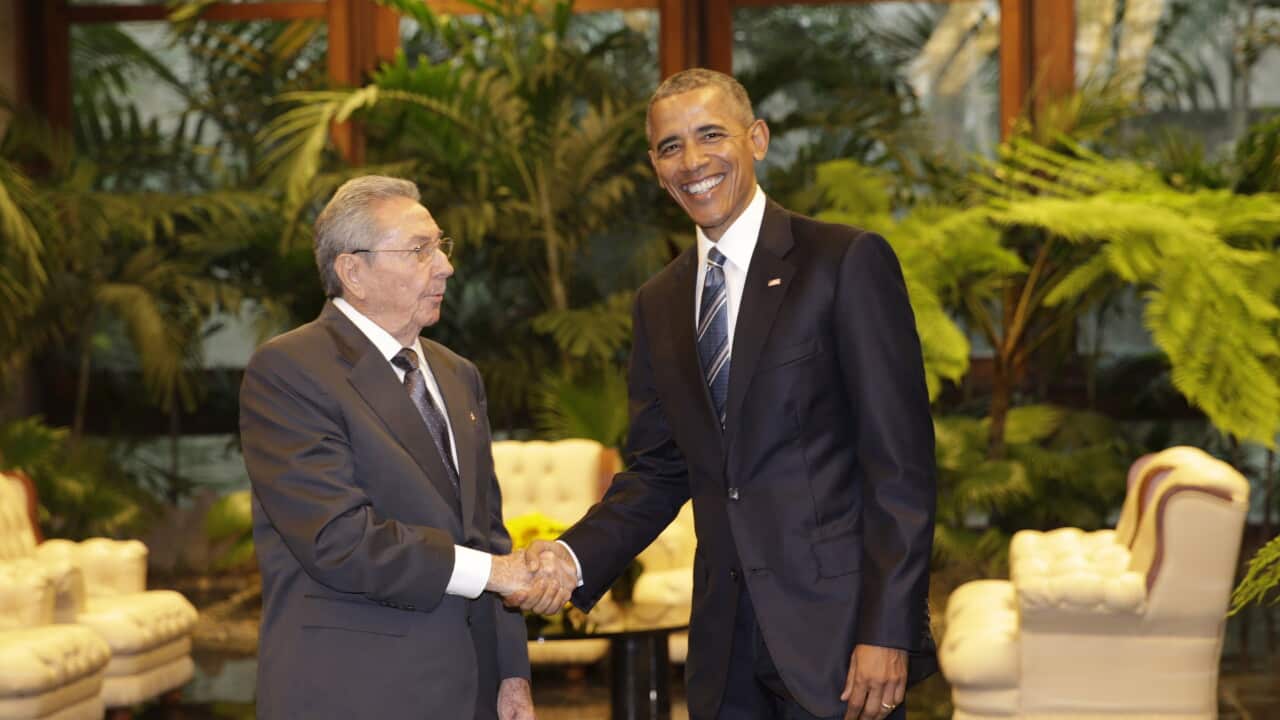
President Obama had lengthy talks with his Cuban counterpart, Raul Castro, in Havana.
The leaders discussed a number of contentious issues, such as human rights, but found common ground on the hope of lifting a US-imposed economic embargo on Cuba.
It is day two of an extremely significant three-day Cuban visit for Barack Obama, and the US President says the two nations are now engaged across more areas than he has witnessed in his lifetime.
He met Cuban President Raul Castro for discussions which lasted hours, and no topic was off the table.
The pair later held a joint press conference to go through those topics, President Obama saying the US has recognised developments made in Cuba, particularly in the fields of education and healthcare.
News that makes sense
Your trusted source for staying up-to-date with the world around you. Get free daily news updates and analysis, straight to your inbox.
He says both countries are looking to the future.
"When we share our deepest beliefs and ideas with an attitude of mutual respect, then we can both learn and make the lives of our people better and today I can report that we continue to move forward on many fronts when it comes to normalising relations. We're moving ahead with more opportunities for Americans to travel to Cuba and interact with the Cuban people. We're moving ahead with more trade. With only 90 miles between us, we're natural trading partners."
The countries agreed to greater cooperation for the prevention and treatment of diseases such as zika and cancer.
An initiative to educate more Cubans at US schools, and vice versa, was also announced.
Raul Castro added further agreements are being developed.
"We signed two memoranda of understanding, on protection of the environment and marine areas, and another to improve the security of maritime navigation. Today, one more will be signed on cooperation and agriculture. At this time, another group of bilateral instruments is being negotiated so as to see how we address drug trafficking, security in commerce, travellers, and health."
Cuba will also end its ten per cent penalty on US dollar conversions, which will make tourism mnore attractive.
But a trade embardo imposed on Cuba 50 years ago remains a barrier, as the US Congress continues to block Barack Obama's efforts to dismantle it.
Raul Castro calls it the "biggest obstacle" to Cuba's economic development.
President Obama says the embargo will eventually be lifted, but couldn't confirm when.
"How quickly that happens will in part depend on whether we can bridge some of our differences around human rights issues and that's why the dialogue I think is so important. It sends a signal that at least there's engagement between the two countries on these matters."
While the mood was certainly warm between the presidents, rhetoric became pointed at times during their hour-long press conference.
Raul Castro denied implications by a US journalist that Cuba held political prisoners, and angrily vowed to release any prisoner if someone gave him a list of who they were.
He also criticised the US over widespread issues of poverty and inequality, and called for territory "illegally occupied" by the US - including the naval base at Guantanamo - to be returned.
"There are profound differences between our countries that aren't going to disappear, for we have different views, different ways of thinking about various issues such as political models, democracy, the exercise of human rights, social justice, international relations and world peace and stability. We must learn the art of living together in a civilised manner with our differences."
Barack Obama says as long as the frank discussions remain respectful, the once-frosty relationship will continue to thaw.
"The road ahead will not be easy. Fortunately we don't have to swim with sharks in order to achieve the goals that you and I have set forth. Despite the difficulties we will continue to move forward. We're focused on the future, and I'm absolutely confident that if we stay on this course we can deliver a better and brighter future for both the Cuban people and the American people, so muchas gracias."







