US President Barack Obama has defended his administration's Iran policy, but says "huge challenges" remained to successfully implement a landmark deal on Tehran's nuclear ambitions.
Obama has come under fierce criticism from Republican rivals at home and key allies abroad, such as Israel, for pursuing a diplomatic solution to the Iran question.
Israel decried the breakthrough agreement reached in Geneva on Sunday - under which Tehran agreed to curb its nuclear program in return for an easing of sanctions - as a "historic mistake."
Obama, however, insisted that the US policy of diplomacy twinned with sanctions had been more productive than rhetoric, stating that "tough talk" alone would not guarantee US security.
"For the first time in a decade, we've halted the progress on Iran's nuclear program," Obama said. "Key parts of the program will be rolled back."
News that makes sense
Your trusted source for staying up-to-date with the world around you. Get free daily news updates and analysis, straight to your inbox.
Obama said diplomacy would continue over the coming months in a bit to settle "once and for all" the "threat of Iran's nuclear program".
"Huge challenges remain, but we cannot close the door on diplomacy, and we cannot rule out peaceful solutions to the world's problems," Obama said.
"We cannot commit ourselves to an endless cycle of violence, and tough talk and bluster may be the easy thing to do politically, but it's not the right thing for our security."
Earlier on Monday, France said the European Union could begin lifting sanctions on Iran next month as world powers set about implementing the deal with Tehran while seeking to placate a furious Israel.
In a radio interview, French Foreign Minister Laurent Fabius said EU foreign ministers were to meet next month to discuss lifting some sanctions as part of the deal, a move he said could take place "in December".
One senior Western diplomat, who refused to be named, told AFP the focus in the coming weeks would be "swift implementation".
Israeli Prime Minister Benjamin Netanyahu on Monday decided to send his national security adviser to Washington for talks on Iran after warning the deal will convince Tehran it has a free hand to achieve a breakout nuclear capability.
Obama has repeatedly tried to reassure Netanyahu, calling him on Sunday to discuss the issue.
The Geneva deal came just days after Iran's supreme leader described Israel as a "rabid dog" that was "doomed to collapse".
Tehran has a long history of belligerent statements towards the Jewish state, and Israel - the Middle East's sole if undeclared nuclear power - has repeatedly warned that a nuclear Iran would pose an existential threat.
Speaking in Jerusalem, the EU ambassador-designate to Israel, Lars Faaborg-Andersen, told a crowd of diplomats and the country's intelligence minister that the 28-member bloc had "Israel's security at heart".
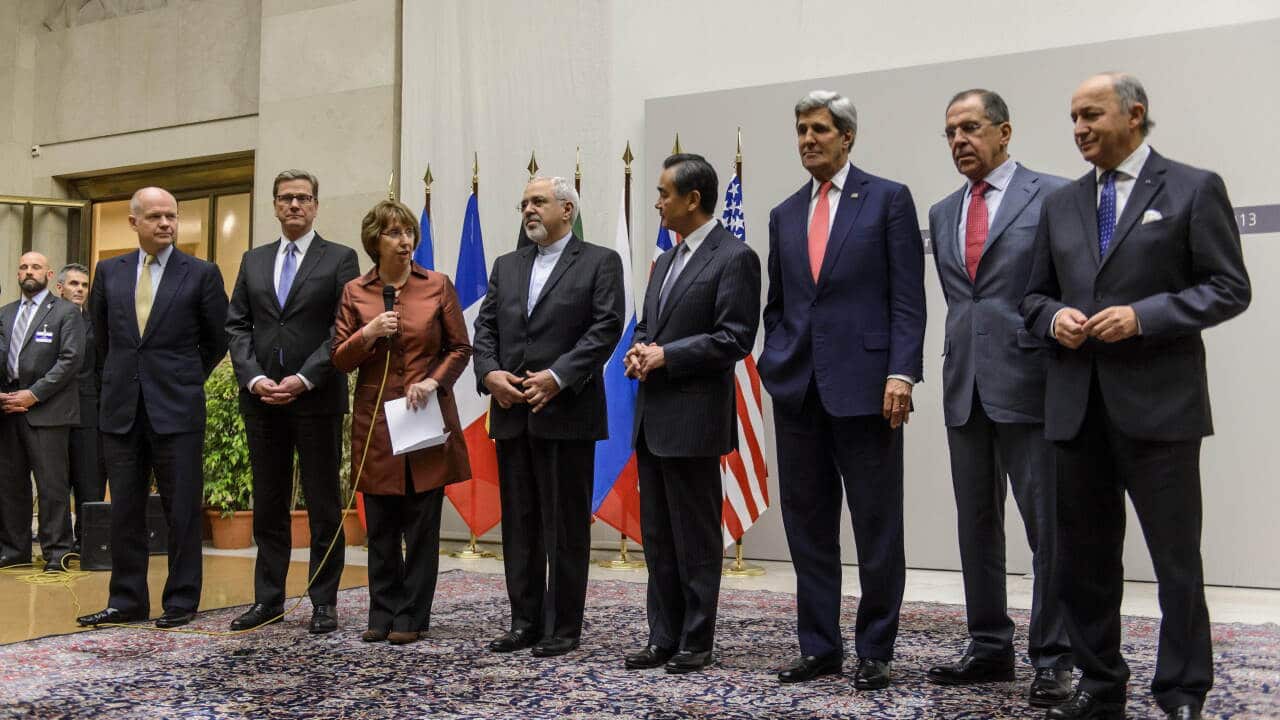
The so-called P5+1 world powers that negotiated the accord with Iran - the US, France, Britain, Russia, China and Germany - say it is a key first step that wards off the threat of military escalation in the volatile Middle East.
Under the deal, which lasts for six months while a more long-lasting solution is negotiated, Tehran will limit uranium enrichment to low levels used only for civilian energy purposes.
It will also neutralise its existing stockpile of uranium enriched to 20 per cent, which is close to weapons-grade and therefore an area of top concern.
In return, the Islamic state will get about $US7 billion ($A7.67 billion) in sanctions relief in access to frozen funds and in its petrochemical, gold and precious metals and auto sectors.
But the raft of international sanctions that have hobbled the Iranian economy remain untouched.
Fabius said that Iran committed "to giving up the prospect of a nuclear weapon" as part of the interim deal.
"As much as Iran can move forward where civilian nuclear energy is concerned, it cannot do so for the atomic weapon," he added.
But these pacifying moves have failed to convince many Israelis, and a poll conducted by the daily Israel Hayom found more than three-quarters of Israeli Jews believe Iran will keep up its nuclear drive despite the Geneva deal.







