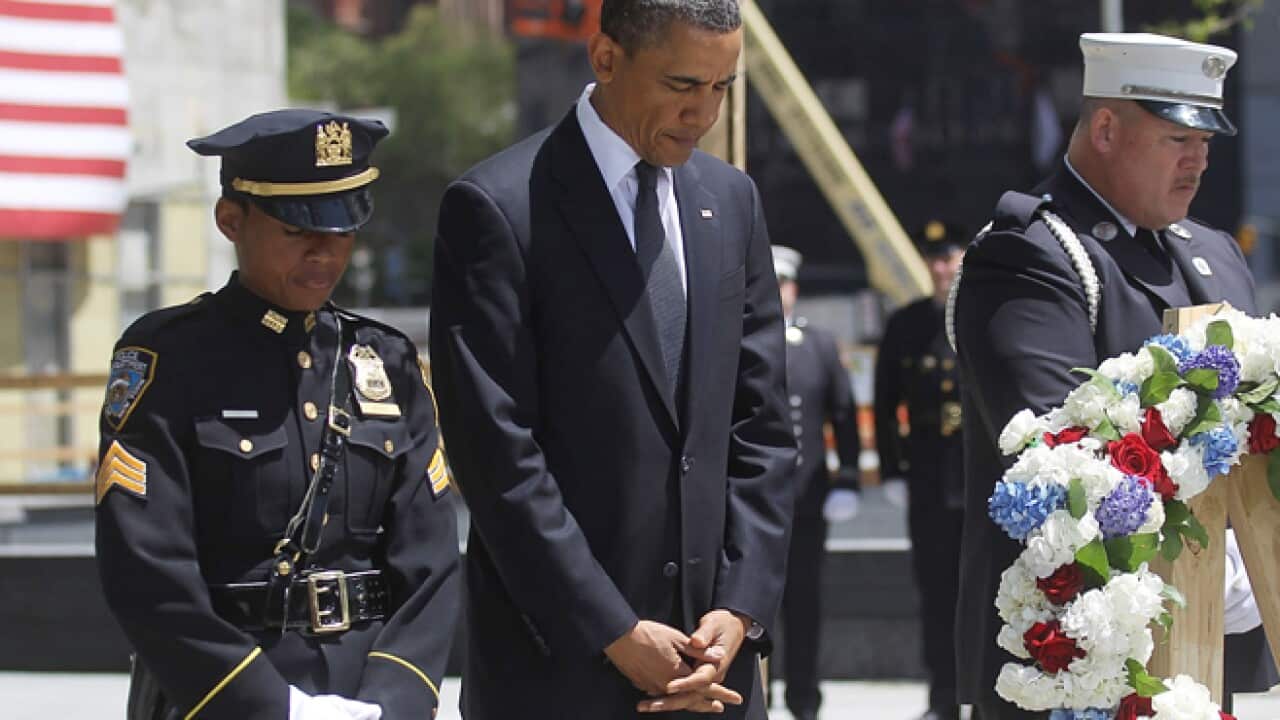
US President Barack Obama paid solemn tribute at the site of the downed Twin Towers here Thursday, days after 9/11 architect Osama bin Laden was shot dead by American commandos in a Pakistani lair.
In a moment of high symbolism in New York, Obama laid a wreath at Ground Zero before hugging relatives of those killed when Al-Qaeda extremists, presumed to be acting on bin Laden's orders, plowed their hijacked planes into the World Trade Center and the Pentagon, AFP reports.
Despite the momentous nature of bin Laden's death, almost a decade after his attacks drove a wedge between the West and the Muslim world, the ceremony was low-key and somber: a remembrance of those fallen rather than a victory celebration.
News that makes sense
Your trusted source for staying up-to-date with the world around you. Get free daily news updates and analysis, straight to your inbox.
Obama, making his first visit to Ground Zero as president, did not make a speech, but solemnly bowed his head and observed a moment of silence after laying the wreath along with city officials and the police and fire chiefs.
With Bin Laden dead, Obama sought to bring closure in his first presidential visit to Ground Zero, but in New York the emotional scars of 9/11 - and expectation of more conflict - run too deep.
"Things will always be embedded in your mind. It was horrifying and no one will be the same again after that," salesman Emilio Vasquez, 45, said after joining a crowd of about 2,000 greeting Obama.
"Bin Laden dying doesn't change anything. They're still out there all over the world and this fight's going to go on."
That view is shared by many in the Big Apple, which suffered most of the nearly 3,000 deaths on September 11, 2001.
The White House said Obama's visit, in which he laid a wreath and met with relatives of slain firefighters, would help "New Yorkers and Americans everywhere to achieve a sense of closure."
The wreath-laying ceremony took place in a building site that after years of delays is finally emerging as a visible sign of renewal from the devastation of 9/11, when hijacked airliners slammed into the World Trade Center, destroying both Twin Towers.
Yet for all the symbolism of Bin Laden's ending and Ground Zero's new beginning, nothing can erase the anger and fear still felt here.
"I saw people jumping out of windows on 9/11. I saw what they looked like," construction worker Alfred Douglas, 49, said.
Although he praised Obama for ordering the special forces operation against Bin Laden's Pakistani hideout, Douglas said he did not feel fully satisfied.
For that, he said, he'd need to see a photograph of the dead al-Qaeda leader: "I'd like to see the end result."
Raylene Stewart, a 43-year-old lawyer also in the crowd hoping to see Obama, said the dramatic victory for US forces had to be put in context.
"Until we can go to the airport and not see guns, not take off our shoes, not strip down baby strollers -- until then, nothing has changed," she said.
Peggy, a 44-year-old social worker, said real change would be America withdrawing from Afghanistan, something she saw unlikely to happen.
"I'd like him to say the wars will end and the soldiers can come back home," she said. "I'd like him to say that everything will be safe now, but of course he can't guarantee that."
When Ground Zero was still just a smoking ruin, then-president George W. Bush made a defining speech to herald the start of his so-called "war on terror," unleashing years of conflict around the world and the invasion of Iraq.
Obama will hope that his quieter visit - in the same place, but in far more auspicious circumstances - will also help define his presidency.
But the mood among New Yorkers shows how hard it may be to move on from 9/11, even with Bin Laden gone.
Parked on Broadway, a block from Ground Zero, was a fire engine, its red sides emblazoned in gold with the names of the 343 firefighters killed on 9/11. Above the names it read: "Never forget."







