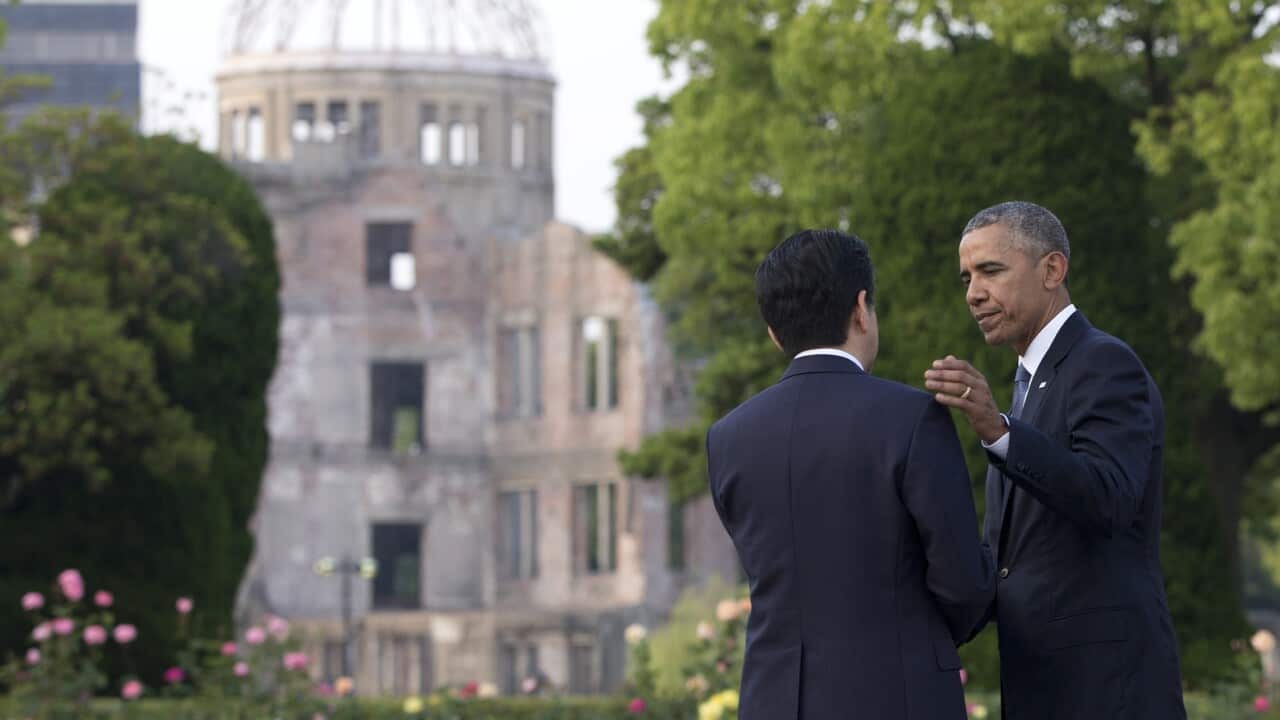
Barack Obama has became the first incumbent US president to visit Hiroshima, site of the world's first atomic bombing, in a gesture Tokyo and Washington hope will showcase their alliance and reinvigorate efforts to rid the world of nuclear arms.
Even before it occurred, the visit stirred debate, with critics accusing both sides of having selective memories, and pointing to paradoxes in policies relying on nuclear deterrence while calling for an end to atomic arms.
The two governments hope Obama's visit to Hiroshima, where a US atomic bomb killed thousands instantly on August 6, 1945, and some 140,000 by the year's end, underscores a new level of reconciliation and tighter ties between the former enemies.
"We come to ponder the terrible force unleashed in the not so distant past," Obama said after laying a wreath at the peace memorial.
"We come to mourn the dead, including over 100,000 Japanese men, women and children, thousands of Koreans and a dozen Americans held prisoner. Their souls speak to us."
News that makes sense
Your trusted source for staying up-to-date with the world around you. Get free daily news updates and analysis, straight to your inbox.
Before laying the wreath, Obama visited a museum where haunting displays include photographs of badly burned victims, the tattered and stained clothes they wore and statues depicting people with flesh melting from their limbs.
"We have known the agony of war," he wrote in the guest book. "Let us now find the courage, together, to spread peace, and pursue a world without nuclear weapons."
After speaking, Obama shook hands and chatted briefly with two atomic bomb survivors. Obama and Sunao Tsuboi, 91, smiled as they exchanged words; Shigeaki Mori, 79, cried and was embraced by the president.
The city of Nagasaki was hit by a second nuclear bomb on August 9, 1945, and Japan surrendered six days later.
A majority of Americans see the bombings as having been necessary to end the war and save lives, although some historians question that view. Most Japanese believe they were unjustified.
The White House had debated whether the time was right for Obama to break a taboo on presidential visits to Hiroshima, especially in an election year.
But Obama's aides defused most negative reaction from military veterans' groups by insisting he would not second-guess the decision to drop the bombs.
Obama's main goal in Hiroshima was to showcase his nuclear disarmament agenda, for which he won the 2009 Nobel Peace Prize.
He avoided any direct expression of remorse or apology for the bombings, a decision that some critics had said would allow Japan to stick to the narrative that paints it as a victim.
For atomic bomb survivor Eiji Hattori, Obama's remarks provided solace.
"I think it was an apology," said Hattori, 73, who was a toddler at the time of the bombing and now suffers from three types of cancer.
"I didn't think he'd go that far and say so much. I feel I've been saved somewhat ... For me, it was more than enough."







