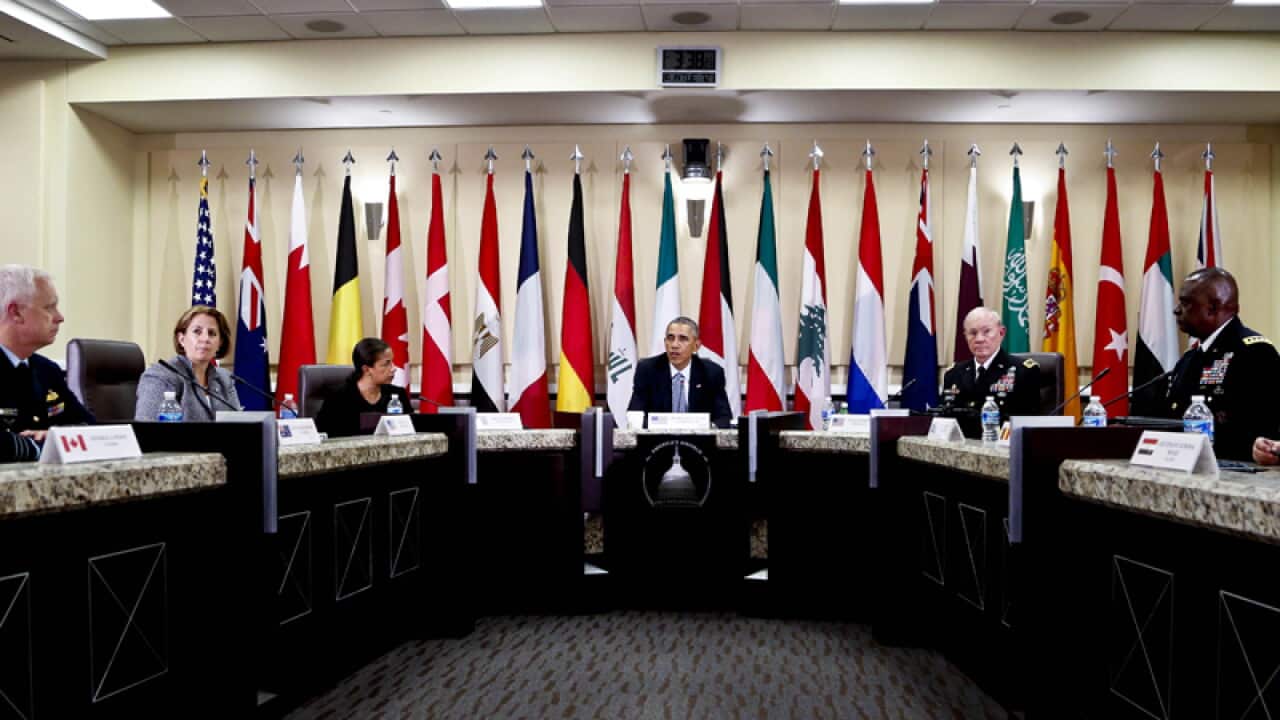
President Barack Obama has attempted to rally allied commanders around his emerging strategy to defeat Islamic State jihadists, as the US-led air armada stepped up its raids in Syria.
Coalition jets carried out two dozen strikes to relieve pressure on Kobane, but Obama admitted to deep concern about the Syrian border town's fate and he warned of a long campaign ahead.
In Washington, the president and the US military's top officer General Martin Dempsey on Tuesday met senior commanders from more than 20 Western and Arab allies involved in the campaign.
"One of the things that has emerged from the discussions, both before I came and during my visit here, is that this is going to be a long-term campaign," Obama warned.
"There are not quick fixes involved. We're still at the early stages," he said, explaining that efforts were focused on breaking the siege of Kobane and on halting the IS advance in western Iraq.
News that makes sense
Your trusted source for staying up-to-date with the world around you. Get free daily news updates and analysis, straight to your inbox.
"As with any military effort, there will be days of progress and there are going to be periods of setback, but our coalition is united behind this long-term effort," he added.
A US military official, summing up the situation, said: "The coalition has strategic momentum although ISIL has tactical momentum."
The coalition will also need to adapt "by leveraging all elements of power", he added, stressing that military action alone "will not be decisive".
The military meeting, at an airbase outside Washington, came after allied warplanes carried out their latest raids: 21 strikes over two days around Kobane, a Kurdish town on Syria's border with Turkey.
The bombing was designed to halt an IS offensive which has seen jihadists push into the town, threatening a massacre under the noses of the Turkish troops and world media watching from the border.
"Obviously at this point we're also focused on the fighting that is taking place in Iraq's Anbar province, and we're deeply concerned about the situation in and around the Syrian town of Kobane," Obama told reporters on Tuesday.
A Syrian exile rights group reported that the latest strikes had at least saved Kobane from "falling entirely into the jihadists' hands", but Obama admitted he was still worried.
IS fighters are now in almost complete control of Sunni-majority Anbar, Iraq's largest province, and are closing in on the western outskirts of Baghdad, headquarters of the Shi'ite-led government.
The talks marked the first time high-ranking officers from so many nations have come together since the US-led coalition was formed in September and which now, on paper, includes about 60 countries, including Australia.
Turkey, which has faced a three-decade Kurdish insurgency, has tightened security of its porous Syrian border after the fighting in Kobane sparked the exodus of 200,000 refugees.
But it remains a cautious ally. Turkey's troops have not intervened in Kobane despite being only a few hundred yards from the fighting, and it has yet to allow US jets to mount attacks from its territory.
Turkey further complicated issues on Tuesday when officials in Ankara said Turkish jets bombed Kurdish rebel targets in the southeast of the country in the first such strikes against the separatists since an increasingly fragile 2013 ceasefire.
Kurdish fighters were trying to push into the eastern sector of the town, under IS control, said the Syrian Observatory for Human Rights, a British-based rights group which has a wide network of sources inside Syria.
Meanwhile, Iraqi forces are reported to be under intensifying pressure in Anbar province, where the town of Heet fell to the IS advance on Monday, according to Iraqi military sources.
Pro-government forces in northern Iraq were under pressure near the strategic Baiji oil refinery, where US aircraft Sunday dropped supplies including food, water and ammunition to Iraqi troops for the first time.
In Baghdad, an Iraqi lawmaker and prominent Shi'ite militia leader, Ahmed al-Khafaji, was one of at least 21 people killed by a suicide car bomb in the Shi'ite neighbourhood of Kadhimiyah.
The third bombing in Kadhimiyah in four days, Khafaji's killing was immediately claimed by the Islamic State group.
Countries taking part in the meeting were: Australia, Bahrain, Belgium, Britain, Canada, Denmark, Egypt, France, Germany, Iraq, Italy, Jordan, Kuwait, Lebanon, the Netherlands, New Zealand, Qatar, Saudi Arabia, Spain, Turkey, the United Arab Emirates and the United States.







