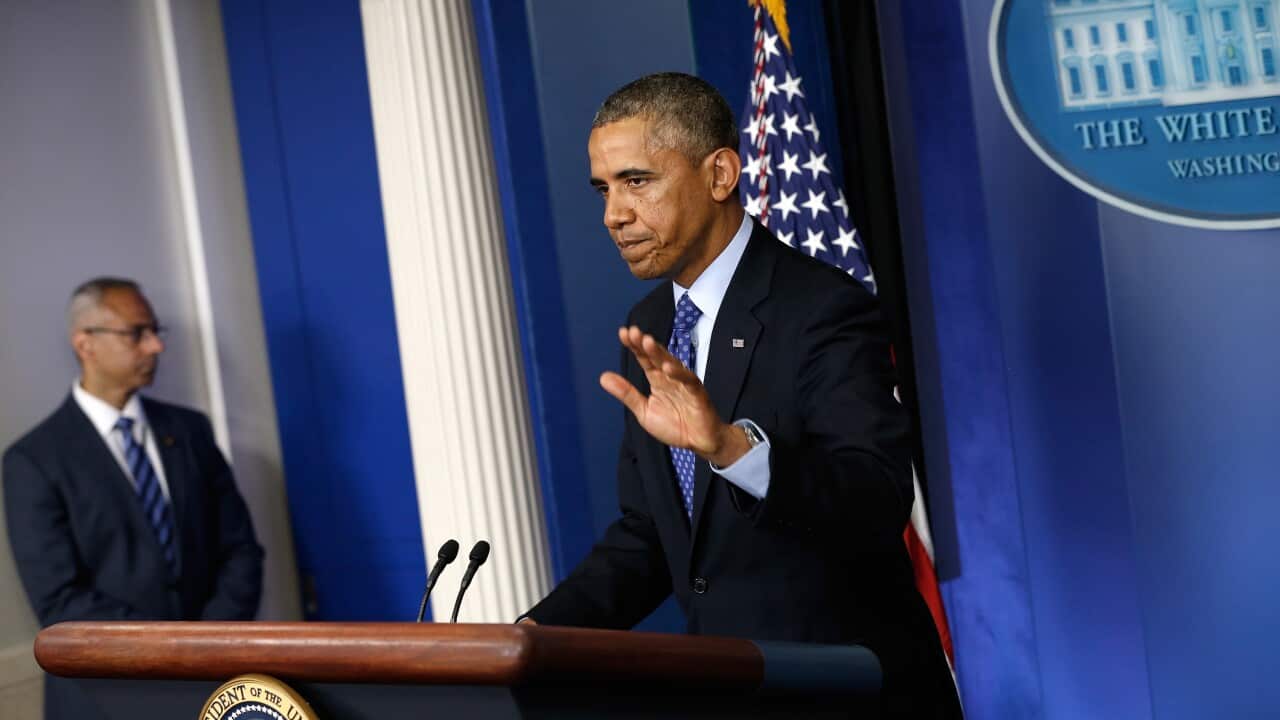
US President Barack Obama has called on Congress to approve $US500 million ($A540 million) to train and equip vetted Syrian rebels battling the forces of strongman President Bashar al-Assad.
Following strong hints by Obama in recent weeks, the White House said it intends to "ramp up US support to the moderate Syrian opposition".
It proposed the funding for "vetted elements of the Syrian armed opposition, to help defend the Syrian people, stabilise areas under opposition control, facilitate the provision of essential services, counter terrorist threats and promote conditions for a negotiated settlement".
The proposal was part of the $US65.8 billion overseas contingency operations request to Congress for fiscal year 2015, which begins on October 1.
"The administration will develop the details of this envisioned program in consultation with the Congress and our international partners," the White House said.
News that makes sense
Your trusted source for staying up-to-date with the world around you. Get free daily news updates and analysis, straight to your inbox.
Washington has been studying options for providing additional assistance to rebel forces beyond the existing aid, which includes mainly "non-lethal" support.
While US officials normally publicly refuse to comment on exactly what they are doing to train opposition groups, Obama's National Security Adviser Susan Rice acknowledged early this month that the Pentagon was aiding Syrian rebels with "lethal and non-lethal support".
About $US287 million in mainly non-lethal support has been cleared for the rebels since March 2011, and the CIA has participated in a secret military training program in neighbouring Jordan for the moderate rebels.
The request comes at an extraordinarily sensitive time in the Middle East, with Sunni ISIL jihadists in Iraq, who are threatening to overtake Baghdad, joining forces with extremists in Syria.
Rights observers have said members of Al-Qaeda's franchise in Syria, Al-Nusra Front, pledged loyalty to the Islamic State of Iraq and the Levant (ISIL), giving it control over both sides of the frontier.
The $US500 million in aid is part of a proposed $US1.5 billion "regional stabilisation initiative" to bolster stability in Syrian neighbours Jordan, Lebanon, Turkey and Iraq, and to support communities hosting refugees.







