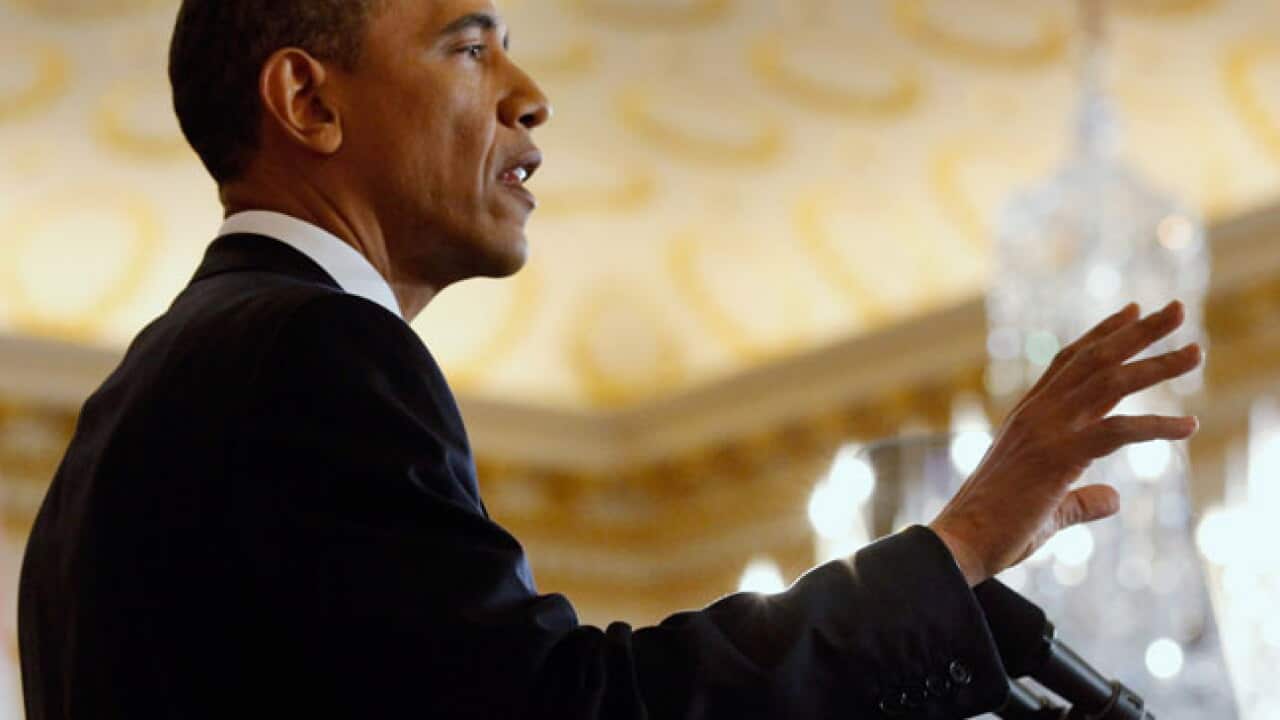
US President Barack Obama has stood his ground to defend his vision of an Israel-Palestinian peace deal following an unprecedented public lambasting from Israel's Benjamin Netanyahu.
Obama took his message to some 10,000 of Israel's staunchest supporters, warning Washington's pro-Israel lobby that the results of a continued stalemate in the Middle East peace process could be dire for the Jewish state.
And after twice dismissing Obama's views as "based on illusions", it was Israeli Prime Minister Netanyahu who appeared to be backing away from further confrontation, now saying he shared Obama's vision for peace.
The crux of the dispute was over Obama's call to see the borders that existed before the 1967 Arab-Israeli war form the basis of a future Palestinian state.
Netanyahu summarily rejected this, interpreting it as a call to return to the actual border lines and saying they were militarily "indefensible".
News that makes sense
Your trusted source for staying up-to-date with the world around you. Get free daily news updates and analysis, straight to your inbox.
But on Sunday, Obama told delegates at the American-Israel Public Affairs Committee that this "misrepresented" his position because it ignored his call for mutually agreed adjustments to the border.
"It allows the parties themselves to account for the changes that have taken place over the last forty-four years, including the new demographic realities on the ground and the needs of both sides," he said.
While Obama is the first US president to specifically state that the 1967 borders should form the basis of a Palestinian state, he said this formula has long been the basis of negotiations and in laying it out he had done "nothing particularly original".
"If there's a controversy, then, it's not based in substance," Obama said. "What I did on Thursday was to say publicly what has long been acknowledged privately."
Following the speech Netanyahu made no mention of the 1967 borders. Instead, his office said: "Netanyahu expressed his appreciation for the words of President Obama at AIPAC."
"I am partner to the president's desire to foster peace and I value his efforts in the past and the present to achieve this goal," Netanyahu said, adopting a more conciliatory tone.
Netanyahu also had reason to be pleased with Obama's speech, which accepted shifting the border to accommodate "new demographic realities", which for Israel means being able to keep the large settlement blocs in the West Bank.
These blocs are mostly close to the 1967 lines and are home to the majority of the settlers, meaning Israel would only have to evacuate more isolated settlements deeper in the occupied territory under any peace deal.
Meanwhile, Palestinian president Mahmud Abbas cautiously hailed Obama's stance as a "step in the right direction," his spokesman Nabil Abu Rudeina told AFP.
Obama said he knew the "easy thing to do, particularly for a president preparing for re-election, is to avoid controversy," but added he took the stand because of the urgency of reviving peace talks.
Obama supervised the relaunch of negotiations last September only to see them collapse within weeks when Netanyahu refused to renew a partial freeze on Jewish settlements in the West Bank.
The Palestinians then refused to come back to talks while Israel builds on land they want for their promised state.
Obama said the longer the dispute went unresolved, the worse it would be.
"The world is moving too fast. The extraordinary challenges facing Israel would only grow. Delay will undermine Israel's security and the peace that the Israeli people deserve," the president said.
These sentiments were echoed by Jordan's King Abdullah II, who warned that failure to resolve the issues could plunge the region into war.
"I just have a feeling that we're going to be living with the status quo for 2011 ... Whenever we accept the status quo, we do so until there is another war," Abdullah II told ABC television's "This Week."
"If you look to the past 10 years, every two to two-and-a-half years, there is either the intifada or a war or a conflict," he said, referring to the Palestinian uprising.
"So looking back over the past 12 years, my experience shows me that if we ignore the Israeli-Palestinian issue, something will burst."
Obama's remarks on the controversy - coming on the eve of Netanyahu's own speech to AIPAC - received loud applause from the thousands of delegates who drowned out a few boos.
Still, not all were convinced of Obama's commitment to the security of Israel.
"Most of us are very disappointed in Obama's comments," Cheryl Rosenbaum, an AIPAC delegate from outside Chicago told AFP.
"I need a safe and secure Israel," she said, and while Washington must maintain its airtight relationship with the Jewish state, "we shouldn't be dictating Israeli policy"..







