
in brief
- One Nation MPs presented conflicting figures regarding their proposed annual net overseas migration targets.
- Party leader Pauline Hanson clarified that the official policy remains a strict cap of 130,000.
One Nation MP Barnaby Joyce has faced questions over his party's immigration target, claiming fellow MP David Farley misspoke when he revealed their figures were "not too different" from Labor's.
The MP for Farrer told ABC's Insiders program on Sunday that One Nation's stated figure of 130,000 net overseas migration annually into Australia did not include those who enter under a Pacific labour scheme, aged-care nurses, and other in-demand skilled workers.
He conceded that those groups would add roughly 100,000 people, bringing their total to 230,000 — 5,000 fewer than the current Labor budget projections.
Party leader Pauline Hanson intervened just hours later, writing on social media that One Nation's policy is to reduce net overseas migration (NOM) to 130,000.
Speaking to Channel Seven's Sunrise program on Monday, Joyce added that Farley simply made a mistake while explaining the numbers.
News that makes sense
Your trusted source for staying up-to-date with the world around you. Get free daily news updates and analysis, straight to your inbox.
"Show me a political career where people haven't made a mistake, and I'll show you a person who's not told the truth," Joyce said.
"I'm not going to throw anybody under a bus. When people are new in parliament, they can sometimes get things incorrect, and that's what happens. God knows, I've done it enough."
The debate over Australia's migration figures has intensified in recent months, with a recent Redbridge/Accent Research poll, conducted for the Australian Financial Review, indicating that voters trust One Nation and its traditionally restrictive approach to handle migration better than Labor or the Liberal Party.
However, the disjointed nature of One Nation's ongoing public discourse on the topic has prompted claims that the party is "incoherent" and "not fit to govern" from federal minister Pat Conroy.
What is One Nation's immigration target?
Since its 1997 inception, cutting immigration has been seemingly a foundational pillar of One Nation policy. During her first speech to federal parliament, Hanson alleged Australia was in danger of being "swamped by Asians", that migrants never assimilated, and that multiculturalism should be abolished.
Its website currently states One Nation would "cut immigration by over 570,000 people" through "capping visas at 130,000 per year".
In a social media post on Sunday, Hanson wrote that NOM would be cut to 130,000 — a figure the party has previously clarified to SBS News. This number would be achieved by reducing international students, temporary graduate visas, and a "much more targeted" skilled migration program, Hanson said.
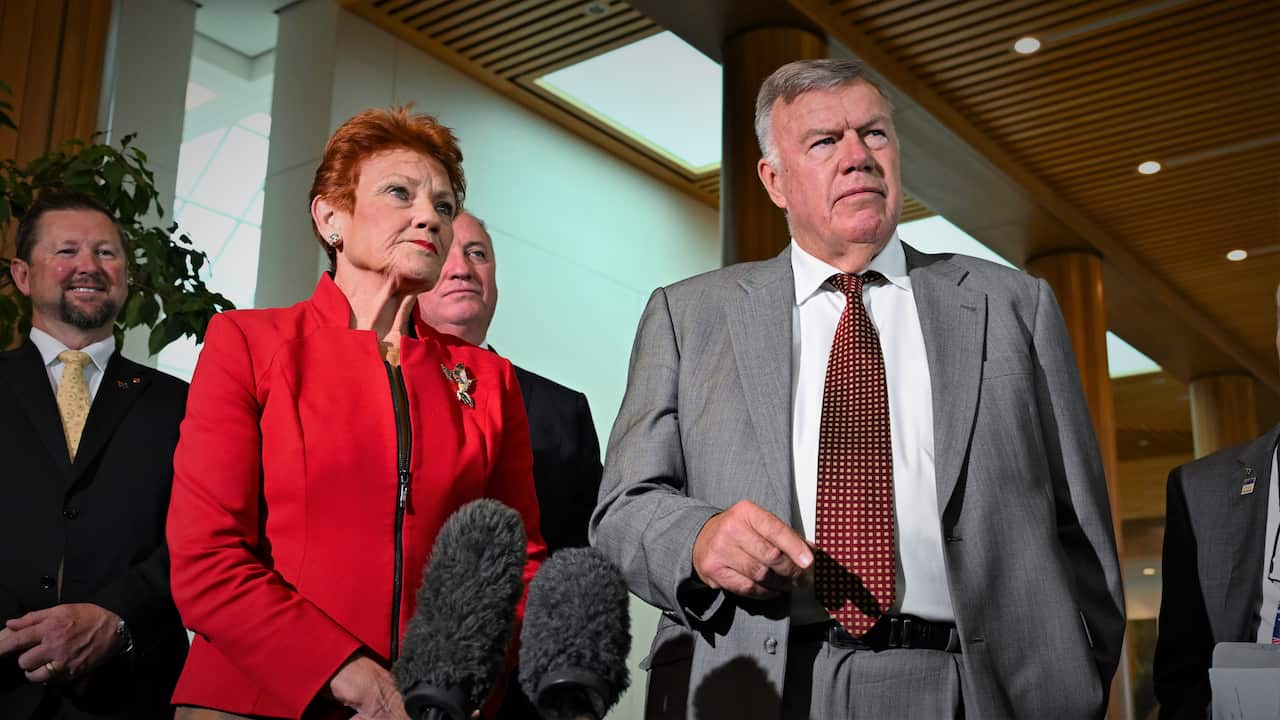
Those figures are different to the ones put forward by Farley, who said One Nation is focusing on "the NOM in its true form", as separate to labour programs "that drive our economy".
"The raw number is not too different [to current projections], but the reality is, where do we need them?" he asked.
"We don't need them in the great urban metroplex — we need them out to be productive, working in agriculture, engineering, mining."
Joyce further affirmed Hanson's view that One Nation's policy remained at 130,000 people annually for NOM.
SBS News has contacted One Nation for comment.
Where do Labor and the Coalition stand on immigration?
NOM hit 306,000 in the 2024-2025 period, down from a post-pandemic peak of 538,000.
Labor is yet to unveil its plan to restrict migration, but has previously set an official cap of 185,000 places on the permanent migration program. Treasury figures project that NOM will fall to 225,000 by the 2027-28 financial year.
Home Affairs Minister Tony Burke was set to detail Labor's plan to ensure that forecast was met, but pulled out of a National Press Club address at the last minute over fears about the implications cuts would have for certain sectors.
"Our policy will be released when Tony Burke is in a position to do so," Conroy told ABC Radio National on Monday. "But we've been very focused on getting the right migration mix to grow the economy as well as the broader interests of Australia."
Opposition leader Angus Taylor has said the Coalition will cap NOM at or below the number of homes built in Australia the previous year. Current building rates suggest their figure would be under 180,000; however, the Coalition is yet to announce where they would restrict immigration to reach that figure.
Opposition immigration spokesperson Jonathon Duniam told ABC Radio National that the Coalition is being "fairly methodical" in assessing its figures but that he would not "put a date" on when it will reveal details.

Duniam attacked One Nation for being cavalier with its migration figures, saying it had not detailed the impact such reductions would have on industries like agriculture, which relies on working holiday visa holders for seasonal labour.
"It was the same leader of One Nation who said in an interview about a week ago as well that she did not care about the impact on business any change to the migration system would have," Duniam said.
What's in a NOM?
NOM is difficult for governments to control because it is a measurement of human behaviour rather than a fixed quota.
NOM is calculated by the Australian Bureau of Statistics (ABS) based on the movement of people, subtracting overseas departures from overseas arrivals. To be included, a person must remain in the country for any 12 out of 16 months.
Citizens, permanent residents, temporary visa holders, and asylum seekers are included, as are backpackers and working holiday makers who stay for more than a year.
In 2024-2025, 568,000 people entered Australia, according to the ABS, down 14 per cent on the previous year.
Of that cohort, 88,000 were permanent visa holders, 53,000 were New Zealand citizens, and 64,000 were returning Australians. At the same time, 263,000 people left the country.
As Hanson stated, "short-term seasonal agricultural workers who do not meet the ABS residency test are not counted in net overseas migration".
However, using Farley's figures, many of the 100,000 additional workers he says would be able to enter the country — such as workers under the Pacific Australia Labour Mobility (PALM) scheme — would be included in NOM.
PALM workers can enter under a short-term placement of up to nine months or a long-term placement of one to four years.
The visa caps One Nation plans to set would place policy restrictions on NOM, but they can't control it entirely. Australians suddenly returning home en masse from abroad would, for example, elevate the figure regardless of visa caps.
Migration experts have long cautioned that linking migration to housing shortages is a flawed argument and that, in fact, migrant workers are essential to increase housing stock.
"If we don't have workers doing the jobs we need, if we don't get the right skill set into our country, then we all are worse off," Duniam said.
"One Nation has zero regard for that, as evidenced by the multiple positions they've had on migration policy all over the last few weeks."
For the latest from SBS News, download our app and subscribe to our newsletter.







