
Key Points
- The Coalition says it wants to boost housing supply through infrastructure funding while reducing migration.
- An expert has warned drastically cutting migration could leave Australians worse off.
Australia should only let in one migrant per house built, the Opposition has pitched in its federal budget rebuttal.
A link between Australia's housing crisis and cuts to migration was central to Angus Taylor's first budget reply as Opposition leader, as he begins the journey to claw back votes lost to One Nation.
"This is a common-sense housing plan. Australia should only bring in as many people as it can house," he said on Thursday night.
"Under Labor, migration has run miles ahead of housing and that puts pressure on rents, house prices and on every young Australian trying to get ahead."
The Opposition's plan includes cutting red tape, redirecting a large portion of Labor's $47 billion housing agenda and recycling the $5 billion infrastructure fund, part of former leader Peter Dutton's 2025 election pitch.
News that makes sense
Your trusted source for staying up-to-date with the world around you. Get free daily news updates and analysis, straight to your inbox.
What's inside its housing pitch and how does it compare to Labor's?
Housing used to justify migration cuts
Net overseas migration (NOM) is the annual change in the Australian population due to people arriving and leaving.
The Opposition would like to cap the NOM based on the number of dwellings built, allowing the construction industry to catch up.
It's unclear what the exact figures would be under a Coalition government.
While the government aims to build 1.2 million homes by the end of the decade, based on current projections, it will fall 200,000 homes short of the target.
In 2024-25, 174,752 homes and apartments were built. The NOM was 306,000 people in the same year.
Emeritus professor Hal Pawson from the University of NSW's City Futures Research Centre said the assumption that every migrant needs a new dwelling was "pretty strange".
He said it's the number of households, not people, that drives housing demand, noting that the average household size is 2.5 residents.
"I think the problem here is a bigger one, which is that migration isn't as dominant as many people believe in creating, determining the demand for housing that we experience in Australia," he said.
Pawson said the COVID-19 pandemic, a time when international borders were closed and migration dropped, but both house prices and rents rose, as illustrating the "complexity of the market".
The NOM has been under scrutiny in recent years by some conservative politicians critical of a perceived spike, which actually may read as more of a levelling out, with numbers reaching close to where they were before 2020. NOM had plunged to negative 94,000 at the height of the COVID-19 pandemic in March 2021, but then rose sharply as borders reopened.
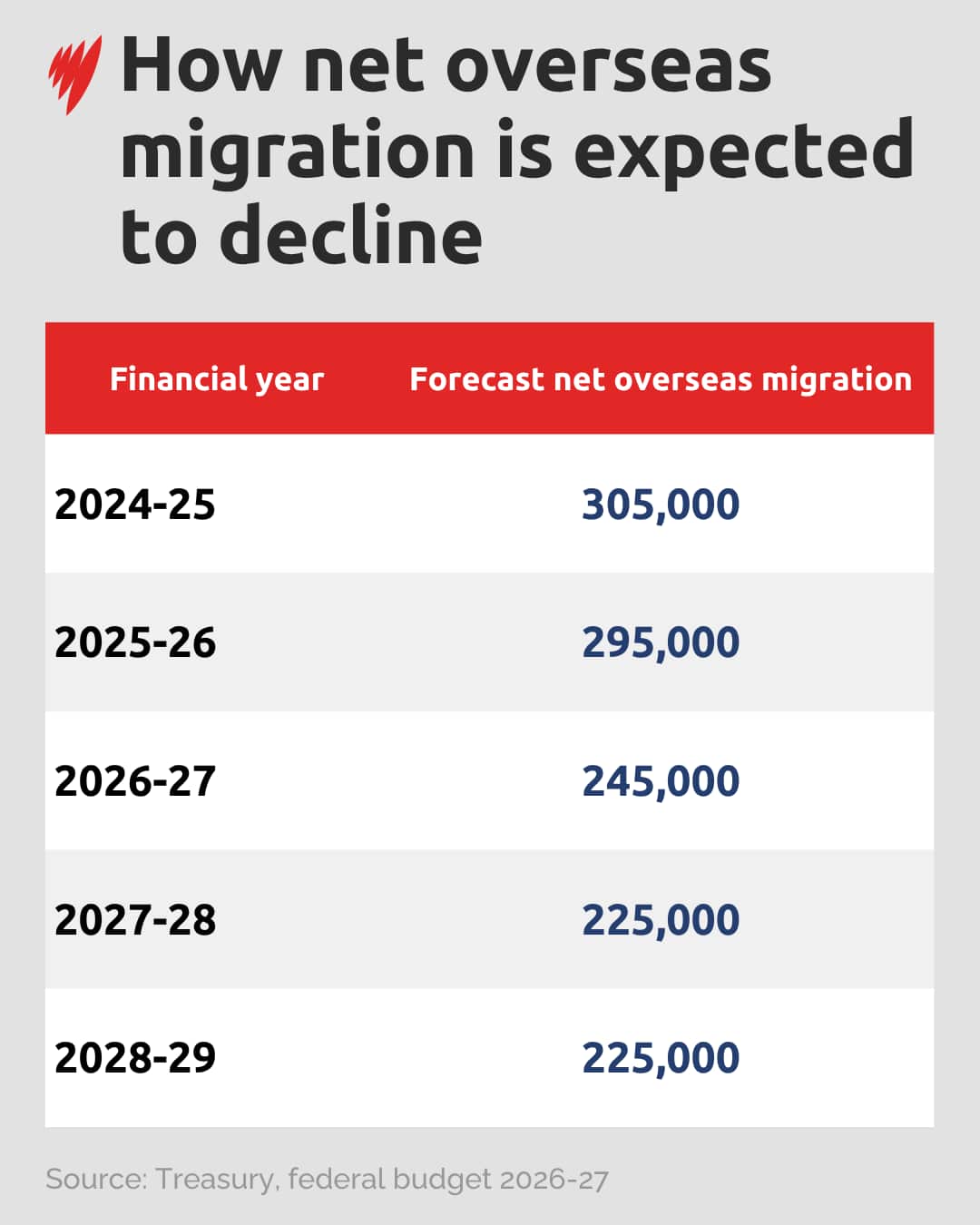
It peaked at 555,000 in September 2023 and has slowly been reducing. NOM was 306,000 in the 2024-25 financial year, according to data released by the Australian Bureau of Statistics.
Treasury had previously estimated this to fall to 260,000 migrants this year but on budget night revised this figure to 295,000, and added 55,000 more in total over the forward estimates.
Matthew Bowes, senior associate at the Grattan Institute's economic prosperity and democracy program, warned that reducing migration levels could forgo economic growth and leave "Australians worse off".
"I think we need to be really careful about the trade-offs we're talking about here. Ultimately, migration in Australia achieves many economic and social purposes," he said.
"Migrants do play an important role in filling particular parts of the labour market that we can't fill locally, but more broadly, they also boost Australian productivity."
What is the Coalition proposing on housing?
The Opposition has vowed a $5 billion critical infrastructure fund — towards water, sewage and road access — to unlock 400,000 new homes. On budget night, Labor committed a further $2 billion towards a $1.5 billion fund with a similar remit.
The Opposition will also take aim at the cost of building a new home, saying it will reduce it by $70,000 by cutting red tape under the National Construction Code.
Pawson is seeking clarity around what will be slashed, noting changes made by Labor in this space, and warns that deregulation comes with risks.
"I would be cautious about that because the deregulation of building standards, which we've tried in the past in Australia and other countries, sometimes has pretty serious unintended consequences," he said.
He pointed to "the leaky buildings disaster in New Zealand, and the flammable cladding problem in the UK" as examples where deregulation of building standards was "bitterly regretted after the event".
The Opposition also intends to cut a series of programs so it can redirect funding to supply.
It includes the Housing Australia Future Fund (HAFF) — which has invested $10 billion in building 40,000 social and affordable houses — the Build to Rent scheme and Help to Buy, a shared equity scheme helping first home buyers.
The Build to Rent scheme incentivises developers to build housing entirely for renting by offering tax concessions and commits at least 10 per cent of the dwellings to affordable housing.
"It's a sector expanding quite fast now and is beginning to make significant contributions to housing supply overall. Doesn't make sense to me that you would change the policy settings that have helped make that happen," Pawson said.
Bowes said cutting the HAFF would mean higher rates of homelessness, as social housing struggles to keep up with population growth.
"It will mean not addressing the ongoing challenges that low income people in our in our community are facing as a result of the really high housing costs that we're seeing," he said.
How Labor and the Coalition's housing policies compare
Pawson said the parties are using different levers to tackle supply and demand.
He said Labor had largely focused on addressing housing affordability by increasing supply.
This includes the funding to build homes as well as working with states to simplify approval processes and zoning restrictions, which is "beginning to bear some fruit".
He said Tuesday's budget broadened this scope to focus on shifting the demand side, by tweaking the capital gains tax discount (CGT) and funnelling negative gearing perks to new builds.
Pawson noted that while the Coalition agreed that both supply and demand need to be the focus, it's instead focusing on unlocking areas where a lack of infrastructure prevents building more homes and lowering population growth through migration cuts.
He labelled the Coalition's opposition to the CGT and negative gearing changes, which they've vowed to repeal if elected, as "illogical", as it ignores the financial incentives to buy a small pool of existing dwellings.
"It would be logical to recognise that that's also part of the reason why our housing is overpriced, not just the number of people coming into the country," he said.
"We need to remember that 80 per cent of properties bought by rental investors or private landlords are existing homes, not new."
For the latest from SBS News, download our app and subscribe to our newsletter.







