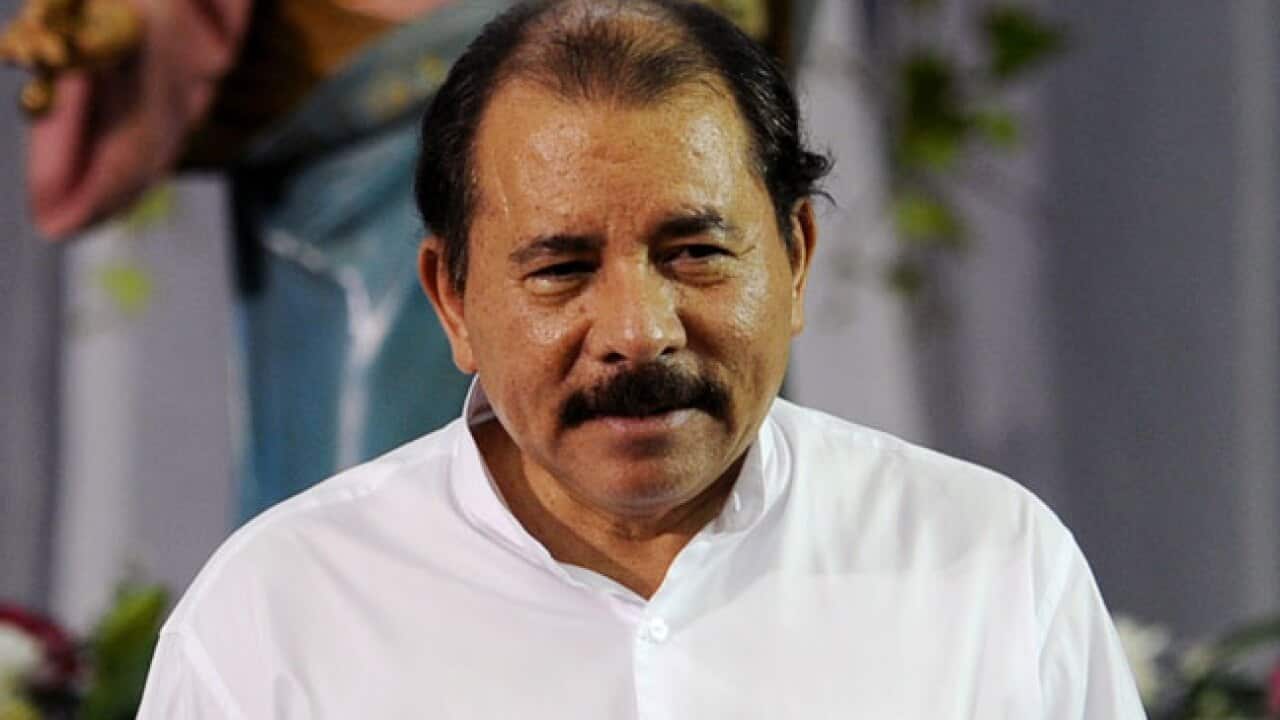
Nicaraguan ex-rebel Daniel Ortega, joined by allies from Iran and Venezuela, started his third term as president with a legislative super-majority that has provoked fears of authoritarianism.
The leftist 66-year-old Ortega, who has long since traded guerrilla garb for white shirts and Christian messages of peace, returned to office in an evening ceremony in Managua's Revolution Square, decked out in thousands of flowers.
"There is no place left on this planet for undiluted capitalism," Ortega said.
News that makes sense
Your trusted source for staying up-to-date with the world around you. Get free daily news updates and analysis, straight to your inbox.
"God willing, people will think hard about this crisis, not about how to save the model, but about how to change the model for one full of love, justice and solidarity."
Iranian President Mahmoud Ahmadinejad, who is on a tour of Latin American allies amid growing tensions with the United States, and Venezuelan President Hugo Chavez, Ortega's key financial backer, were among more than 8,000 guests.
Ortega gave a military salute to Chavez before hugging his wife and the Iranian president, and then offering sound support for Ahmadinejad in his showdown with the West over Tehran's suspect nuclear program.
"Countries have the right to develop nuclear energy," Ortega said.
"Don't forget what happened in Iraq," Ortega warned. "They swore Saddam Hussein had nuclear weapons. They swore it, and launched an invasion based on that. Then they had to admit ... there were no such nuclear weapons."
Ahmadinejad greeted his "revolutionary brother Ortega" upon arriving in Nicaragua Tuesday and said the two nations were "fighting to establish solidarity and justice."
Ex-rebel Ortega won reelection in November with 62 percent of the vote in polls that also gave his Sandinista National Liberation Front (FSLN) a majority broad enough in the unicameral legislature to change the constitution.
Ortega first governed at the height of the Cold War -- supported and inspired by Cuba and the former Soviet Union -- suspending civil rights and taking on the US-backed "Contra" rebels.
Defeated in 1990 elections, Ortega returned to power in 2007 after 17 years of right-wing governments.
Though Ortega has moderated his socialist rhetoric, he still riles the United States, even while respecting a bilateral free trade accord and receiving US aid.
Many analysts believe his relationship with Iran has so far produced little more than symbolism and rhetoric, while risking US ties.
But Ortega is riding a wave of popular support at home, where his latest term saw economic growth despite the global crisis, though the country of almost six million still remains the poorest in the Americas after Haiti.
Ortega counts on $500 million of annual aid from Chavez to help fund popular social programs for the poor and has courted business and religious leaders in recent years.
Guests at the inauguration ceremony included several Central American leaders, Spain's Crown Prince Felipe and Cuban Vice President Ramiro Valdez.
Ortega is the first president to be reelected since the 1979 Sandinista revolution ended the more than 40-year dictatorship of the Somoza family.
The broad powers he won in the November 6 polls -- in which the broken opposition denounced fraud and observers cited irregularities -- caused concern among critics who accuse him of seeking to stay in power indefinitely.
Tensions already rose after the Supreme Court cleared the way for Ortega to seek a third term despite the fact that consecutive re-elections and third terms were supposedly banned.
"The president has all the power that no one in the history of Nicaragua has had in their hands," writer Sergio Ramirez, who was vice president under Ortega during his first mandate in the 1980s, told La Prensa daily.
Ortega has promised he will make no "dramatic changes" and maintain ties with business leaders as well as workers.
Many former Sandinistas, as well as human rights and women's groups outraged by strict anti-abortion laws, strongly oppose him.







