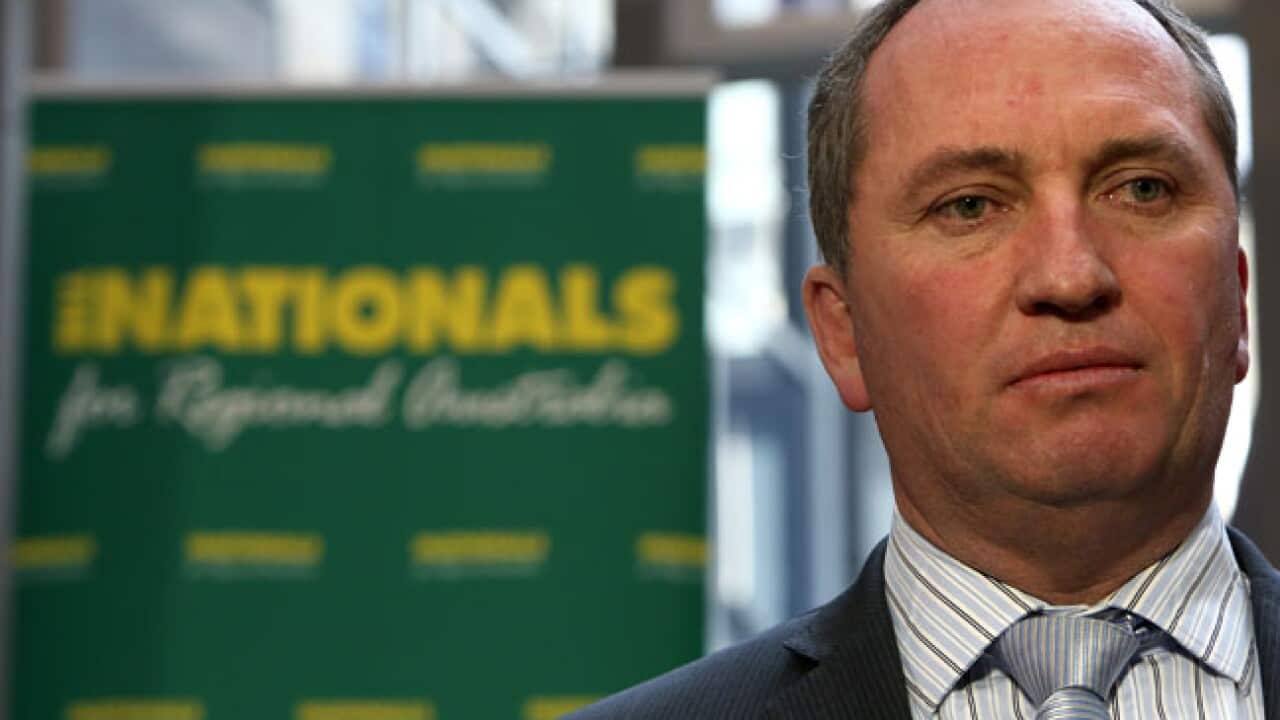
It started off as the Australian Country Party, when 11 non-aligned members of federal parliament who all supported the Australian Farmers' Federal Organisation came together from regional parts of the country.
But the party has since evolved to be more than just a party advocating for the interests of farmers to one which aims to represent people from a range of backgrounds in regional parts of Australia.
News that makes sense
Your trusted source for staying up-to-date with the world around you. Get free daily news updates and analysis, straight to your inbox.
(Transcript from World News Australia Radio)
The Nationals' policy platform lists repaying national debt and ensuring that all Australians have fair access to health, education, transport and telecommunications regardless of where they live.
The party has changed its name a number of times over its history from the Australian Country Party to the National Country Party, the National Party and then finally rebadging itself as the Nationals in 2006.
In Queensland, the party merged with the state's Liberals to become the Liberal National Party in 2008.
Former Nationals Leader and Deputy Prime Minister Mark Vaile says what distinguishes the party at the federal level is its commitment to representing Australians in regional and rural parts of the country.
"We are the only political party that only represents regional Australians. The Liberal Party has members from regional Australia; the Labor party has members from regional Australia. We are not schizophrenic, we do not have members from the metropolitan areas. We can uniquely represent the views of 7-million Australians that don't live in the metropolitan areas."
For most of its history, the Nationals have been in coalition with the Liberal Party, in which it has held the key agricultural and trade ministerial portfolios.
Its senior coalition partner, the Liberal Party- which supports free market competition- has often clashed with the traditional philosophy of the Nationals that set out to protect the economic interests of primary producers.
However over recent years, the Nationals have become less protectionist in their trade policies and this has led some voters in regional areas to support local Independents with more protectionist policies.
Some of these Independent MPs have been former National MPs themselves, such as Bob Katter and Tony Windsor.
Doctor (ms) Rae Wear (wair) specialises in rural politics at the University of Queensland.
She says the Nationals' policies have adjusted to changing circumstances over time including a shift towards free trade.
"For a very long time, when it was the Country Party, its policies were really totally oriented towards support for farming and agriculture. Over time, it's tried to broaden out and at the moment, it's really positioning itself as a regional party, rather than just a rural party."
In the upcoming federal election, the Nationals are likely to win back two seats from Independents in New South Wales.
Polling is predicting the National's Senate Leader Barnaby Joyce will win the House of Representatives seat of New England, held by retiring Independent MP Tony Windsor.
And the Nationals are tipped to win back the NSW north coast seat of Lyne which was held by another retiring Independent MP Rob Oakeshott.
The party is also campaigning to win some marginal seats off Labor in regional areas including the NSW north coast seat of Page, held by Janelle Saffin.
Troy Whitford lectures in politics at Charles Sturt University in the regional NSW city of Wagga Wagga and is a director of the National Party's policy researcher, the Page Research Centre.
He says that while the Nationals have tended to adopt less protectionist policies over recent years, he believes they still tend to be more open to government intervention than their coalition partners, the Liberals.
"The National Party is very much about that the government has a role in the economy. Whilst that might sound as though we're splitting hairs (being pedantic), it's a very important position because they don't believe that industries will make it unless there is government support, particularly in regional areas."







