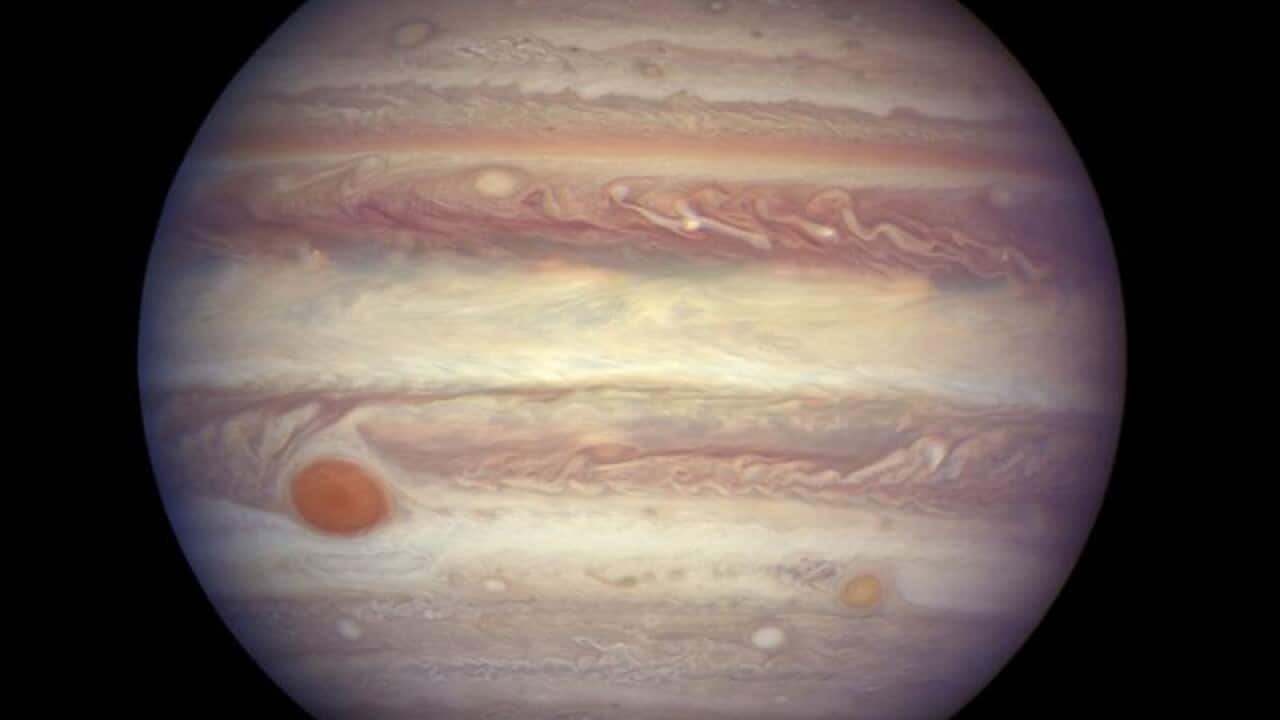
Scientists have identified a cycle of unusual meteorological events on Jupiter's equator and predict that the next parting of the planet's clouds could happen as soon as 2019.
The timing of Jupiter's constantly changing striped appearance is poorly-understood - sometimes expanding and contracting, while fading away entirely at other times.
Now, planetary astronomers at the University of Leicester have spotted a pattern by pulling together observation data covering more than four decades.
"Every six or seven years, we found examples of observations when the equatorial clouds had vanished completely, allowing us to see deeper into Jupiter's churning atmosphere," said Dr Arrate Antunano, lead author of the research, published in Geophysical Research Letters.
"These cloud-clearing disturbances left the equator looking very bright in the infrared, and dark brownish in visible light. These disturbances lasted for 12-18 months, and we saw spectacular examples in 1973, 1979, 1992, 1999 and 2006.
News that makes sense
Your trusted source for staying up-to-date with the world around you. Get free daily news updates and analysis, straight to your inbox.
"If we follow the pattern over the last 45 years, the really exciting result of this work is that we expect to see a new event very soon, perhaps as early as next year."
According to the pattern, the planet should have become exposed in 1985 and 2013, but only the brownish equatorial colours were apparent as the clouds failed to completely clear.
"As usual, Jupiter is reluctant to give up all its secrets at once," said Dr Glenn Orton, senior research scientist at Nasa's Jet Propulsion Laboratory.
"It seems that this six-seven-year pattern isn't perfect, and sometimes we don't see a complete cloud-clearing disturbance."
Small breaks in Jupiter's equatorial clouds have already been noticed in the latest images, suggesting that 2019 could be on track for another clear view of the planet.
"Only by putting all of these observations together, from a wide variety of instruments over more than three Jupiter years - a year on Jupiter lasts 12 Earth years - did we begin to spot a pattern," said Dr Leigh Fletcher, co-author of the paper.
Jupiter is the largest planet in our solar system and fifth planet from the sun.







